


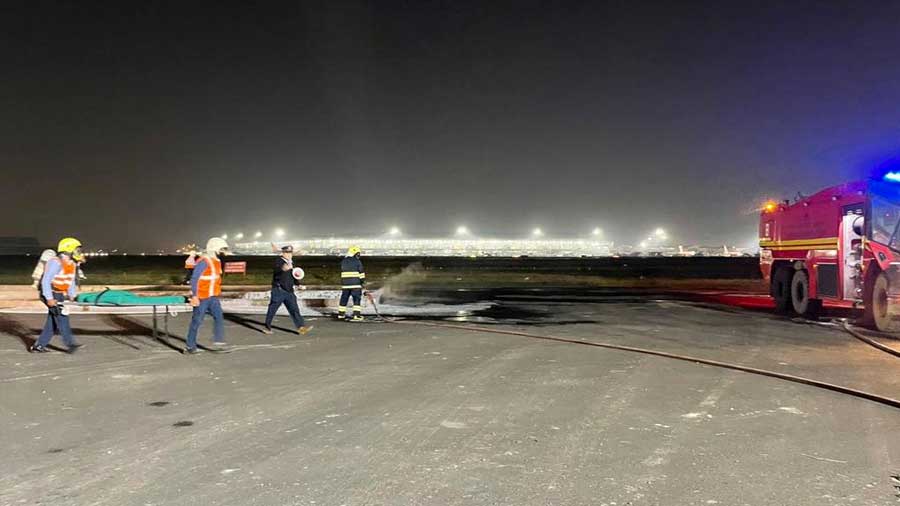
Kolkata Airport conducted a full-scale emergency simulation on Monday to assess disaster preparedness, operational response, and inter-agency coordination in the event of an aviation-related crisis. The exercise recreated the emergency landing and crash of an aircraft outside the airport perimeter, providing a realistic setting for over a dozen participating agencies to respond under pressure.
The simulated scenario involved an incoming aircraft reporting engine failure during approach amid heavy rainfall. The aircraft was imagined to have skidded off the runway, breached the perimeter, and caught fire upon impact. Though no actual plane was involved, the use of live smoke, emergency sirens, and staged casualties created a lifelike environment, even prompting concern among local residents who were unaware of the drill. Officials at the airport confirmed that the simulation was conducted in line with the Directorate General of Civil Aviation (DGCA) and Bureau of Civil Aviation Security (BCAS) regulations. According to protocol, such full-scale drills are mandated every two years, with partial drills conducted annually. However, sources revealed that the recent air crash in Ahmedabad, which claimed over 270 lives, had expedited the scheduling of this exercise.
Responders included teams from the Airports Authority of India (AAI), Airport Fire Services, Air Traffic Control, Central Industrial Security Force (CISF), State Disaster Response Force (SDRF), National Disaster Response Force (NDRF), Indian Coast Guard, local police, fire brigades, and medical services, alongside NGOs such as Saint John’s Ambulance. Their objective was to test response time, coordination, and execution across a wide range of scenarios, including fire suppression, passenger evacuation, medical triage, and logistics. The AAI fire services demonstrated rapid deployment, reaching the mock crash site well within the required timeframe and initiating containment and rescue operations. Simultaneously, triage and medical aid stations were activated, and ambulances were dispatched to designated hospitals to simulate casualty transport and treatment timeframes.
The exercise drew real-time performance data on factors such as response time, command chain efficacy, inter-agency communication, and readiness of logistics support. Officials later clarified that local public reaction—sparked by visible smoke plumes and emergency vehicle movement—was expected, and that public awareness is also a component tested during such drills. In a debriefing following the exercise, senior airport and security officials reviewed the outcomes and identified key learnings. The debrief, chaired by the airport director in the presence of representatives from DGCA, BCAS, and the CISF, highlighted strengths such as rapid mobilisation and inter-agency coordination, while also pointing out areas needing procedural refinement and technology upgrades.
Experts involved in the drill noted the growing complexity of managing urban airports amid rising traffic volumes and climate-related challenges. In the context of sustainability and safety, simulations like these are being seen not just as regulatory mandates, but critical planning tools. Real-time data capture, response integration, and scenario planning are increasingly forming the backbone of disaster preparedness strategies in major Indian airports. The exercise also spotlighted the role of advanced technologies, such as AI-enabled surveillance, geospatial incident mapping, and mobile command centres, in enhancing future emergency response protocols. Senior disaster management experts in attendance advocated for greater investment in such technologies, citing the need for precision and agility in high-density operational environments like international airports.
Environmentalists, meanwhile, underscored the need to link emergency preparedness to broader urban resilience planning. As airports sit at the nexus of air travel, urban mobility, and infrastructure systems, ensuring their robustness against both manmade and natural disasters is essential for maintaining city-wide operational continuity. The Kolkata airport drill serves as a timely reminder of the urgent need for cities to integrate comprehensive emergency planning into their growth strategies. While aviation safety in India has improved markedly over the past decade, systemic preparedness remains crucial amid rising air traffic and evolving risks.
Also Read : Maharashtra likely to witness heavier than normal rainfall this July warns IMD
