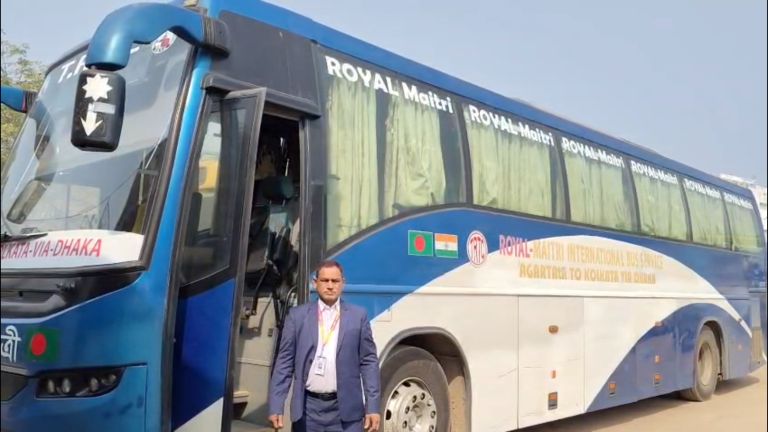
Kolkata Agartala Connectivity Restored Through Bangladesh
Agartala after a prolonged suspension, passenger bus services connecting Agartala and Kolkata via Dhaka have recommenced, signalling renewed cross-border transport connectivity between northeastern India and Bangladesh. The resumption, facilitated through an international land port, highlights the strategic importance of regional transport corridors in fostering economic linkages, tourism, and urban mobility.
The first bus to arrive at the Tripura border today marked a milestone for both passenger movement and trade facilitation. Officials overseeing transport operations noted that the uninterrupted flow of buses could stimulate greater cross-border economic activity while improving accessibility for citizens travelling between the two regions. Experts highlight that such services are vital not only for mobility but also for sustaining urban economies reliant on inter-state and international linkages. The operational restart follows a period of political transition in Bangladesh, underscoring how bilateral governance and regulatory stability directly influence regional transport infrastructure. Urban planners and mobility consultants observe that reliable cross-border bus services can relieve pressure on domestic airports and railways, offering a lower-carbon alternative that aligns with climate-resilient urban transport strategies. From a socio-economic perspective, the service is expected to benefit multiple stakeholder groups. Residents of Tripura and neighbouring areas gain cost-effective and predictable travel options, while tourism and retail sectors along the route are likely to experience increased demand.
Urban analysts further suggest that enhanced connectivity can support equitable growth by linking smaller cities and towns with larger metropolitan hubs, enabling workforce mobility and access to broader markets. The resumption also carries environmental and infrastructure implications. Long-distance buses, especially those operated through regulated transport corporations, are recognised as comparatively energy-efficient compared with individual car travel or short-haul flights. Integrating such services into broader regional planning can help reduce transport-related carbon emissions while enhancing urban transport resilience. Additionally, coordinated scheduling and management at international land ports ensure smoother border processing, minimising delays that could otherwise discourage sustainable transport adoption.
While passengers reported a smooth journey with minimal procedural hurdles, officials emphasised the need for continued investment in transport infrastructure, including terminal facilities, safety upgrades, and digital tracking systems. Urban development experts stress that sustaining such international services requires long-term planning and cooperation across administrative and municipal levels to ensure the economic, environmental, and social benefits are fully realised. The restart of the Agartala–Kolkata bus corridor underscores the potential of transport networks to foster regional integration, equitable economic opportunity, and low-carbon mobility. As the service stabilises, policymakers are expected to explore further enhancements to schedules, capacity, and complementary urban infrastructure, reflecting a people-first approach to cross-border connectivity.