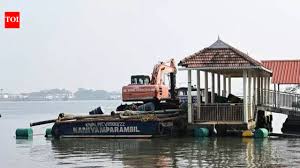
Boat operations between Ernakulam Jetty and Mattancherry have partially resumed, offering relief to daily commuters after weeks of disruption. However, services under the Kochi water transport network remain restricted to high-tide windows, as incomplete dredging continues to limit navigability along sections of the channel.
Officials in the state water transport department confirmed that while vessels are back on the route, trips are being scheduled around tidal movements. During low tide, several services remain suspended due to insufficient draft levels for safe passage.The Ernakulam–Mattancherry corridor is one of the most relied-upon links in the Kochi water transport system, serving office workers, traders and residents who depend on ferries as a cost-effective alternative to congested road networks. The suspension had forced many commuters onto already crowded bridges and arterial roads, adding to peak-hour traffic stress across the city.
Urban mobility analysts point out that Kochi’s waterways are not merely tourist assets but an essential component of its multimodal transport ecosystem. The city’s geography—interspersed with backwaters and islands—makes inland water transport uniquely positioned to reduce vehicular emissions and travel time when functioning reliably.The recent disruption stems from sediment accumulation in key stretches, a recurring challenge in tidal urban waterways. Dredging, which restores channel depth, requires coordination between multiple agencies overseeing navigation, environment and port management. Delays in execution can quickly translate into operational bottlenecks for passenger services.
Transport economists argue that predictable ferry schedules are crucial for maintaining public confidence. Unlike discretionary travel, daily commuting demands timetable certainty. When services are limited to high tide, commuters must adjust work hours or shift modes, undermining the environmental and economic benefits of water-based transit.There are broader implications for Kochi’s sustainable mobility ambitions. The city has invested in metro rail, electric buses and water metro initiatives to build a low-carbon transport network. In that context, resilience of traditional ferry routes is equally vital. Experts note that climate variability—including erratic rainfall and tidal shifts—may intensify siltation patterns, making proactive channel management essential.
From a real estate perspective, reliable water links enhance the attractiveness of heritage precincts such as Mattancherry, supporting small businesses and local tourism. Interrupted connectivity can dampen footfall and affect micro-economies dependent on daily movement.Officials indicated that full restoration of the Kochi water transport schedule will depend on the completion of dredging works. Until then, commuters are advised to check tide-based timings before travel.For a city built around water, maintaining navigable channels is not simply a transport issue—it is central to urban resilience, equitable access and climate-responsive planning. Ensuring consistent ferry operations will test inter-agency coordination and long-term maintenance planning in the months ahead.