


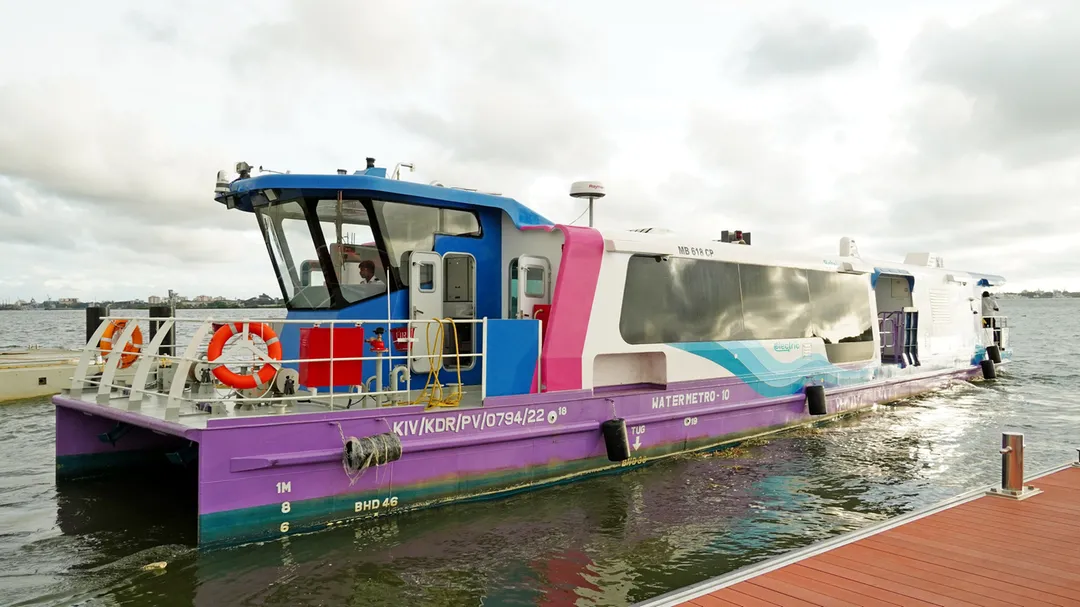
Kochi Metro Rail Limited has initiated the next stage of planning for a proposed water-based transit link between Aluva and the city’s international airport, inviting bids to conduct a detailed survey for a Kochi water metro airport connection. The exercise will assess the technical feasibility of integrating inland waterways with existing metro infrastructure, a move that could reshape airport access in Kerala’s largest urban cluster.
The proposed corridor would stretch roughly four kilometres, connecting Aluva Metro Station with Cochin International Airport Limited through navigable waterways. Officials confirmed that the scope includes a comprehensive topographic survey to prepare a feasibility report covering route alignment, hydrological conditions, land interfaces and terminal infrastructure requirements.The Kochi water metro airport link is envisioned as a multimodal extension of the city’s growing public transport network. By leveraging rivers and canals, planners aim to provide an alternative to road-based airport transfers, which are often affected by congestion on arterial corridors. If viable, the project could strengthen first- and last-mile connectivity while reducing dependence on private vehicles.
Transport economists note that airport access projects increasingly influence urban competitiveness. Seamless transit links can enhance business mobility, tourism flows and real estate value along connected corridors. In Kochi’s case, integrating the metro with water transport may also unlock development potential around Aluva and peri-urban waterfront zones.The survey will examine terrain profiles, embankments, existing settlements and environmental sensitivities along the proposed route, which is expected to pass through residential and semi-urban stretches before reaching the airport precinct. Experts say such groundwork is critical in Kerala’s flood-prone geography, where tidal patterns and monsoon flows can affect navigation and infrastructure resilience.
The Kochi water metro airport proposal builds on the broader water metro initiative already operational in parts of the city, designed to modernise traditional ferry systems with electric vessels and upgraded terminals. Urban planners view this integrated approach as aligned with low-carbon mobility goals, provided vessel operations and shore infrastructure adhere to energy-efficient standards.From a governance perspective, feasibility findings will determine cost viability, passenger demand projections and potential funding structures. Public transport specialists caution that airport-oriented services must balance premium positioning with affordability to ensure inclusive access for workers as well as travellers.
Should the Kochi water metro airport link progress beyond the survey stage, it could represent one of India’s first dedicated water-based airport connectors. However, execution will depend on environmental clearances, navigational safety measures and alignment with regional land-use plans.For a rapidly expanding metropolitan region bounded by backwaters and waterways, the outcome of this study will signal how effectively Kochi can integrate blue infrastructure into its transport future while strengthening climate-resilient urban mobility.
Also Read:Poulomi Estates Enters Bengaluru With Premium Project
Kochi Water Metro Airport Link Survey
