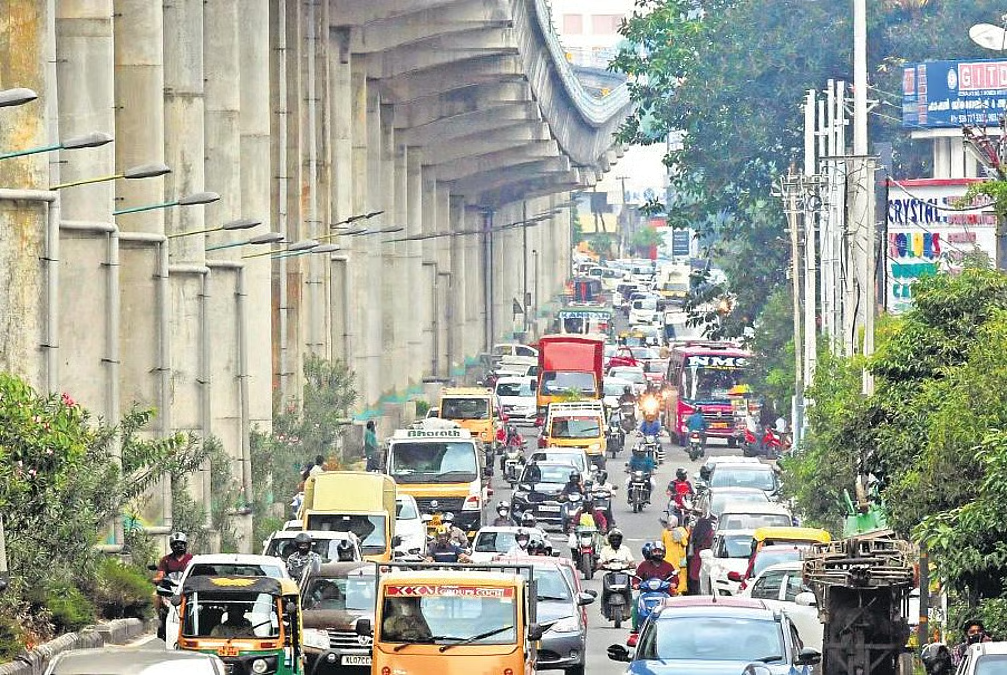
Kochi Urban Roads Show Safety Gaps Near Metro Pillars
Hidden road undulations developing around metro pillar sites on key urban thoroughfares are emerging as a significant road safety hazard for commuters, especially two-wheeler riders, in Kerala’s commercial capital. The protrusions — often rising several inches above adjacent surfaces — have been linked to multiple accidents and near-misses along busy stretches such as Sahodaran Ayyappan Road, prompting renewed scrutiny of infrastructure planning in fast-growing cities.
Residents and frequent commuters report that these uneven road patches, particularly around metro support columns, are difficult to see until the last moment and have caused erratic vehicle movement and loss of control. This issue is symptomatic of a broader challenge urban engineers face in balancing rapid infrastructure rollout with resilient pavement engineering in coastal cities like Kochi. Urban planners note that Kochi’s underlying geography — once marshland with shifting clay subgrades — complicates roadbed stability after major construction. Where metro pillars have been installed, disruption to the soil and lack of comprehensive foundation reinforcement on adjoining carriageways have allowed differential settlement under continuous traffic load, leading to the formation of bumps.
The problem has been observed at several nodal points, including around Manorama Junction and stretches near the North Railway Overbridge, Changampuzha Park and Pathadippalam. Commuters say the hazards intensify at night when visibility drops and motorists tend to maintain higher speeds on uninterrupted road segments. City emergency responders and medical professionals warn that such road surface irregularities — especially when unmarked — can precipitate serious crashes involving motorbikes and light vehicles, with ambulances and emergency traffic also exposed to the risk.
Local traffic safety advocates argue that these recurring bumps highlight a systemic gap in road infrastructure management. While Kochi Metro’s construction contracts mandate temporary service road provisions to ensure traffic flow, they do not extend to holistic pavement reinforcement. Without adequate soil stabilisation measures or drainage improvements, similar deformations are likely to appear along other sections of the burgeoning metro network. Comparisons with stretches such as the Edappally-Aluva corridor — where highway-grade sub-surface drainage and ground stabilisation were incorporated — suggest that integrated engineering solutions can mitigate settlement issues even where metro pillars are densely spaced.
Transport safety experts stress that better hazard communication — including prominent road signage, reflective markers and speed-reduction measures — could reduce accident rates in the short term. In the longer term, coordinated action among municipal authorities, metro project managers and state highway engineers is needed to retrofit at-risk locations and integrate foundation stabilisation into future urban infrastructure planning.
For Kochi, whose road network continues to absorb rising vehicle volumes and complex infrastructure interfaces, addressing such surface defects is crucial for realising safe, inclusive, and climate-resilient mobility. Municipal officials have yet to outline a remediation plan, underscoring an urgent need for transparent timelines and budget allocations for corrective works.