


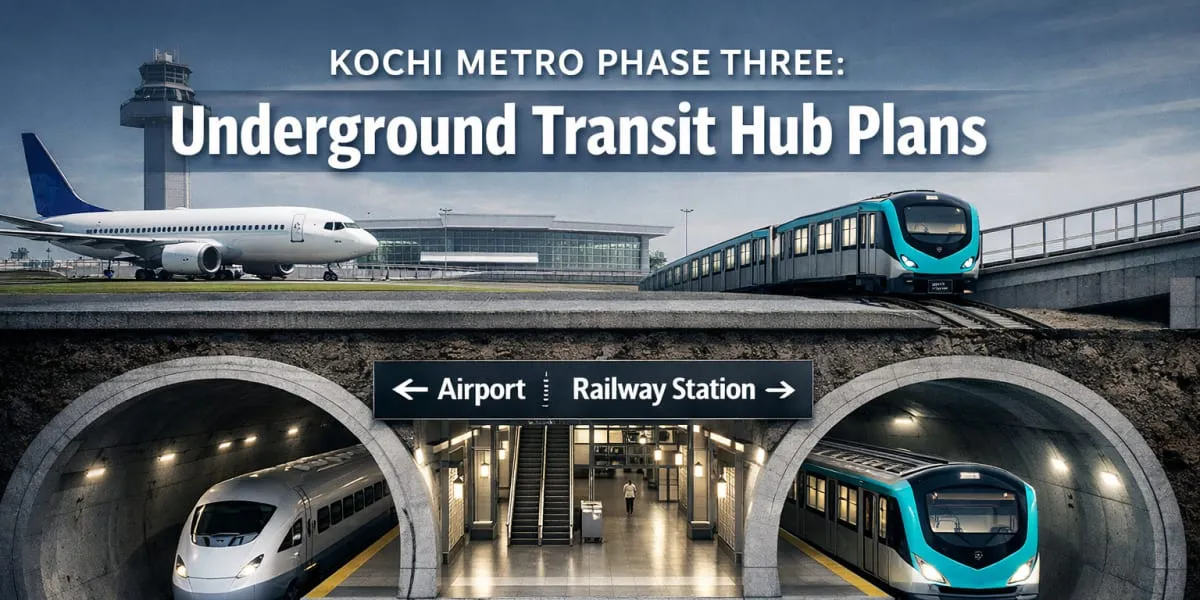
Kochi’s next metro expansion is set to include a large underground interchange near the airport corridor, signalling a strategic shift in how the coastal city is planning high-capacity public transport. The proposed Underground Transit Hub under Kochi Metro Phase Three is expected to integrate multiple mobility modes while addressing space constraints in one of the region’s fastest-growing urban stretches.
According to officials involved in early-stage planning, the hub is being conceptualised as a below-ground multi-level facility that can accommodate metro lines, feeder systems and passenger amenities without disrupting surface traffic. The move reflects a broader trend in Indian cities where underground infrastructure is increasingly used to preserve limited land while enabling higher transit volumes.The Underground Transit Hub is expected to form a critical node in Kochi Metro Phase Three, which aims to extend connectivity towards the airport and adjacent growth corridors. Urban planners note that the airport zone has witnessed steady commercial and residential development, creating rising demand for reliable mass transit. An integrated underground interchange would allow seamless transfers, reduce congestion, and improve last-mile efficiency.
Transport economists argue that transit-oriented development around such hubs can reshape real estate patterns. “High-capacity underground stations often catalyse mixed-use growth while limiting urban sprawl,” said a mobility consultant tracking southern India’s metro projects. In Kochi’s case, structured development near the proposed hub could strengthen economic activity without expanding the city’s carbon footprint.The design of the Underground Transit Hub is also expected to incorporate climate-responsive features. Given Kochi’s heavy monsoon cycles and flood vulnerabilities, underground construction demands advanced drainage systems, water-resistant engineering, and resilient electrical networks. Infrastructure specialists suggest that lessons from other coastal metros will likely inform design safeguards.
Beyond engineering, financing remains a key variable. Phase Three will require substantial capital investment, and underground construction typically raises per-kilometre costs compared to elevated corridors. However, planners argue that long-term operational benefits — including reduced land acquisition, improved urban aesthetics and higher ridership potential — can offset upfront expenditure.Sustainability advocates see the project as part of Kochi’s gradual transition toward low-emission mobility. Metro expansion reduces reliance on private vehicles, cutting congestion and urban air pollution. When linked to airports and commercial hubs, such corridors also enhance economic accessibility, making growth more inclusive across income groups.
Officials indicate that detailed project reports are being refined, including technical alignments and passenger demand projections. Clearances, funding structures and phased execution timelines will shape the pace of implementation.If realised as envisioned, the Underground Transit Hub under Kochi Metro Phase Three could redefine how the city balances density, connectivity and climate resilience — embedding mass transit deeper into its urban fabric while preparing for the next cycle of metropolitan growth.
Also Read:Bengaluru Sees New Premium Residential Launch
Kochi Plans Underground Transit Hub Expansion
