


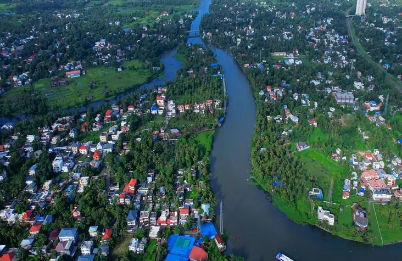
India’s canal systems have long been integral to local life, serving critical roles in transportation, fishing, and flood management. However, these waterways have faced severe degradation over time, leading to polluted waters and increased flood risks.
Recent data highlights the urgency of the situation: a survey of over 300 households along the canals revealed that 44% experienced flooding during heavy rainfall, while 39% encountered tidal flooding. With climate change exacerbating extreme weather patterns and contributing to rising sea levels, these issues are set to intensify. In response to these mounting challenges, a pioneering canal restoration initiative has been launched, spearheaded by a partnership between Bechtel’s social impact arm, ICLEI-Local Governments for Sustainability (South Asia), and Swiss Re. This pilot project focuses on the Pandarachirathodu Canal, stretching over 2 km, and introduces a novel approach to canal rehabilitation. The strategy involves a new grey-green hybrid solution known as Integrated Wetland Technology (IWT), which combines wastewater treatment capabilities with flood prevention measures.
The project also incorporates nature-based interventions, including floating wetlands and mangroves, alongside the removal of obstructive culverts to further enhance the canal’s ecological health. Additionally, the plan envisions the creation of a biodiversity park designed to bolster ecotourism and generate local employment opportunities. A comprehensive cost-benefit analysis has evaluated three proposed scenarios for this restoration effort. Findings indicate that all three options offer substantial investment value, with the highest net benefits projected for Scenarios 2 and 3, which integrate IWT with nature-based interventions. Specifically, these scenarios are estimated to deliver net benefits ranging from INR 325 to 331 million. Nonetheless, Scenario 1—employing the hybrid IWT alone—boasts the most favourable benefit-to-cost ratio.
For every INR 1 invested in this baseline approach, the anticipated net benefits amount to INR 9.78, underscoring its exceptional value for society, the economy, and the environment. This restoration project represents a forward-thinking approach to urban infrastructure, blending advanced engineering with ecological stewardship to address pressing environmental and social challenges in Kochi.
