


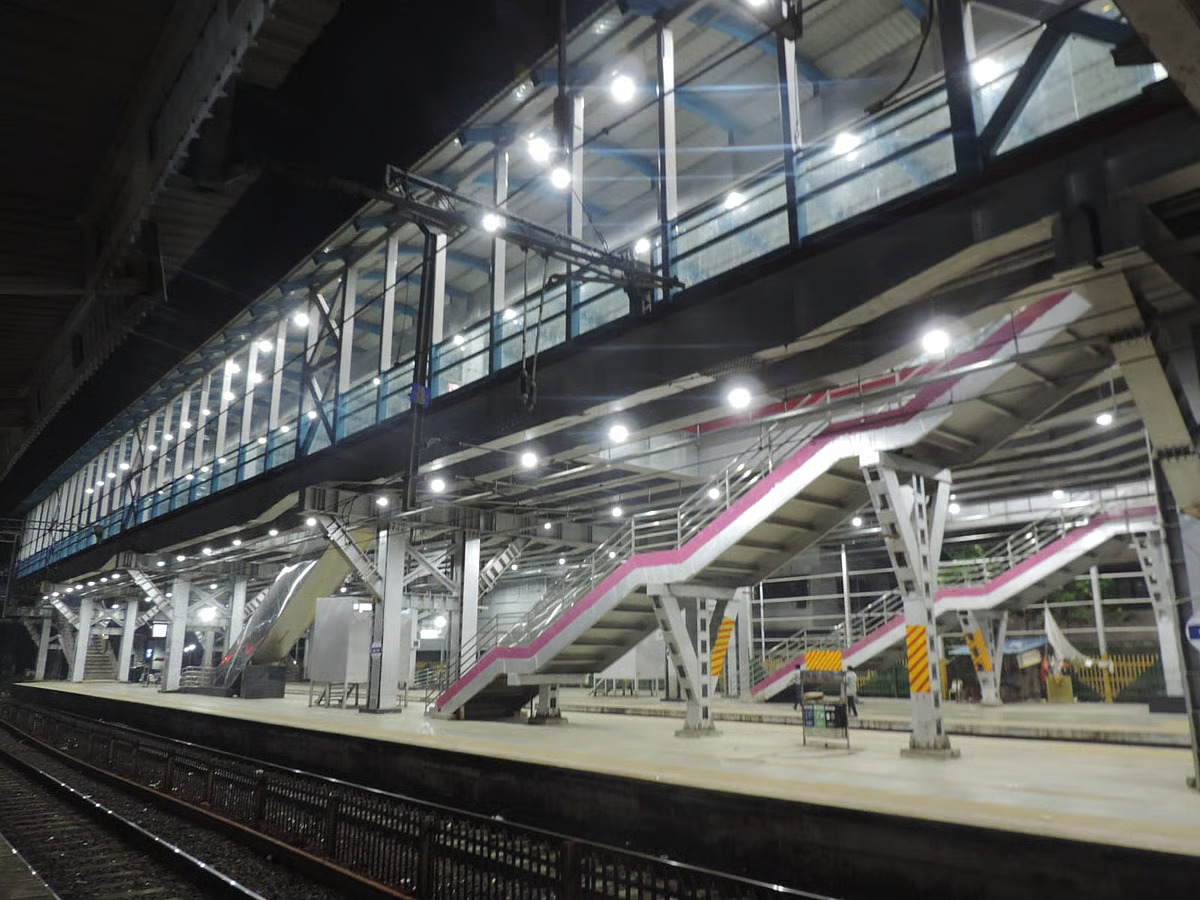
Mumbai’s Khar Road Railway Station has officially become the first to be redeveloped under the ₹950 crore Mumbai Urban Transport Project 3A (MUTP-3A), setting the tone for a larger vision to revamp 17 high-traffic suburban railway stations across the city. The redevelopment aims to modernise and decongest the city’s busy transport hubs, with a clear emphasis on sustainability, commuter comfort, and universal accessibility.
Executed by the Mumbai Railway Vikas Corporation (MRVC) at a cost of ₹85 crore, the upgraded Khar Road station is now designed to serve over 1.6 lakh daily passengers with improved facilities, seamless mobility features, and significantly enhanced safety infrastructure. The transformation focuses not only on aesthetics and crowd management but also on sustainable design elements aligned with the city’s broader goals of building inclusive and eco-friendly public spaces. According to officials from MRVC, one of the station’s most distinctive new features is a state-of-the-art home platform measuring 270 metres in length and 10 metres in width, which has been created to ease congestion during rush hours. This addition is central to improving passenger movement, especially for those navigating the suburban network during peak travel times.
Equally noteworthy is the massive elevated deck built above the tracks — the largest yet within the Western Railway’s suburban network. Covering a total area of 4,952 square metres, the deck has been structurally divided into a main platform area of approximately 4,393 square metres and an auxiliary segment of around 413 square metres. A 31-metre-long skywalk has also been integrated, offering a direct pathway for pedestrians and reducing ground-level congestion. These features are designed to optimise pedestrian circulation while offering a safer and more intuitive travel experience. In a significant step toward universal design and inclusivity, the redeveloped station is now equipped with five escalators, three lifts, and a well-graded ramp featuring handrails — a rare design that connects MCGM Road directly to the station platform. These enhancements ensure accessible transit for persons with disabilities, senior citizens, and families with children. Tactile tiles and guiding paths have been strategically installed on platforms, staircases, and ticketing areas, aiding passengers with visual and mobility impairments.
Officials confirmed that the upgraded station layout has been planned with an eye on both convenience and energy efficiency. High Volume Low Speed (HVLS) fans have been installed to improve ventilation across waiting areas, while LED lighting systems now ensure enhanced visibility and reduced power consumption. The renovated façade and expanded circulating area reflect a cleaner, more welcoming urban transit environment, blending design and functionality. Passenger convenience has been further prioritised through the construction of two modern booking offices — one on the ground level and the other on the elevated deck. These include dedicated counters for persons with disabilities. In addition, a deluxe toilet block with accessible amenities and a new station manager’s office have been built to support daily operations and better commuter service.
This transformation at Khar Road is just the beginning of a broader overhaul envisioned by MRVC under the MUTP-3A scheme. The programme covers 17 suburban stations — seven on the Western Railway and ten on the Central Railway network. On the Western line, stations including Santacruz, Kandivli, Mira Road, Bhayandar, Vasai, and Nallasopara are next in line for modernisation. These stations will receive similar upgrades involving platform extensions, improved lighting, upgraded security systems, and advanced ticketing infrastructure. On the Central line, redevelopment work is underway at key stations such as Kasara, Neral, Dombivli, Mulund, Bhandup, Ghatkopar, Govandi, Mankhurd, Chembur, and Guru Teg Bahadur Nagar. The primary objective here is to reduce overcrowding, widen entry and exit points, and introduce vertical mobility solutions like escalators and lifts to improve access across all user groups.
Officials noted that the first phase of the upgrade at Ghatkopar station has already been completed, with the second phase nearing conclusion. Similar progress is being witnessed at other locations, with project timelines being closely monitored to ensure minimum disruption to daily rail services. Urban planners and transport experts have hailed the initiative as a critical step in reimagining Mumbai’s overburdened public transport system. With over 75 lakh commuters using the suburban rail network daily, the city’s stations have long struggled with infrastructure deficits. The ongoing upgrades represent a pivot towards high-capacity, people-centric rail systems that not only improve passenger flow but also reduce the city’s overall carbon footprint by encouraging greater use of public transport.
The MRVC’s focus on gender-neutral design, safety-first infrastructure, and barrier-free accessibility underscores a commitment to reshaping Mumbai’s transport ecosystem into one that serves all demographics equitably. More than just a facelift, the transformation of Khar Road signals the beginning of a commuter-centric approach to railway development that values sustainability, technology integration, and inclusive design. As Mumbai continues to expand vertically and geographically, ensuring that public transport infrastructure keeps pace with population growth and commuter demand will be essential. The successful execution of the Khar Road station upgrade demonstrates that strategic investment in core infrastructure, when done thoughtfully, can yield substantial civic dividends.
While challenges around project execution timelines, commuter management during construction, and funding efficiency remain, the project marks a promising shift in how Indian cities are thinking about mobility. For now, the transformation at Khar Road sets a high benchmark for the remaining stations under MUTP-3A and offers a model that could be replicated across other urban centres in the country.
Also Read : Agrochemical Firms to Gain from Early Monsoon
