


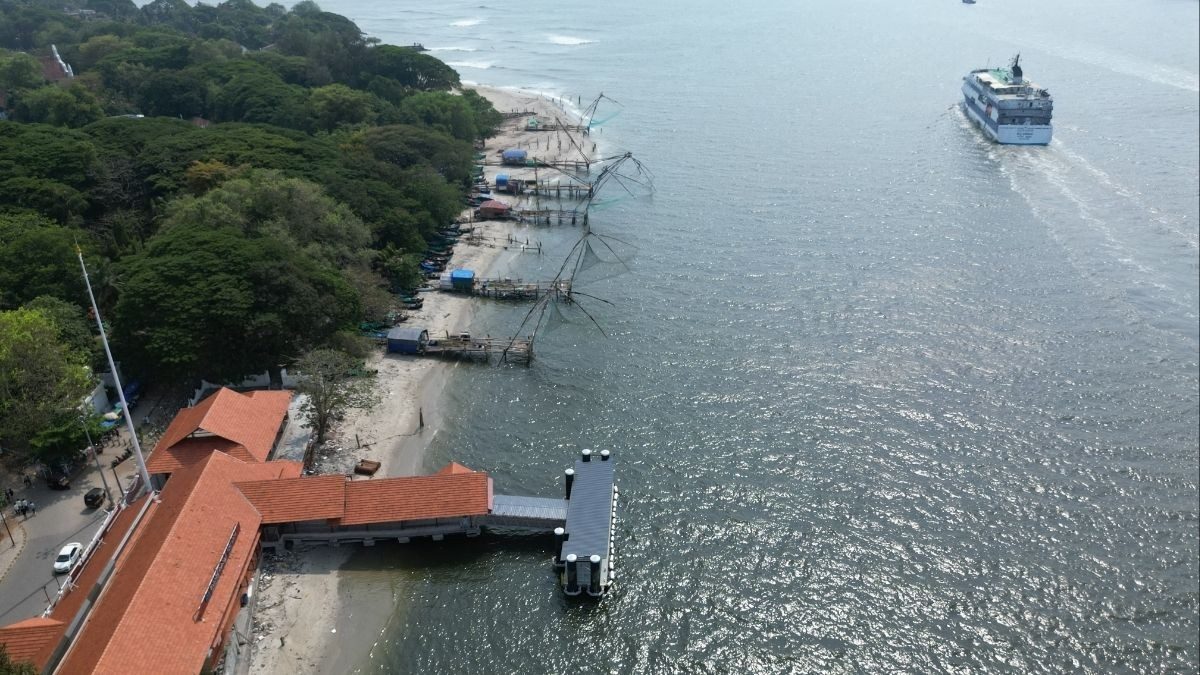
Kerala has operationalised a 280-km inland navigation stretch linking its southern and central districts, marking a significant step in reviving the Kerala Inland Waterways network as an alternative transport spine. The newly commissioned Akkulam–Chettuva corridor is part of the larger 616-km Kovalam–Bekal waterway plan and is positioned to ease road congestion, stimulate waterfront economies and reshape regional logistics.
The operational stretch integrates rivers, lakes and man-made canals into a continuous navigable route under National Waterway 3, one of India’s earliest declared national waterways. Officials describe it as the first functional phase of a long-term strategy to create an uninterrupted water corridor parallel to Kerala’s heavily burdened north–south highway network.Kerala’s geography — a narrow coastal strip between the Western Ghats and the Arabian Sea — has constrained road and rail expansion. With rising vehicle density across Thiruvananthapuram, Kollam, Alappuzha and Thrissur, transport planners view the Kerala Inland Waterways system as a low-emission supplement rather than a substitute for highways. While water transport is slower, it offers predictable transit times and the potential to shift bulk cargo off congested roads.
The corridor has undergone dredging, embankment strengthening and structural upgrades to ensure uniform draft and navigability across seasons. A senior infrastructure official said funding for the larger programme has been structured through the state’s infrastructure investment framework, with multi-year allocations aimed at long-term viability rather than one-time restoration.Tourism is expected to provide immediate traction. Select nodes, including a renovated 19th-century canal tunnel in Varkala, are being developed as heritage-linked visitor experiences with electric boat services. However, transport economists argue that sustained impact will depend on cargo integration, terminal development and multimodal connectivity linking jetties to bus and rail hubs.
Kerala’s experiment builds on its urban ferry model in Kochi, where structured water-based commuting has gained public acceptance. Expanding this logic to an inter-district scale could test whether waterways can support daily mobility patterns beyond tourism circuits.Yet, challenges remain. Canal ecosystems in tropical climates are prone to siltation and invasive aquatic vegetation, both of which can quickly undermine navigability. Marine researchers caution that regular desilting and strict waste regulation will be essential to prevent environmental degradation. Nearly 600 residents were reportedly rehabilitated in certain canal-side stretches during widening and reinforcement works, underscoring the social dimension of infrastructure revival.If effectively maintained, the corridor could catalyse canal-side micro-economies — from small hospitality ventures to boat maintenance services — while lowering freight emissions. Real estate analysts also anticipate gradual appreciation in select waterfront zones where structured passenger services increase footfall.
The broader Kovalam–Bekal ambition still requires bridge reconstruction and further deepening in northern segments. For now, the commissioning of phase one signals a strategic pivot: Kerala is re-investing in water as infrastructure. Whether the Kerala Inland Waterways network reshapes mobility will depend less on inauguration milestones and more on service reliability, climate resilience planning and integration with the state’s wider transport grid.
Kerala Inland Waterways corridor opens new mobility chapter
