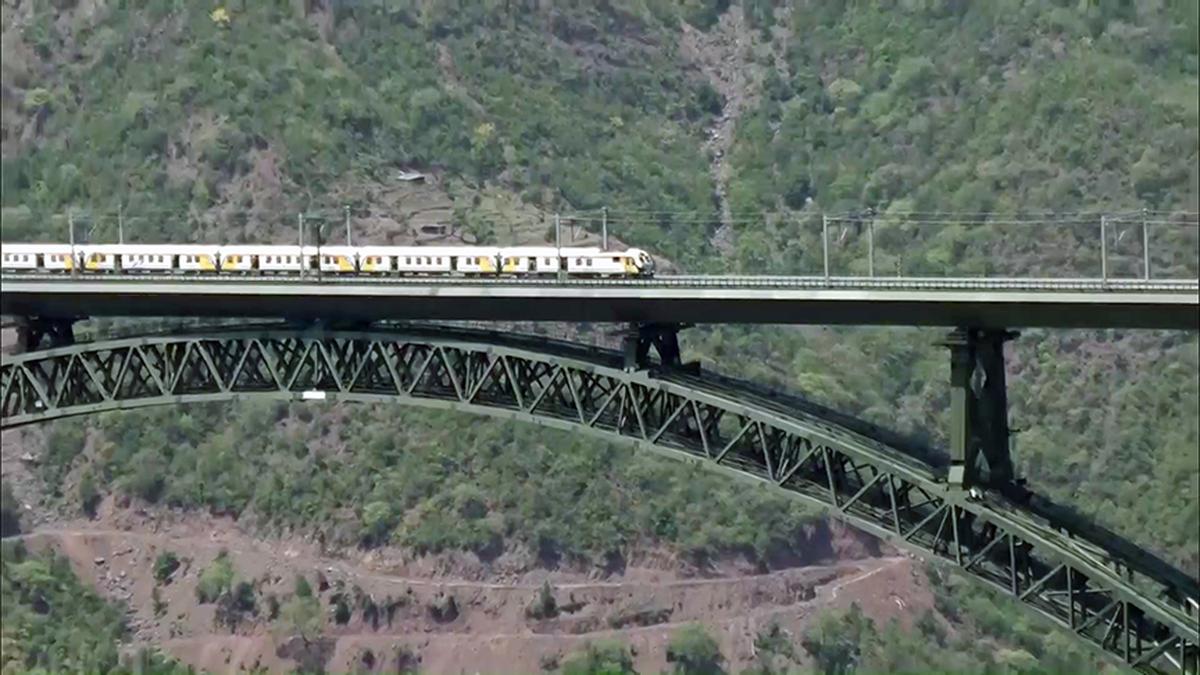
Kashmir’s transport network entered a new era as the first loaded freight train crossed the world’s tallest rail bridge and reached Anantnag, signalling the operational start of a critical segment of the Udhampur-Srinagar-Baramulla Rail Link (USBRL) project. This milestone connects the Valley’s railway system directly to the national freight grid, promising a transformative boost to trade, logistics, and year-round supply of goods.
The operationalisation of the Banihal-Sangaldan-Reasi-Katra section not only integrates the Valley into India’s broader rail logistics corridor but also ensures smoother access for industries, agricultural producers, and small traders. Officials expect this connectivity to lower freight costs, open new market routes, and provide reliable delivery of essential commodities irrespective of seasonal disruptions.The USBRL project, spanning 272 kilometres across eight districts of Jammu and Kashmir, has been described by engineering experts as one of post-independence India’s most challenging railway ventures. The route cuts through the young Himalayas, requiring advanced tunnelling, bridge construction, and climate-resilient infrastructure to withstand the region’s geological volatility.
The engineering centrepiece of the project is the Chenab Bridge in Reasi district, soaring 359 metres above the riverbed and stretching 1,315 metres in length, making it the tallest railway bridge in the world. Equally remarkable is India’s first cable-stayed rail bridge over Anji Khad, with its deck standing 331 metres above the riverbed.Beyond the engineering feats, the project has had far-reaching socio-economic effects. Construction has generated over 50 million man-days of employment, while 215 kilometres of approach roads, along with more than 320 smaller bridges and tunnels, have dramatically improved local connectivity. Many previously isolated communities now have all-weather access to markets, schools, and health services.
Safety protocols for the USBRL are benchmarked against global standards. Tunnels longer than two kilometres are equipped with mechanical ventilation systems and fire suppression units, while escape tunnels totalling 66 kilometres enhance passenger safety for longer sections. The infrastructure is designed not only for operational efficiency but also for disaster readiness, with emergency response systems in place.Officials highlight that while the freight service marks a turning point, passenger connectivity will follow, further integrating the Valley into national economic and social networks. For a region historically dependent on limited road access often hampered by weather and terrain, the USBRL is positioned as a game-changing asset in both economic resilience and national cohesion.The arrival of the first freight train is more than just a logistical breakthrough; it is a symbol of connectivity, economic opportunity, and engineering innovation anchored by infrastructure designed to endure and empower.