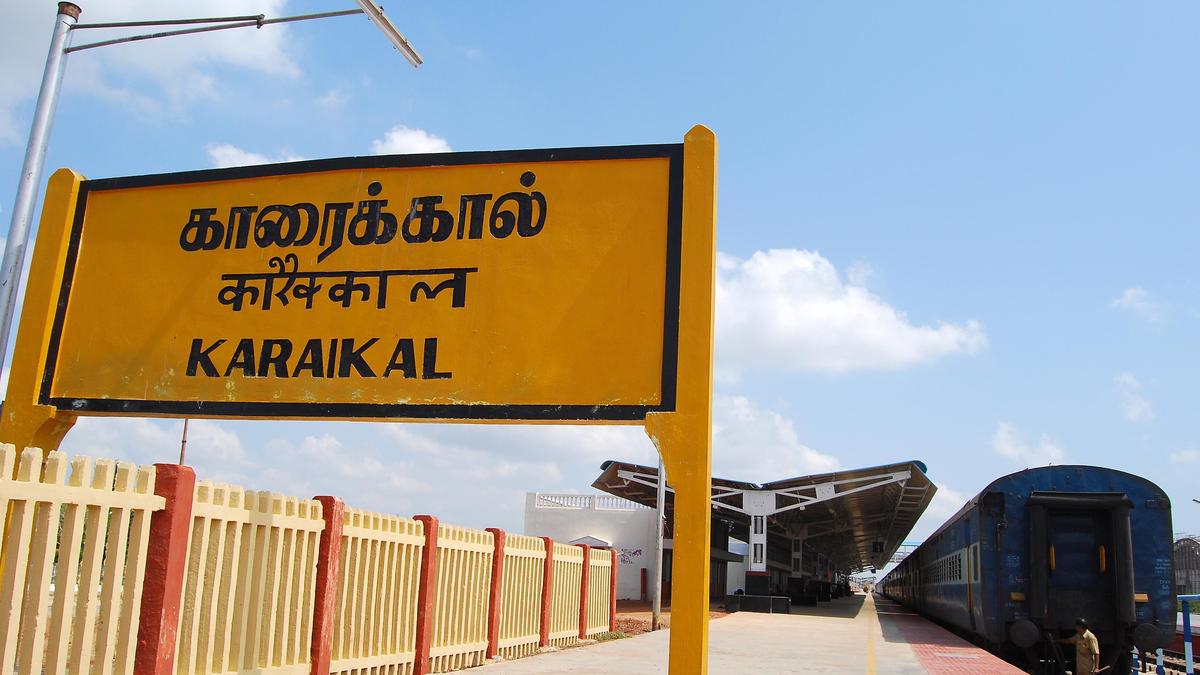
More than a year after receiving statutory safety clearance, the Karaikal–Peralam railway corridor remains without regular passenger services, raising questions about infrastructure utilisation and regional connectivity in coastal Tamil Nadu and the Union Territory of Puducherry. The delay has left daily commuters, pilgrims, and local businesses without the benefits of a modernised rail link designed to shorten travel times and ease congestion on older routes.
The 23.5-kilometre stretch forms a strategic connector between Karaikal and the broader rail network through Mayiladuthurai. Once operational for scheduled services, it would offer a faster alternative to circuitous routes via Tiruvarur, reducing journey times by up to two hours for several long-distance trains. Instead, the line currently handles only occasional special passenger services and freight movements, limiting its impact on everyday mobility. Transport planners note that the corridor plays a critical role in linking pilgrimage centres such as Velankanni, Nagore, and Thirunallar with larger urban hubs, including Chennai. In the absence of regular services, passengers are often forced to change trains mid-journey, navigate crowded platforms with luggage, or endure extended halts caused by locomotive changes on indirect routes. These inefficiencies disproportionately affect elderly travellers, women, and low-income passengers who rely on rail for affordable transport.
The project itself represents a significant public investment. After decades of inactivity, the line was converted from metre gauge to broad gauge and electrified following approvals earlier in the last decade. With construction completed and trial runs successfully conducted by mid-2025, the Commissioner of Railway Safety authorised passenger operations at speeds of up to 75 kmph. From an infrastructure readiness standpoint, the corridor is technically fit for service. Urban development experts point out that delays of this nature undermine the economic logic of rail upgrades. Improved rail access typically supports local tourism economies, enhances labour mobility, and reduces dependence on private road transport, contributing to lower emissions and safer travel. For towns along the Karaikal–Peralam stretch, regular trains could stimulate small businesses, hospitality services, and real estate development near stations.
One operational constraint frequently cited by rail users is the limited capacity at Velankanni station, which lacks adequate stabling lines to manage additional train movements. Addressing such last-mile infrastructure gaps is seen as essential for unlocking the full value of the corridor. In similar projects elsewhere, modest station upgrades have enabled significant service expansion with limited additional capital expenditure. Railway officials indicate that preparatory steps are under way to introduce scheduled passenger services, though no firm timeline has been communicated. Until that transition occurs, the Karaikal–Peralam railway line stands as a reminder that infrastructure delivery is only complete when assets are fully integrated into daily urban and regional life.
For a region seeking more inclusive, low-carbon mobility options, the next phase will depend less on engineering and more on operational coordination, timetable planning, and targeted station improvements to ensure the line serves the communities it was built for.