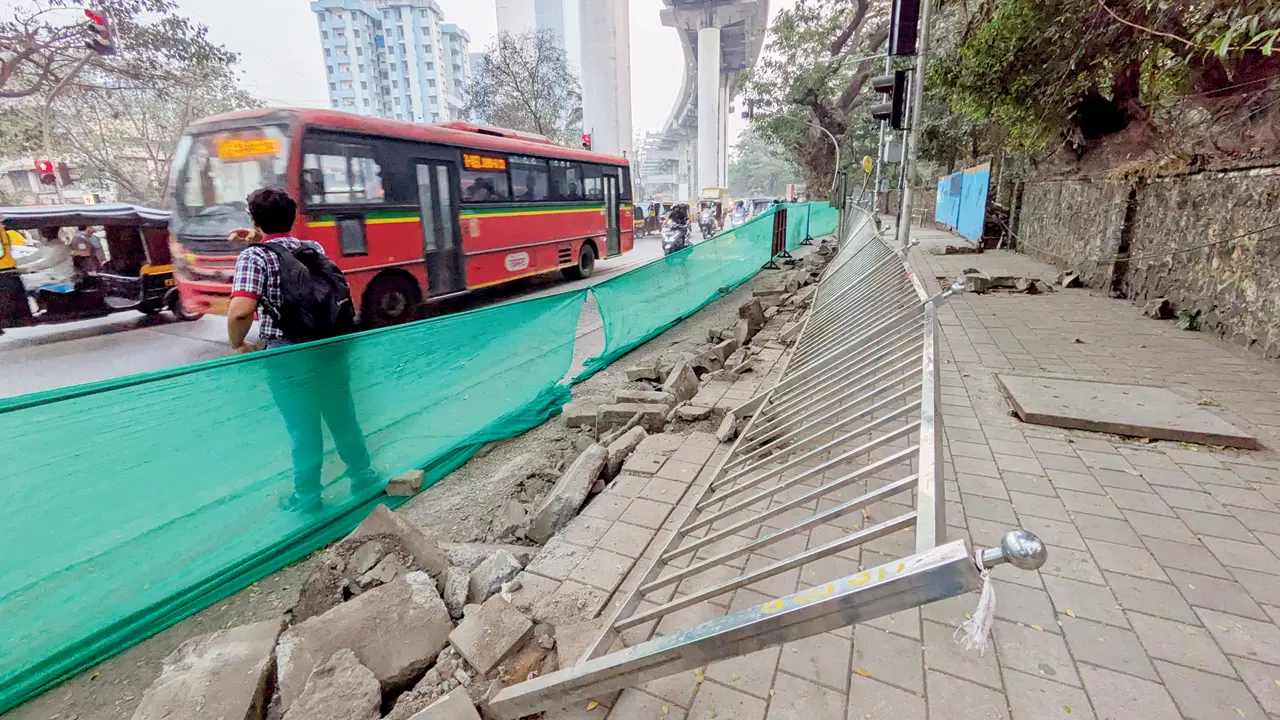
Daily commuters passing through Kanjurmarg’s Gandhi Nagar junction in eastern Mumbai are navigating what many describe as one of the city’s most fragile infrastructure interfaces. The convergence of two under-construction metro corridors, a major arterial road and an elevated flyover has left the junction with broken carriageways, fragmented footpaths and limited safety measures—highlighting the pressures of rapid transit expansion in dense urban zones.
The Gandhi Nagar intersection sits at a critical node where Metro Line 4, linking Wadala to Kasarvadavali, meets Metro Line 6, connecting the western suburbs with the city’s eastern employment clusters. Beneath the elevated corridors, however, road surfaces have deteriorated sharply. Uneven patches, exposed construction material and poorly aligned barricades have narrowed usable road space, increasing the risk for motorists while forcing pedestrians into live traffic lanes. Concerns escalated after a recent structural failure at another Metro Line 4 construction site in the eastern suburbs, prompting residents and urban safety observers to question whether ground-level conditions beneath elevated infrastructure are receiving adequate attention. Local civic groups say they have repeatedly flagged the junction’s condition to authorities, pointing to loose soil on concrete roads, inconsistent barricading and the absence of continuous, accessible footpaths.
Urban planners note that such junctions represent a broader governance challenge. “When multiple layers of transport infrastructure overlap, coordination between project agencies and civic bodies becomes critical,” said an urban mobility expert. Poorly managed construction zones, the expert added, undermine public confidence in mass transit while increasing accident risks, particularly for women, older citizens and people with disabilities. A site visit this week showed that ongoing road repairs, combined with metro construction activity, have reduced traffic capacity at peak hours. The situation worsens after dark due to inadequate lighting, raising concerns over personal safety and last-mile connectivity—an issue central to sustainable and inclusive transport systems.
Officials from the Mumbai Metropolitan Region Development Authority, which is executing the metro corridors, said a corridor-wide technical review is underway following the recent incident. According to officials, inspections are being conducted not only on elevated structures but also on road conditions and safety arrangements below, with instructions issued to rectify deficiencies where immediate action is possible. The 32-km Metro Line 4 and the 15-km Metro Line 6 are expected to significantly cut travel times across Mumbai once operational, easing pressure on road-based transport and lowering vehicular emissions. Yet experts caution that delivery quality matters as much as delivery speed. Temporary disruptions that persist for years can impose economic costs through congestion, higher fuel use and lost productivity.
As Mumbai accelerates its metro-led expansion, Gandhi Nagar junction underscores a crucial lesson: climate-resilient and people-first infrastructure must prioritise safe streets and walkable access during construction—not only after project completion.
Kanjurmarg Faces Safety Gaps Amid Metro Build