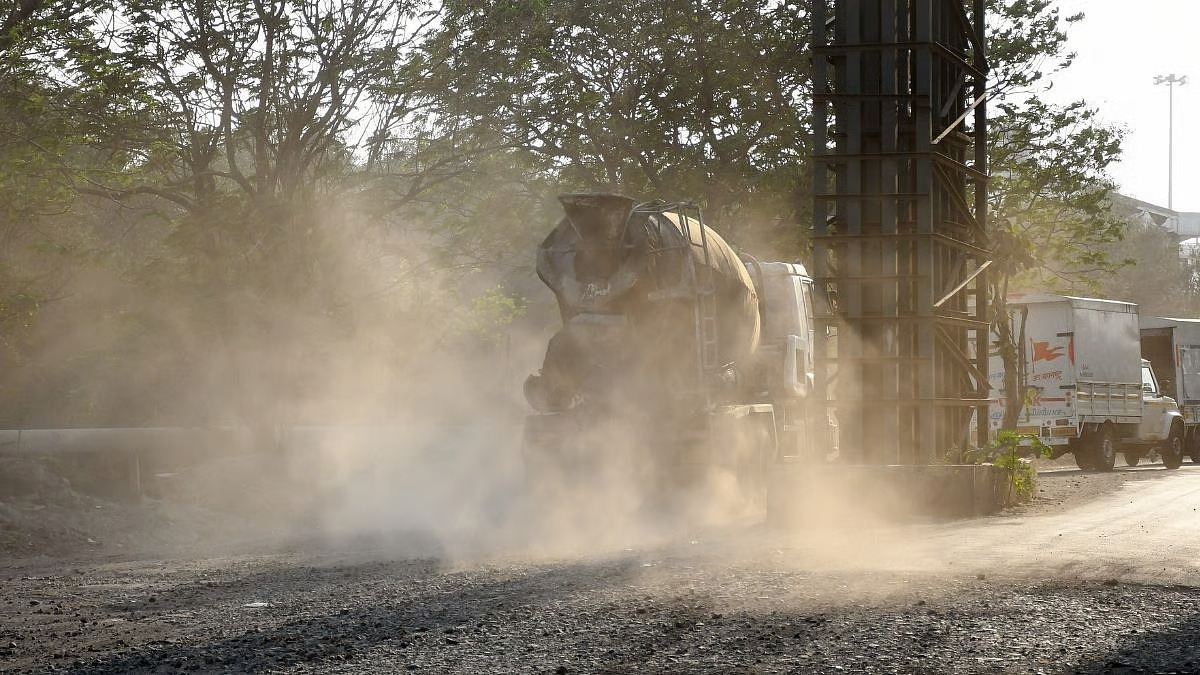
A sharp spike in pollution levels in Kalamboli has drawn attention to the environmental impact of construction-linked activity and traffic emissions in Navi Mumbai, raising questions about how urban growth projects are being managed in sensitive residential zones.
Recent air quality readings show that the area briefly entered the “very poor” category before easing slightly, though pollution levels remain elevated. Officials monitoring the Kalamboli air quality situation have attributed the deterioration largely to dust generated at an ongoing infrastructure site, compounded by emissions from heavy vehicular movement in the vicinity. The site in question involves ground-level work associated with a solar energy installation, where loose construction material such as soil and aggregates has contributed to higher particulate matter in the air. Experts note that such dust, particularly fine particulate matter (PM10 and PM2.5), can significantly impact respiratory health, especially in densely populated neighbourhoods.
Compounding the issue is the presence of freight and construction vehicles operating near the site. Urban transport analysts highlight that in rapidly developing nodes like Kalamboli, the overlap between infrastructure projects and logistics corridors often intensifies localised pollution hotspots. Without effective mitigation measures, these combined sources can push air quality into hazardous ranges within short periods. Civic authorities have initiated on-ground assessments following the spike in Kalamboli air quality levels, directing officials to review compliance with environmental safeguards. Measures such as water sprinkling, covering of construction materials, and regulation of vehicular movement are expected to be enforced more strictly to contain dust emissions.
The episode underscores a broader challenge in urban sustainability: balancing the expansion of renewable energy and infrastructure projects with immediate environmental impacts. While solar installations contribute to long-term decarbonisation goals, their construction phase can temporarily degrade local air quality if not managed with adequate controls. Environmental planners argue that project approvals should incorporate stricter dust management protocols, particularly when works are located near residential clusters or monitoring stations. Continuous air quality tracking and real-time disclosure can also improve accountability and enable faster corrective action.
For residents, the recent spike has renewed concerns about exposure to fluctuating pollution levels and the adequacy of preventive measures. Public health experts emphasise that even short-term exposure to high particulate concentrations can have cumulative effects, particularly for vulnerable groups such as children and the elderly. As authorities move to stabilise conditions, the focus will be on ensuring that construction activity proceeds with minimal environmental disruption. The Kalamboli case may serve as a reminder that achieving cleaner, low-carbon urban systems requires not only investment in green infrastructure but also rigorous enforcement of environmental standards during implementation.
Kalamboli Air Quality Hit By Dust And Traffic Emissions