


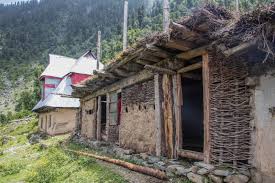
Across the Himalayan belt of Jammu & Kashmir, Uttarakhand and Himachal Pradesh, housing patterns among nomadic pastoral communities are undergoing a visible transformation. Families belonging to the Gujjar, Van Gujjar and Bakkarwal groups are gradually replacing traditional mud-and-timber dwellings with concrete structures, reshaping both the mountain landscape and long-held architectural practices.
For generations, these communities have followed seasonal migration routes across the Pir Panchal and adjoining valleys. Their homes reflected that mobility. Kutcha structures were compact, locally built and designed to respond to sharp climatic shifts. Livestock occupied the lower level, while families lived above in multipurpose spaces warmed by cooking fires. Clay walls provided thermal insulation, and roofs made from timber and shrub layers were easily repairable using materials gathered nearby. Architects studying mountain settlements describe these houses as examples of climate-responsive design. Built without industrial inputs, they required minimal transport, produced little waste and could be dismantled without leaving a permanent ecological footprint. Over the past decade, however, reinforced cement concrete and brick construction has gained ground in villages along improved road corridors. Two central government schemes Pradhan Mantri Gram Sadak Yojana and Pradhan Mantri Awas Yojana have accelerated connectivity and incentivised permanent housing. Easier access to cement, steel and corrugated metal sheets has made modern materials more affordable and aspirational. Younger residents often associate concrete homes with security and upward mobility. RCC roofs promise durability against heavy snowfall and monsoon rains, while brick walls reduce maintenance. Yet many elders point to unintended consequences. Concrete slabs absorb heat in summer and intensify cold during winter nights, altering the delicate thermal balance once achieved by mud walls.
Environmental planners warn that this material shift carries broader implications. Cement production is carbon intensive, and metal roofing increases heat gain in fragile mountain ecosystems already facing climate variability. Unlike biodegradable kutcha structures, RCC buildings are difficult to modify or recycle, embedding long-term material footprints in high-altitude landscapes. The change is not merely technical but cultural. Traditional layouts supported collective living patterns, livestock integration and seasonal flexibility. Concrete houses often separate these functions, reflecting a gradual sedentarisation of communities historically defined by mobility. Policy researchers argue that the solution need not be binary. Hybrid models combining stabilised earth blocks, timber framing and selective concrete reinforcement could balance safety with thermal efficiency. Integrating passive design principles, such as orientation, ventilation shafts and insulated roofing layers, may reduce energy demand while respecting cultural forms.
As Himalayan districts urbanise and infrastructure expands, housing decisions in these pastoral settlements will influence ecological resilience and social continuity. The challenge for planners and policymakers is to ensure that development pathways strengthen safety and dignity without erasing locally evolved knowledge systems that have long enabled people to live sustainably in the mountains.
Also Read: India Hospitality Platform Model Expands
Jammu Kashmir Nomadic Housing Faces Transition
