


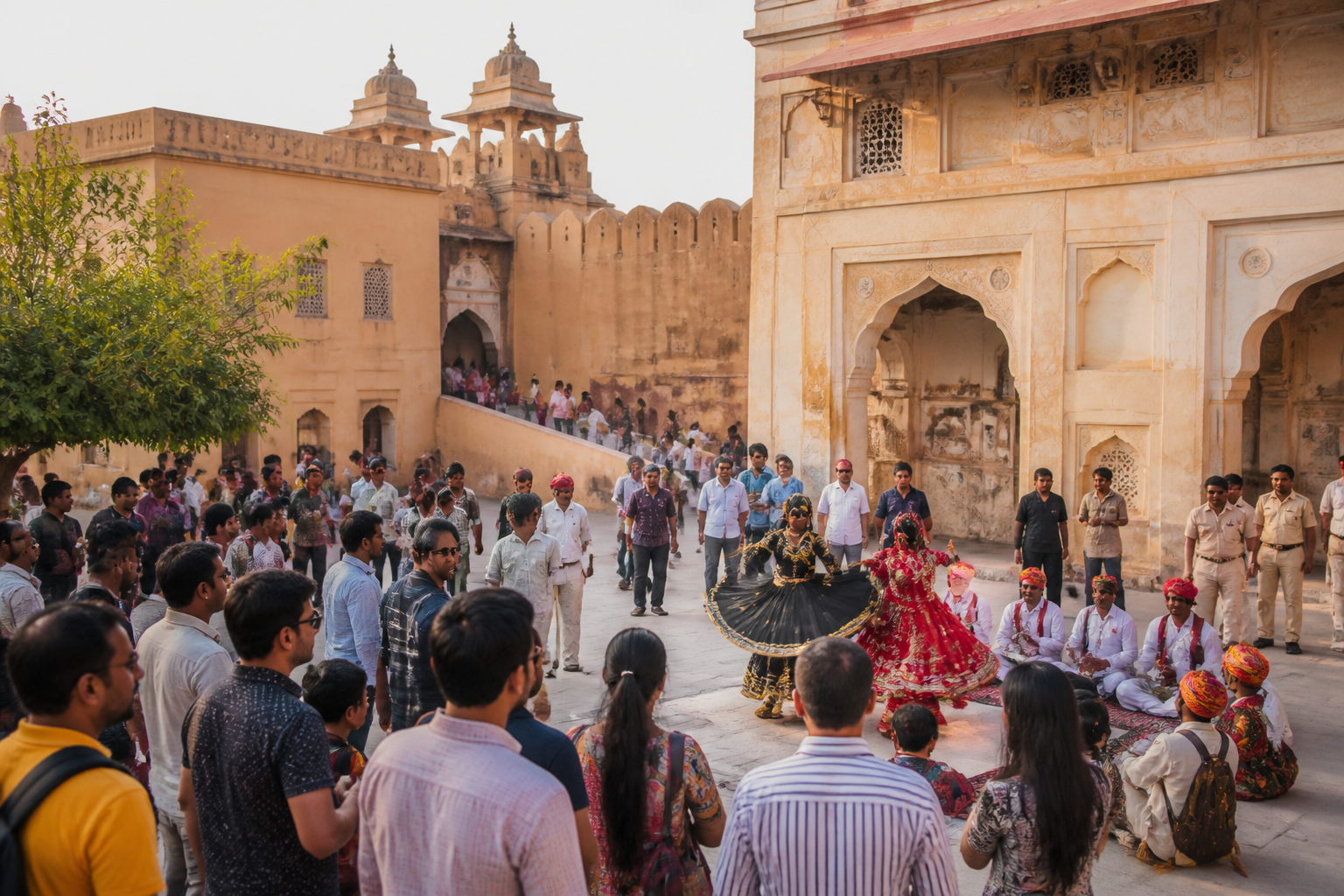
Jaipur’s major heritage sites drew large crowds on Sunday after Rajasthan opened its protected monuments and museums to Indian and foreign tourists without entry charges to mark World Tourism Day.
The state’s archaeology and museums department made free access available across its protected monuments and museums. In Jaipur, special arrangements were made at Amer Fort, Nahargarh, Hawa Mahal, Jantar Mantar and Albert Hall, among the city’s best-known heritage attractions.
Visitors were welcomed with garlands and presented with performances based on Rajasthan’s folk traditions. The programme included Kalbelia and Kachhi Ghodi dances, puppetry, Bahurupiya performances and shehnai recitals. At Amer Fort and Jantar Mantar, activities were organised to introduce visitors to the state’s history, architecture and cultural heritage.
The combination of a Sunday holiday and the removal of entry charges increased footfall at several of Jaipur’s most visited sites, according to the report. The event placed the city’s heritage infrastructure in the spotlight not only as a tourism asset but also as a public-facing part of Jaipur’s built environment.
Free entry can widen access to protected monuments for residents, domestic visitors and international tourists who might otherwise be deterred by ticket costs. It also brings operational demands for sites that must manage visitor movement, security, cleanliness, conservation concerns and crowd circulation within historically significant structures. The report does not provide attendance figures or details of any crowd-management incidents.
The celebrations also included recognition for tourism-sector contributions. The Hotel Federation of Rajasthan honoured 14 distinguished personalities and frontline professionals for their work in the development of the state’s tourism industry.
Outside Jaipur, Kota has traditionally marked World Tourism Day through activities linked to its heritage and the Chambal region. These have included heritage walks, cleanliness drives, cultural programmes and public engagement around the Hadoti region.
The state’s wider tourism effort is also moving beyond the established forts-and-palaces circuit. The report said Rajasthan is placing greater emphasis on crafts, rural experiences, cuisine and folk culture, indicating an attempt to distribute tourism interest across a broader set of cultural and regional offerings.
For Jaipur, the immediate challenge following high-footfall events is to balance wider public access with the protection of historic sites. The archaeology and museums department’s next steps will determine whether similar programmes are accompanied by detailed visitor-management arrangements and whether the cultural activities become a recurring part of the city’s heritage calendar.
