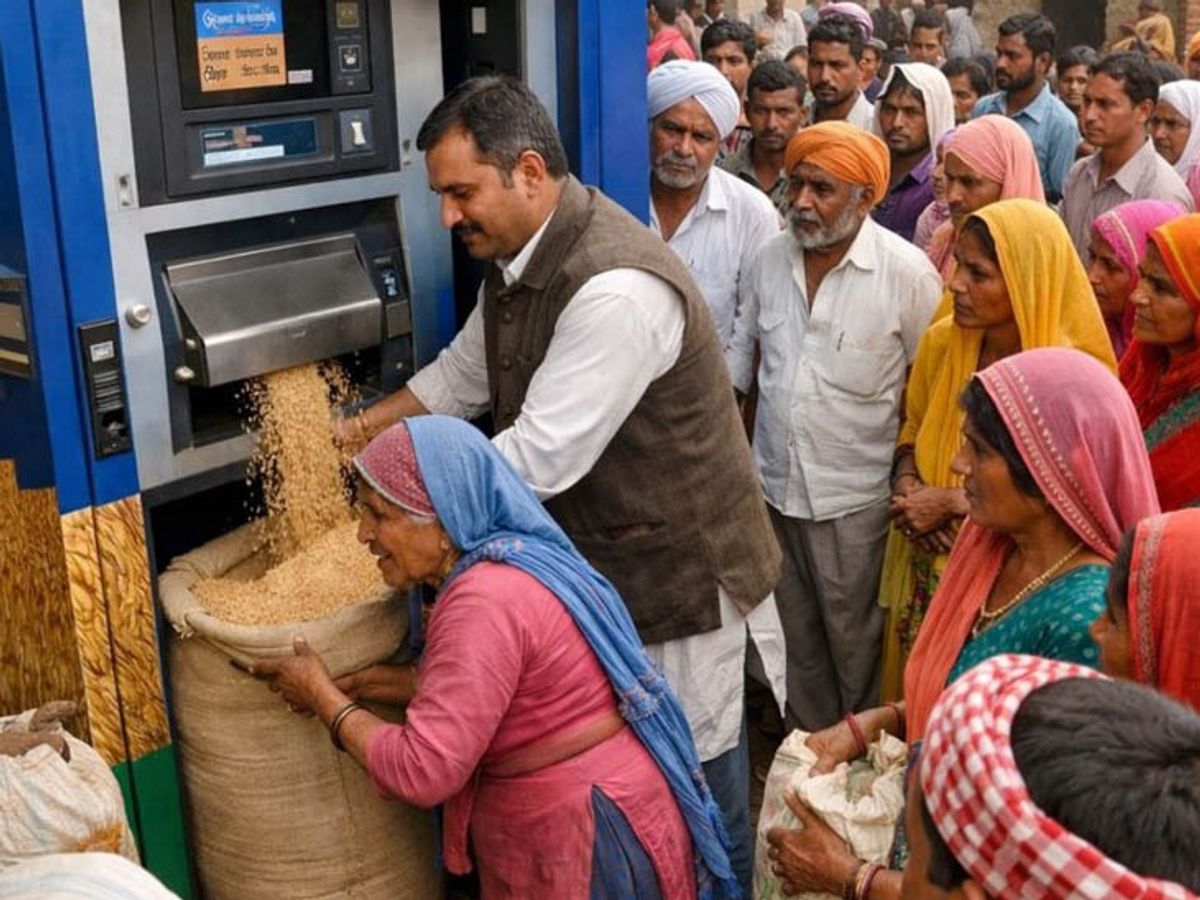
The Rajasthan government has unveiled plans to roll out automated grain “ATMs” across key districts including Jaipur, as part of an effort to modernise the Public Distribution System (PDS) and strengthen food security infrastructure in a state with more than 43.5 million beneficiaries.
This pilot initiative, announced in the state assembly, seeks to reduce manual bottlenecks, improve transparency and enhance dignity in access to subsidised food grains under the National Food Security framework. Known under the working name Annapurti, these machines will dispense wheat, rice and pulses directly to entitled households using ration cards for identity verification. In contrast to traditional fair price shops — where beneficiaries often endure queues and variable service quality — the automated dispensing units are designed to operate round-the-clock and deliver precise quotas without manual intervention.
The technology behind grain ATMs reflects a growing trend in India to digitise and decentralise essential service distribution. Such machines have precedent in places like Odisha, where early pilots demonstrated reduced congestion at distribution outlets and tighter control over grain allocation. The integration of biometrics and digital identity systems with ration cards also dovetails with national portability efforts like “One Nation, One Ration Card,” which enable beneficiaries to access entitlements across state borders. Officials say the pilot phase in Bharatpur, Jaipur and Bikaner will provide critical insights into operational reliability, community uptake and integration with existing PDS supply chains. If successful, the programme could be scaled statewide, positioning Rajasthan as a testbed for national adoption. Beyond convenience, the move promises to tackle enduring challenges in food distribution — from human errors in measurement to potential leakages and diversion of stocks that have historically eroded programme efficacy.
Public distribution remains a cornerstone of urban and rural resilience, particularly as cities like Jaipur grow and attract migrant populations who depend on stable access to subsidised grains. With rising temperatures, drought pressures and climate-driven instability in rural hinterlands, resilient food systems are increasingly viewed not as welfare add-ons but as foundational civic infrastructure. Data-enabled dispensers can also provide real-time usage metrics to policymakers, supporting more dynamic allocation and demand forecasting. The state’s food and supply minister noted ongoing efforts to streamline beneficiary lists through e-KYC and voluntary “give up” campaigns, which have reduced ineligible entries and freed up capacity for eligible households. These complementary reforms aim to ensure that automation does not simply digitise existing inequities but facilitates wider, more equitable access to entitlements.
Urban economists highlight that while technology can enhance efficiency and transparency, the broader success of grain ATMs will depend on robust connectivity, reliable power supply and interface design that is accessible to marginalised populations including the elderly and digitally excluded. As Rajasthan pilots the scheme, its outcomes could inform similar interventions in other states grappling with the dual pressures of population growth and food security management.