Indore Road Widening Eases Congestion For Residents
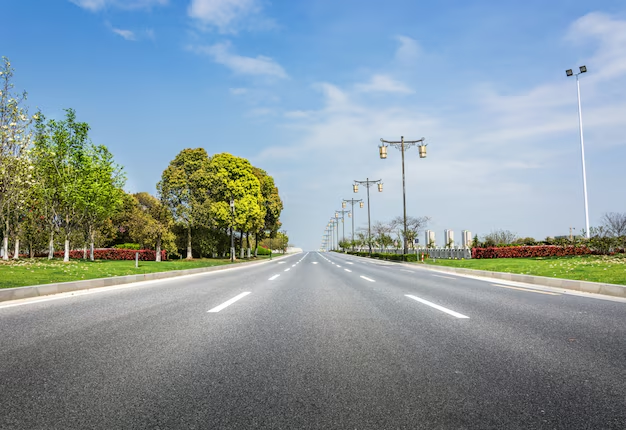
Indore’s ongoing road widening programme is beginning to ease daily congestion in dense neighbourhoods, with a key stretch upgraded to a width of nearly 70 feet, offering visible relief to residents and commuters. The intervention reflects a broader push to modernise urban mobility infrastructure in one of Madhya Pradesh’s fastest-growing cities, where traffic volumes have surged alongside rapid expansion.
Civic officials indicated that the widening of the corridor was undertaken to address persistent bottlenecks caused by narrow carriageways and rising vehicle density. The expanded road is expected to improve traffic flow, reduce travel time, and enhance access for emergency and public transport services—critical factors in a city that continues to attract both population and economic activity.Urban planners note that such upgrades are increasingly necessary as legacy road networks struggle to accommodate present-day mobility demands. In many parts of Indore, streets designed decades ago are now under pressure from mixed traffic, including private vehicles, goods carriers, and informal transport systems. The Indore road widening initiative is therefore seen as both a corrective measure and a step toward future-proofing key urban corridors.Residents in the affected areas have reported smoother movement and reduced peak-hour congestion following the expansion. Improved road width has also created space for better lane discipline and pedestrian movement, although experts caution that design interventions—such as footpaths and crossings—must accompany widening efforts to ensure safety and inclusivity.
Beyond mobility, the project has implications for urban liveability. Reduced idling time for vehicles can lower fuel consumption and emissions, contributing incrementally to cleaner air in high-traffic zones. However, urban development experts stress that road widening alone cannot resolve long-term transport challenges. Without parallel investment in public transport and non-motorised mobility, cities risk reinforcing car-dependent growth patterns.The initiative is part of a wider set of infrastructure works across Indore, including drainage upgrades and corridor improvements aimed at handling both traffic and climate-related stress, such as urban flooding. Integrating stormwater systems alongside road expansion is becoming increasingly important as cities face more frequent extreme weather events.At the same time, planners highlight the need to manage the social impact of such projects. Road widening often involves removal of encroachments or informal structures, requiring careful rehabilitation measures to ensure that vulnerable groups are not disproportionately affected.As the city continues to implement the Indore road widening programme, the focus is likely to shift toward balancing efficiency with equity—ensuring that improved mobility does not come at the cost of pedestrian safety, environmental sustainability, or inclusive urban design.
Looking ahead, the challenge for Indore will be to align road expansion with broader transport planning, including public transit integration and compact urban growth. Done effectively, such interventions can transform not just how people move, but how the city evolves in a more sustainable and accessible direction.