


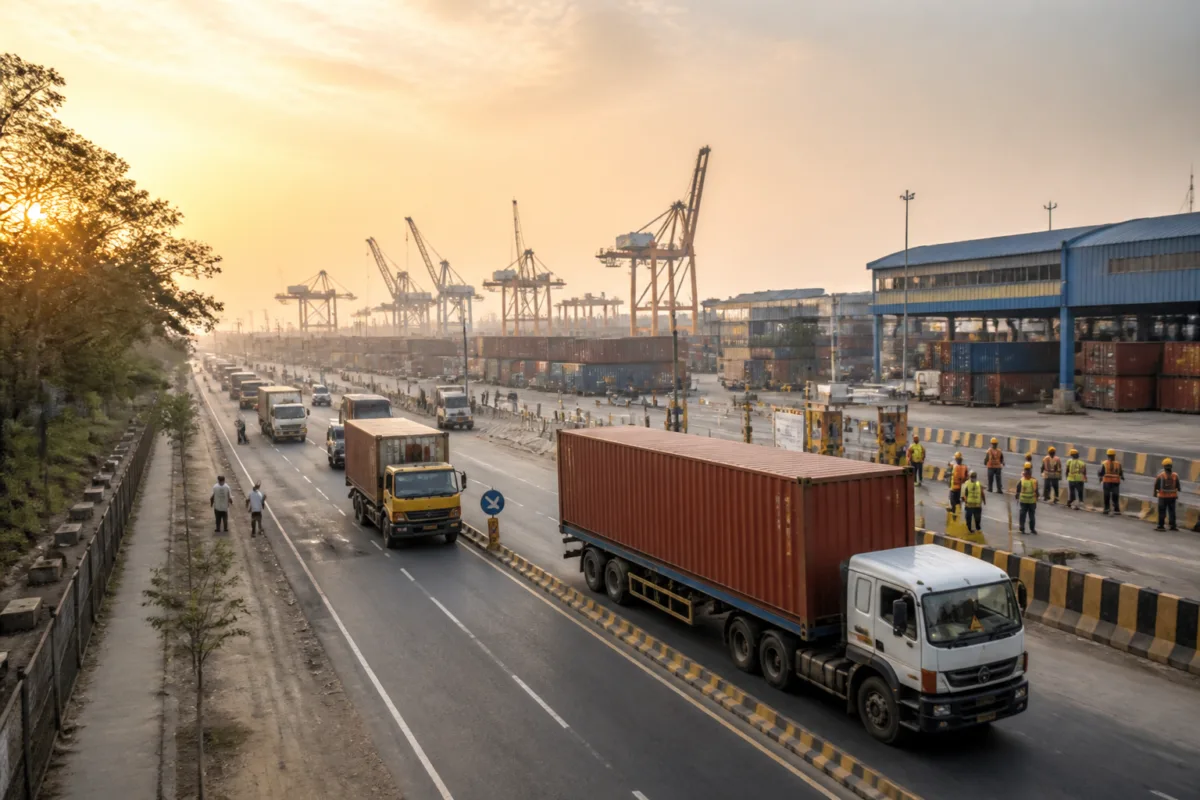
India’s merchandise exports are projected to rise 28.7 per cent year-on-year to $141.8 billion in the third quarter of FY27, according to Export-Import Bank of India. The forecast is positive for the country’s trade economy, but it also exposes a less examined urban question: whether India’s cities and logistics systems can convert export growth into reliable, broad-based economic activity.
The projection covers October to December and is based on what Exim Bank describes as a diversified export basket and wider range of markets, new trade agreements and an improving global growth outlook. The bank expects non-oil exports to reach $120.3 billion in the quarter, a 21.9 per cent year-on-year increase. Non-oil and non-gems and jewellery exports are projected at $106.4 billion, up 16.2 per cent.
These figures matter to cities because merchandise exports are not generated by national policy alone. They depend on the interaction between production centres, industrial clusters, warehouses, roads, rail links, ports, airports, customs systems, financial institutions and labour markets. The supplied data does not identify which cities or corridors will capture the projected growth. It does, however, indicate that export performance is being shaped by market diversification and supply-chain realignment—developments that place urban infrastructure and administrative capacity at the centre of the trade story.
The export forecast follows a strong September. Commerce department data cited by Business Standard shows that exports rose 23 per cent year-on-year to $44.4 billion during the month. The trade deficit narrowed to $30.21 billion from $33 billion a year earlier, even as imports increased 8 per cent to $74.61 billion.
For the first six months of the financial year, exports rose 18.51 per cent to $259.89 billion, while imports grew 16.31 per cent to $437.53 billion. The numbers show that export growth is occurring alongside a substantial expansion in imports. That combination is important for urban economies because it points to the scale of movement through India’s production, distribution and trade infrastructure, although the supplied report does not provide a commodity-wise or location-wise breakdown of that activity.
The most prominent bilateral trade figure in the report concerns China. China was India’s largest trading partner during the April-September period, with merchandise trade rising 29 per cent to $91.8 billion. Exports to China increased 36 per cent year-on-year to $11.4 billion, while imports rose 27.8 per cent to $80.4 billion.
This relationship illustrates the difference between export growth and trade balance. India’s exports to China expanded faster in percentage terms than imports during the period, but the value of imports remained substantially higher. The data therefore records stronger two-way trade rather than a reversal of the bilateral imbalance. For cities connected to manufacturing, distribution and freight activity, the distinction matters: rising trade can increase demand for logistics and industrial services even when the value of imports remains larger than exports.
Exim Bank attributes the positive outlook to several factors. These include continued diversification of markets and products, opportunities created by recent trade agreements, sustained demand in major export destinations, an improving global and domestic growth outlook, strong investment activity and exchange-rate movements. The bank also identifies tighter global monetary policy and evolving trade regulations as downside risks.
That combination makes the forecast more than a simple growth estimate. It describes an export system attempting to become less dependent on a narrow group of products or destinations while remaining exposed to international financial and regulatory conditions. Diversification can reduce concentration risk, but it also requires businesses and public agencies to manage more destinations, compliance requirements, transport routes and commercial relationships. The report does not quantify those operational requirements, but the institutional implication is clear: market access must be supported by systems capable of handling greater complexity.
The urban dimension is particularly relevant because the physical and administrative foundations of trade are concentrated in and around cities. Exporters rely on industrial estates, storage facilities, freight connections, customs processing, banking and professional services. Workers involved in manufacturing, packaging, transport, warehousing and trade administration are also linked to urban and peri-urban labour markets. However, the supplied material does not establish how much of the projected export growth will be generated in metropolitan regions, smaller industrial towns or rural production areas.
That limitation is important. A national export number cannot by itself demonstrate that cities are becoming more productive, that logistics costs are falling or that workers are receiving a greater share of trade-led growth. Nor does it establish whether infrastructure capacity is adequate in the locations where demand is increasing. Those questions require data on cargo volumes, turnaround times, freight costs, industrial output, employment and the geographic distribution of exports—none of which is included in the report.
What the available evidence does show is that the export outlook is being supported by a combination of external demand, policy openings and domestic investment activity. The September data provides a recent indication of momentum, while the April-September figures show that the trend is not limited to a single month. At the same time, the gap between exports and imports remains significant, and international risks could affect the pace of expansion.
For urban governance, this creates a coordination challenge. Trade growth can involve multiple institutions with different responsibilities, including commerce authorities, customs agencies, transport departments, port and airport operators, municipal bodies, industrial development agencies and financial institutions. The Exim Bank statement does not set out a new implementation framework or assign responsibilities among these bodies. It is a projection and risk assessment rather than an urban infrastructure plan.
The reference to supply-chain realignment is nevertheless significant. When companies alter sourcing, production or distribution arrangements, the effects are usually distributed across several locations rather than confined to one factory or port. New demand may emerge for industrial land, warehousing, road access, rail freight or processing services. Whether those benefits translate into durable urban employment depends on the composition of the export basket and the location of related investment. The supplied report does not provide enough evidence to determine either outcome.
The same caution applies to new trade agreements. Exim Bank identifies them as an opportunity for export growth, but the report does not specify which agreements, products or markets are expected to contribute most. Without that information, it is not possible to assess which sectors or urban regions may benefit, or whether the gains will be concentrated among established exporters.
The data also shows why export growth should be read alongside import growth. During April-September, imports increased 16.31 per cent to $437.53 billion, compared with exports of $259.89 billion. In September, imports rose to $74.61 billion while exports reached $44.4 billion. These figures may reflect the inputs, equipment and goods required by a growing economy, but the supplied report does not break imports down sufficiently to establish their relationship with domestic production or export capacity.
The larger urban question is therefore not whether India’s exports are growing. The evidence supports that conclusion for the periods and measures cited. The more consequential question is how that growth is organised spatially and institutionally. If export expansion is to strengthen cities, the benefits would need to appear through productive investment, dependable freight and utility systems, formal employment and improved connections between manufacturing locations and trade gateways. The available figures do not yet measure those outcomes.
Exim Bank’s projection provides a positive short-term outlook, supported by September’s export performance and the first-half trade data. It also identifies monetary tightening and changing trade regulations as risks. What remains unresolved is the distributional and spatial impact of the forecast: which cities, industrial regions and worker groups will gain, and whether existing infrastructure can support the additional flows. Those are the indicators that will determine whether higher merchandise exports become a broader urban economic dividend rather than only a stronger national aggregate.

