


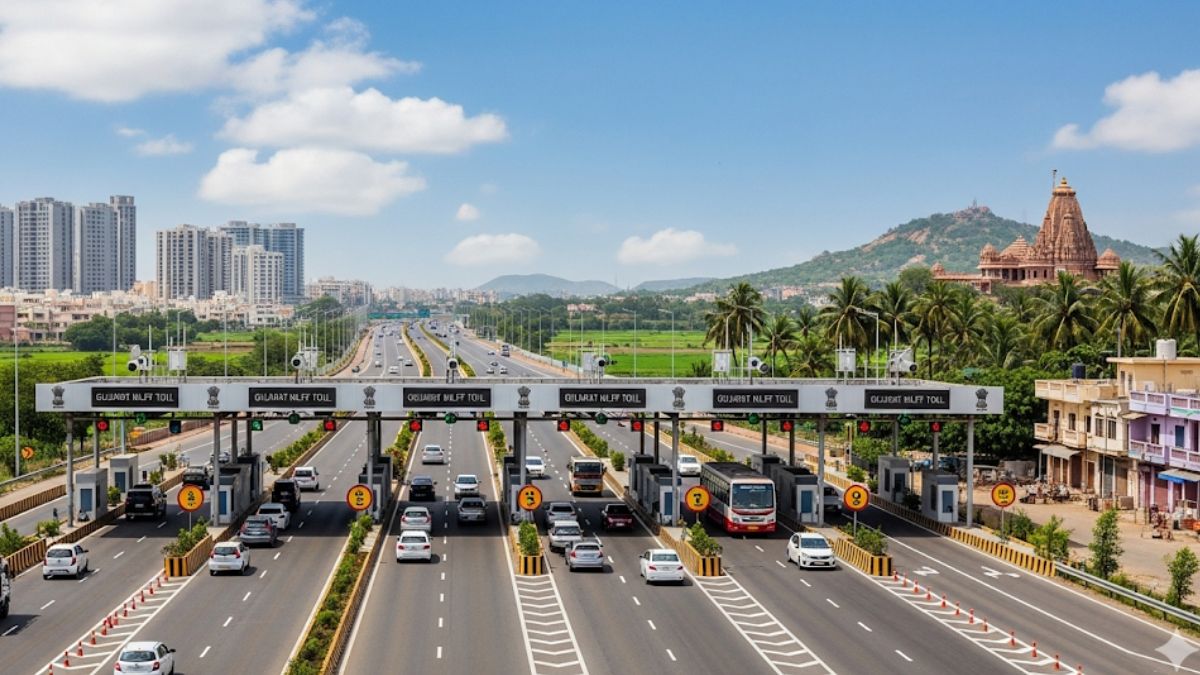
India’s first multi-lane free flow tolling plaza at Choryasi on National Highway 48, ushering in a new era of seamless and sustainable highway travel. The move, officials confirmed, will make road journeys faster, greener, and more efficient, eliminating the long-standing barrier of stoppages at toll booths.
The Indian Highways Management Company Limited, backed by the National Highways Authority of India (NHAI), has finalised an agreement with a private sector bank to execute the ambitious project. Choryasi Fee Plaza in Gujarat will be the pilot site for the barrier-free system, while Gharaunda in Haryana on NH-44 has also been identified for rollout under the same model. The programme is designed as a precursor to a nationwide implementation, with 25 toll plazas shortlisted for adoption during the ongoing financial year. At the core of the initiative is the Multi-Lane Free Flow (MLFF) tolling technology. Using high-performance RFID readers and automatic number plate recognition cameras, the system enables toll deductions without requiring vehicles to halt. This not only reduces congestion but also cuts travel time significantly, translating into lower fuel consumption and reduced vehicular emissions—two critical factors in building climate-friendly transport networks.
Officials emphasised that the transition marks one of the most meaningful shifts in the country’s highway operations in recent years. By integrating FASTag with advanced vehicle recognition tools, the new framework promises not only smoother commuter experience but also stronger toll revenue accountability. Experts highlight that by moving towards automation, leakages in toll collection could be minimised, thereby ensuring greater transparency. India’s national highway network has expanded rapidly in the past decade, from about 91,000 km in 2014 to over 1.46 lakh km at present. With traffic volumes rising in tandem, the introduction of barrier-free tolling is seen as an inevitable step to prevent bottlenecks that have long plagued fee plazas across the country. Gujarat’s Choryasi project, therefore, is expected to set a benchmark for other regions aiming to modernise mobility while aligning with sustainability goals.
Industry experts note that the model will demand robust technological integration and real-time data management. However, its potential to improve fuel efficiency, reduce emissions, and contribute to India’s commitment towards net-zero carbon targets is expected to outweigh initial challenges. Beyond environmental gains, the system also aligns with the government’s ambition of building smart, resilient, and equitable transport infrastructure. With the groundwork laid at Choryasi, Gujarat is positioning itself as the testing ground for a transformative change in Indian highways. If successful, the model could redefine tolling across the nation, offering travellers an experience that is faster, fairer, and more eco-conscious.
Also Read : Delhi Bharat Vandana Park Mini India Nears Completion Showcasing Monuments
