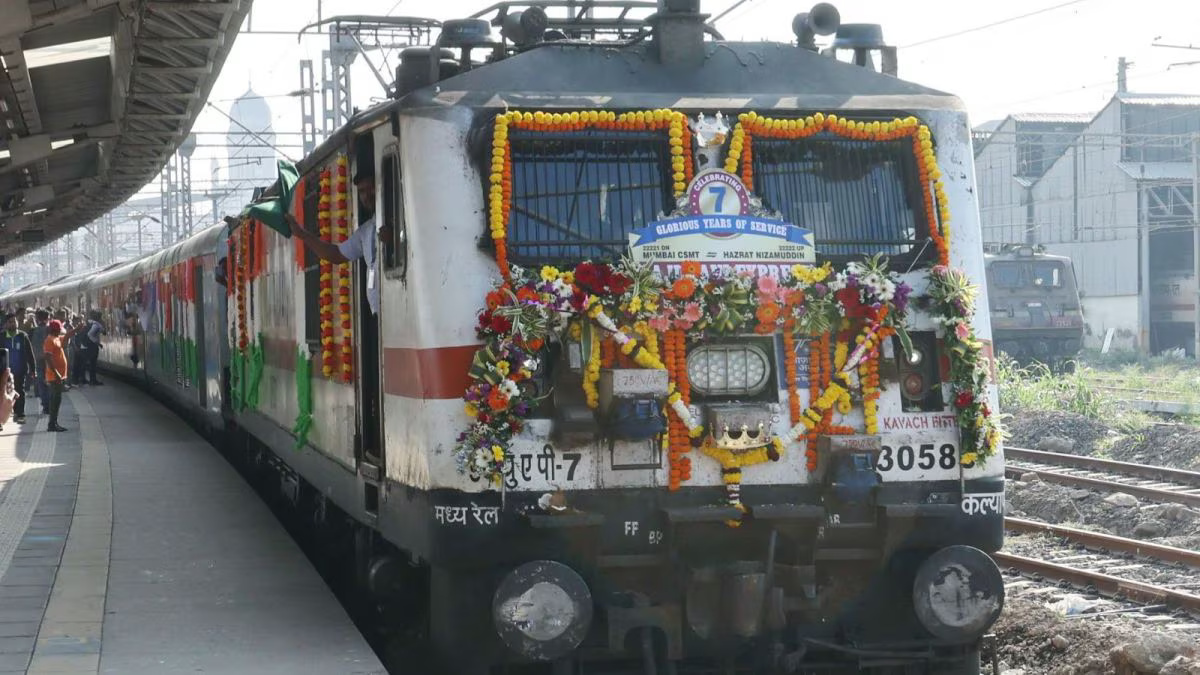
Indian Railways’ first push-pull Rajdhani Express has completed seven years of continuous service, marking a quiet but significant shift in how premium intercity rail operations are managed on one of the country’s busiest corridors. Operating between Mumbai and the national capital, the train has emerged as a test case for time efficiency, energy optimisation, and capacity-driven rail planning.
Introduced in early 2019, the service was among the first long-distance trains in India to adopt push-pull technology, a configuration that places electric locomotives at both ends of the rake. This design allows the train to change direction without time-consuming locomotive reversals, particularly across gradient-heavy sections of the route. Rail operations experts note that the approach reduces dwell time, improves schedule reliability, and lowers mechanical strain on rolling stock. The corridor connecting Mumbai and Delhi remains one of the most economically vital rail links in the country, supporting business travel, government movement, and long-distance passenger flows across multiple states. Over the years, rising demand led to the service being upgraded from limited frequency operations to a daily schedule, reflecting sustained passenger confidence in faster and more predictable rail journeys.
From an infrastructure perspective, push-pull operations offer broader system-level advantages. By eliminating the need for additional banking engines in ghat sections, railways are able to cut idle engine deployment, optimise crew utilisation, and reduce operational emissions. Transport planners point out that such incremental efficiency gains are critical as Indian Railways works towards lower-carbon mobility solutions without expanding track footprint. The train’s configuration has also evolved alongside demand patterns, with capacity augmentation allowing a higher proportion of air-conditioned coaches while maintaining onboard service standards expected of a Rajdhani-class service. Officials associated with train operations indicate that the experience gained from this corridor has informed deployment decisions for similar technology on other premium and semi-high-speed routes.
Strategically, the success of the push-pull Rajdhani aligns with Indian Railways’ broader effort to modernise legacy infrastructure through operational innovation rather than only large-scale capital expansion. As cities like Mumbai and Delhi grapple with congestion, air quality pressures, and time poverty, dependable long-distance rail services play a role in reducing reliance on short-haul aviation and private road travel. Looking ahead, transport economists suggest that wider adoption of push-pull technology could support future network densification, especially on saturated trunk routes where adding new tracks is complex and land-intensive. For passengers, the impact is less technical but more tangible: shorter journeys, fewer unscheduled halts, and a rail system incrementally adapting to the demands of a high-growth, climate-constrained economy.
Indian Railways Push Pull Rajdhani Marks Seven Years