


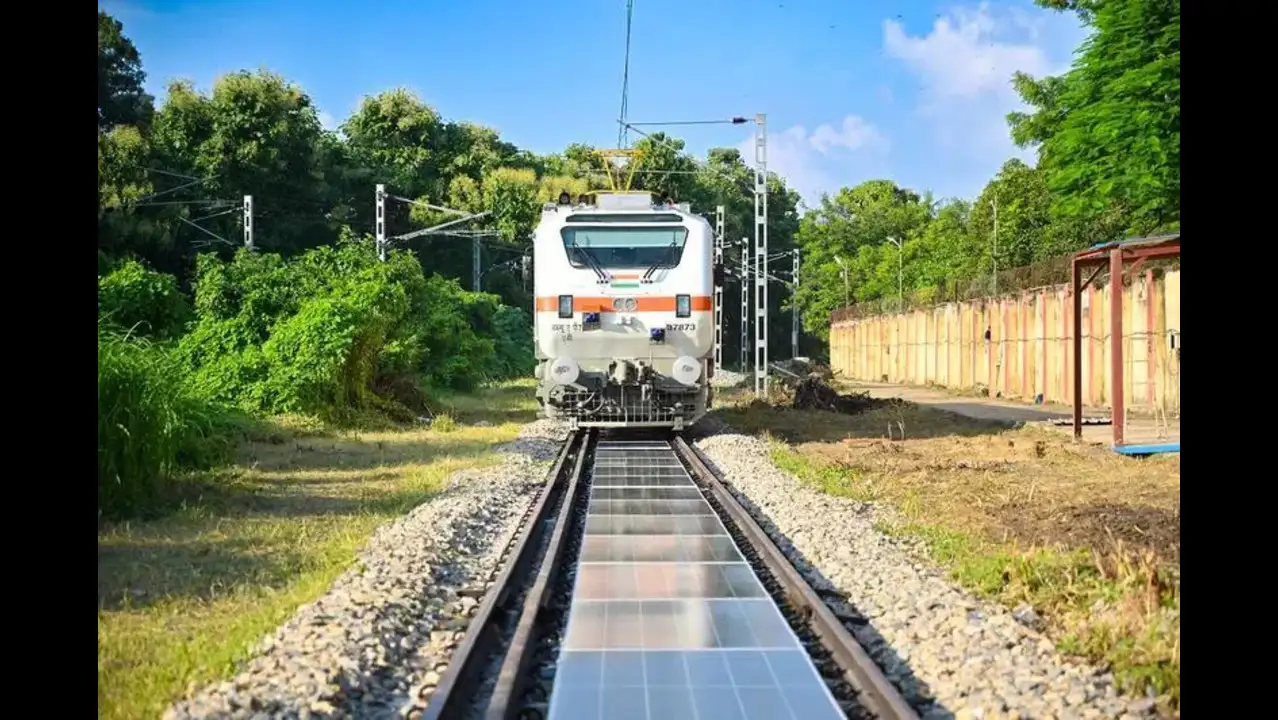
Indian Railways has marked a decisive shift towards sustainable transport with the commissioning of the country’s first removable solar panel system installed between railway tracks at Banaras Locomotive Works in Varanasi. The pilot project spans 70 metres and comprises 28 solar panels with a capacity of 15 kWp, a move aimed at embedding renewable energy generation into India’s fast-modernising rail infrastructure.
Officials described the initiative as a “historic first” that reinforces the government’s broader vision of building a zero-carbon transport network. Unlike conventional rooftop panels, this removable design enables easy maintenance and ensures that energy production does not disrupt operations, offering flexibility and resilience. The innovation is expected to cut dependence on grid electricity, lower operational costs, and demonstrate how underutilised spaces in railway assets can be repurposed for green power generation. The development comes at a time when the railways is aggressively expanding its sustainability agenda. Parallel to this achievement, freight operations in Gujarat saw a new milestone when the first rake carrying industrial salt was dispatched from Sanosara on the Bhuj–Naliya section to Dahej. With nearly 3,851 tonnes of cargo transported across 673 kilometres, railway officials estimated freight revenues of more than Rs 31 lakh from the consignment. The move is being viewed as an enabling step for the salt industry, improving regional connectivity while reducing logistics costs through rail-based freight.
Further strengthening its infrastructure backbone, Western Railway successfully energised India’s first 2×25 kV electric traction system at the Nagda–Khachrod section under the Ratlam Division. The substation, equipped with Scott-connected 100 MVA transformers, is designed to enhance the efficiency of power supply to overhead equipment, ensuring uninterrupted traction energy. Railway engineers said the deployment of Scott Transformer technology, for the first time in India, signals a significant advancement in the country’s electrification roadmap, an essential pillar of its decarbonisation strategy. Experts have noted that these seemingly separate developments—renewable energy pilots, freight corridor optimisation, and power system upgrades—together signal a deep transformation underway in Indian Railways. By embedding innovation in energy, logistics, and electrification, the organisation is attempting to balance operational scale with sustainability. Analysts argue that for India to achieve its net-zero commitments, such integrated steps within its largest public transport system will serve as a critical lever.
Railway officials emphasised that these projects are not isolated demonstrations but form part of a phased expansion. The removable solar panel system in Varanasi is expected to be scaled up across suitable track sections, while advanced electrification technologies are likely to be deployed in other corridors to ensure energy efficiency. On the freight side, newer routes and commodities are being prioritised to attract industrial players towards cleaner and more cost-effective transport solutions. With Indian Railways transporting millions daily and moving a significant share of the nation’s cargo, the adoption of renewable and efficient technologies signals a progressive reimagining of mobility. While challenges such as scaling innovations, funding green infrastructure, and aligning regional industries remain, the convergence of solar, electrification, and logistics reforms suggests that the railways is fast positioning itself as a cornerstone of India’s sustainable growth agenda.
Also Read : Mumbai Records Maximum Rainfall In Chembur, Dadar, Worli As Showers Intensify
