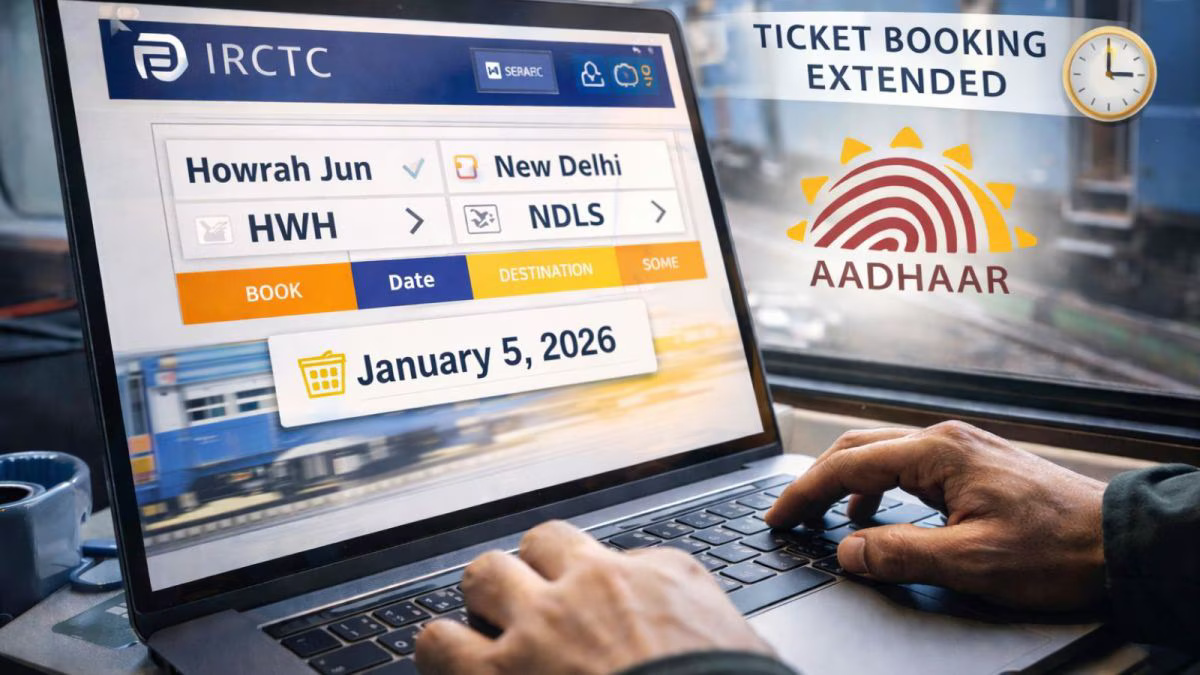
Indian Railways has expanded the reservation access window for Aadhaar-authenticated users on the IRCTC platform, a move that is expected to reshape how millions of passengers plan long-distance rail travel. From January 5, users with Aadhaar-linked accounts will be able to book reserved tickets for a longer duration on the first day of the advance reservation period, signalling a stronger push towards fairness, transparency, and digital accountability in India’s largest public transport system.
Under the revised framework, Aadhaar-authenticated users can access IRCTC ticket booking from 8 am to 4 pm on the day reservations open for a train. Until now, this extended access was limited to noon, with narrower windows in earlier phases of the policy rollout. Railway officials say the change is part of a calibrated effort to ensure genuine passengers—rather than automated agents or tout networks—benefit from the most in-demand booking slots. The policy builds on a series of incremental reforms introduced over the past year. Aadhaar verification was initially mandated for the first few minutes of reservation opening, a period traditionally vulnerable to misuse through high-speed scripts and bulk bookings. Encouraged by early outcomes, the Railways gradually widened the Aadhaar-only window, reflecting confidence in digital identity as a tool for equitable access.
For urban India, where rail remains the backbone of intercity mobility, the implications extend beyond ticketing convenience. Reliable access to reservations is critical for migrant workers, students, and families who depend on affordable long-distance travel. Transport planners note that reducing booking manipulation improves predictability in passenger flows, enabling better scheduling, energy efficiency, and capacity utilisation—key elements of a lower-carbon transport ecosystem. The revised IRCTC ticket booking rules apply only to online reservations made through the official website or mobile application. The process at computerised passenger reservation system counters remains unchanged, ensuring inclusivity for those without consistent digital access. Officials emphasise that the dual-track approach is essential in a country where digital adoption varies widely across regions and income groups.
Alongside booking reforms, Indian Railways has also reiterated its updated norms on reservation chart preparation. Earlier chart finalisation provides passengers with greater clarity on confirmed and waitlisted statuses, reducing last-minute uncertainty and unnecessary station congestion—an often overlooked factor in urban mobility planning. Industry experts view the extended booking window as a signal of institutional maturity in managing large-scale digital infrastructure. With over a million bookings processed daily, IRCTC has become one of the country’s most critical civic platforms, influencing travel behaviour, economic productivity, and regional connectivity.
As Indian Railways continues modernising its passenger interface, the focus is shifting from sheer capacity expansion to system integrity and user trust. The success of the latest IRCTC ticket booking reform will likely shape future decisions on dynamic pricing, demand management, and the integration of rail travel into more sustainable, people-first urban transport networks.
Indian Railways Expands IRCTC Ticket Booking Access