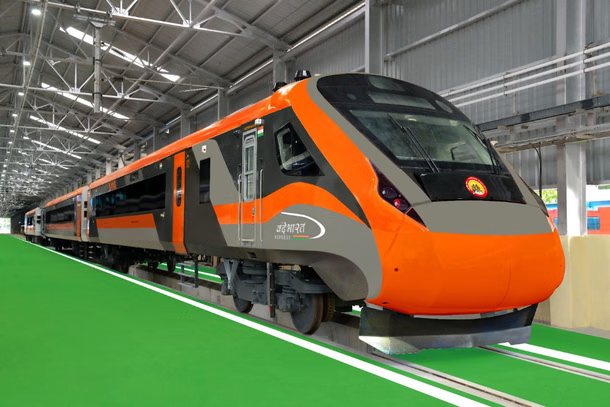
Indian Railways is recalibrating its passenger strategy with a renewed emphasis on non-air-conditioned travel, safety upgrades and service quality, signalling a shift toward mass mobility as demand for affordable rail transport continues to rise across India. The policy direction, discussed at a recent national-level review of transport priorities, reflects the rail network’s central role in supporting inclusive economic growth and low-carbon urban and intercity travel.
Officials familiar with the discussions said the focus on non-AC coaches is driven by both passenger demand and sustainability considerations. While premium services have expanded over the past decade, the bulk of India’s rail users continue to depend on general and sleeper-class travel for daily commuting, seasonal migration and long-distance journeys. Strengthening these services is seen as essential for maintaining railways as the backbone of affordable public transport. Capacity augmentation is a key pillar of the push. Indian Railways has been steadily increasing the manufacturing of non-AC coaches, including modernised sleeper and general coaches with improved ventilation, bio-toilets and safer interiors. Railway planners argue that improving comfort without increasing fares helps retain rail’s competitive edge against road transport, which is more carbon-intensive and often less safe.
Safety upgrades are being positioned alongside capacity expansion rather than as a separate agenda. Officials said investments are being directed toward track renewal, signalling systems and level-crossing elimination, all of which disproportionately benefit non-AC and passenger trains that stop more frequently and operate across dense corridors. Enhanced onboard safety measures, including better lighting, emergency communication systems and improved maintenance protocols, are also being rolled out.
Digitisation has emerged as another enabler of the shift. Platforms that streamline ticketing, grievance redressal and passenger information are being aligned to reduce overcrowding and improve predictability for non-AC travellers. Railways officials note that smoother operations can lower dwell times at stations and reduce operational emissions by cutting unnecessary idling and congestion.
Urban transport experts see the renewed focus as critical for cities and regional economies. Rail corridors connect labour markets to industrial clusters, construction hubs and service centres, enabling workforce mobility at scale. Affordable and reliable trains reduce household transport costs, especially for lower-income groups, while easing pressure on urban road networks already strained by private vehicles.
From a climate perspective, prioritising non-AC rail travel supports India’s broader decarbonisation goals. Non-AC coaches consume less energy per passenger kilometre, and higher rail modal share can significantly reduce emissions compared to road-based alternatives. Planners argue that investments in basic rail services deliver strong returns in both social equity and environmental performance.
Looking ahead, Indian Railways is expected to continue balancing modernisation with affordability, ensuring that service upgrades do not come at the cost of accessibility. The success of the strategy will depend on consistent funding, coordination with state transport systems and sustained attention to passenger experience. As demand for mobility grows alongside urbanisation, strengthening the everyday train journey may prove just as transformative as launching the next premium service.
Indian Railways expands focus on affordable passenger travel