


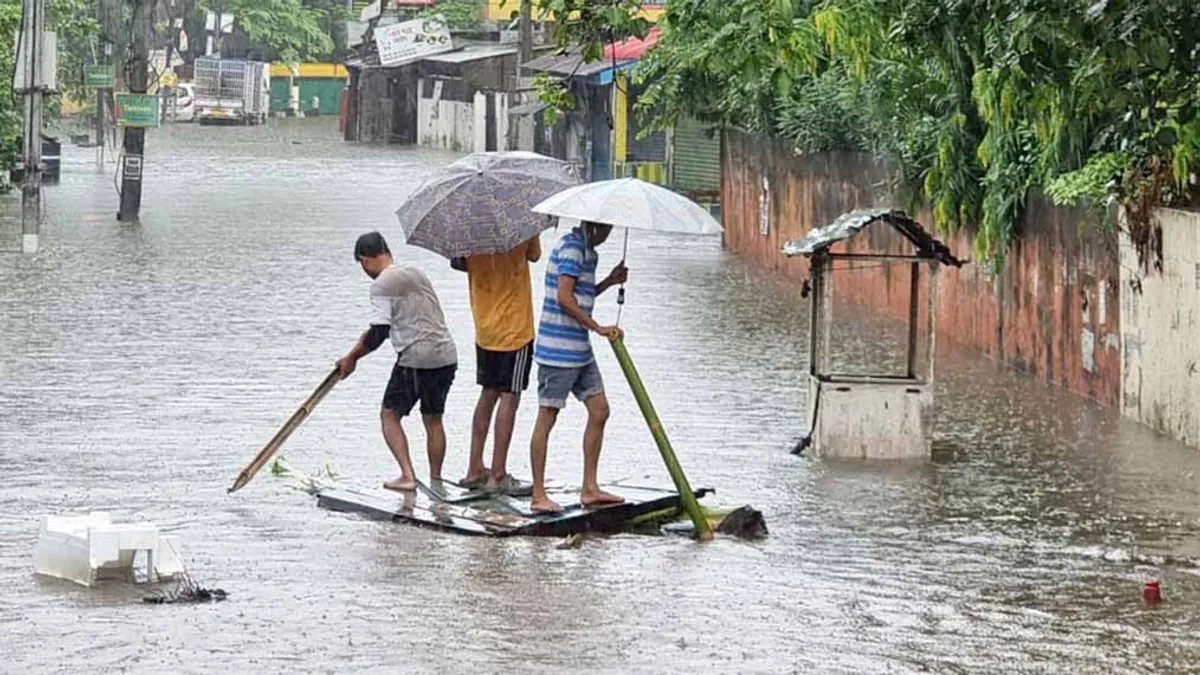
India’s major cities: waterlogged roads, stranded commuters, paralysed traffic, and homes submerged in rainwater. From Delhi and Mumbai to Bengaluru and Chennai, urban flooding is no longer an occasional hazard—it has become a structural reality.
The distressing scenes that unfold every year are not the product of sudden cloudbursts or freak weather events alone, but of years of unsustainable urbanisation marked by rampant concretisation.The increasing impermeability of Indian cities is a crisis of their own making. While authorities often point to inadequate and ageing drainage networks, the deeper challenge lies in the relentless sealing of urban surfaces. Open soil, once crucial for absorbing rainfall and recharging groundwater, has been buried beneath layers of asphalt and cement. Even parks, pavements and road medians—formerly green buffers—have been converted into impermeable surfaces, leaving rainwater with nowhere to go.
Delhi’s outdated stormwater system, still based on a 1976 master plan, was catastrophically overwhelmed last year when a single rain event brought 228 mm of precipitation. But it’s not just legacy infrastructure at fault; it is the dramatic loss of pervious ground that is choking the city. Satellite data suggests that in several metros, green cover has shrunk by over 80 percent over the past two decades. The result is a cityscape where even moderate rainfall overwhelms the system, flooding roads within minutes and causing significant economic and human disruption.
According to the National Disaster Management Authority, nearly half of all urban flood events in India over the last decade are directly linked to excessive surface sealing and drainage failures. Despite these warnings, few cities have implemented mandatory measures to integrate climate-resilient urban design. Mumbai only made soak pits compulsory in 2023, and even then, enforcement remains inconsistent.In Bengaluru, tech parks and upscale neighbourhoods alike faced widespread flooding in 2022. Chennai continues to reel from water stagnation despite substantial investments in stormwater projects. These examples point to a systemic failure—not just of infrastructure, but of planning, coordination, and ecological understanding.
In contrast, cities like Wuhan, Berlin, and Singapore are embracing green, permeable infrastructure to counter flooding. China’s ‘Sponge City’ initiative is reimagining urban areas as absorptive systems using green roofs, wetlands, and permeable pavements to retain up to 70 percent of rainfall. Berlin mandates sponge-city principles in all new developments, while Singapore’s ABC Waters programme has transformed flood zones into sustainable water landscapes.For Indian cities, the path forward must prioritise permeability. Roads and pavements must be constructed with porous materials, bioswales and soak pits must become standard urban features, and hydrological mapping should inform every land-use decision. Guidelines from the Indian Roads Congress already support these approaches, but poor enforcement and fragmented governance dilute their impact.
Urban flooding must no longer be seen as an inevitable monsoon side-effect. It is the product of poor choices, weak regulation, and short-term thinking. To reverse this, city planners must treat green infrastructure not as beautification but as vital civic investment for climate resilience. A unified flood management strategy that cuts across departments and jurisdictions is long overdue.
Indian cities are at a tipping point. Every monsoon that passes without reform deepens the vulnerability of millions. Unless cities urgently move towards eco-sensitive, low-carbon design, the future will not just be wetter—but unliveable. The rains will keep coming. It’s time Indian cities stopped sinking.
Also Read : Mumbai’s Colaba Records 161.9 mm Rainfall in 24 Hours
