


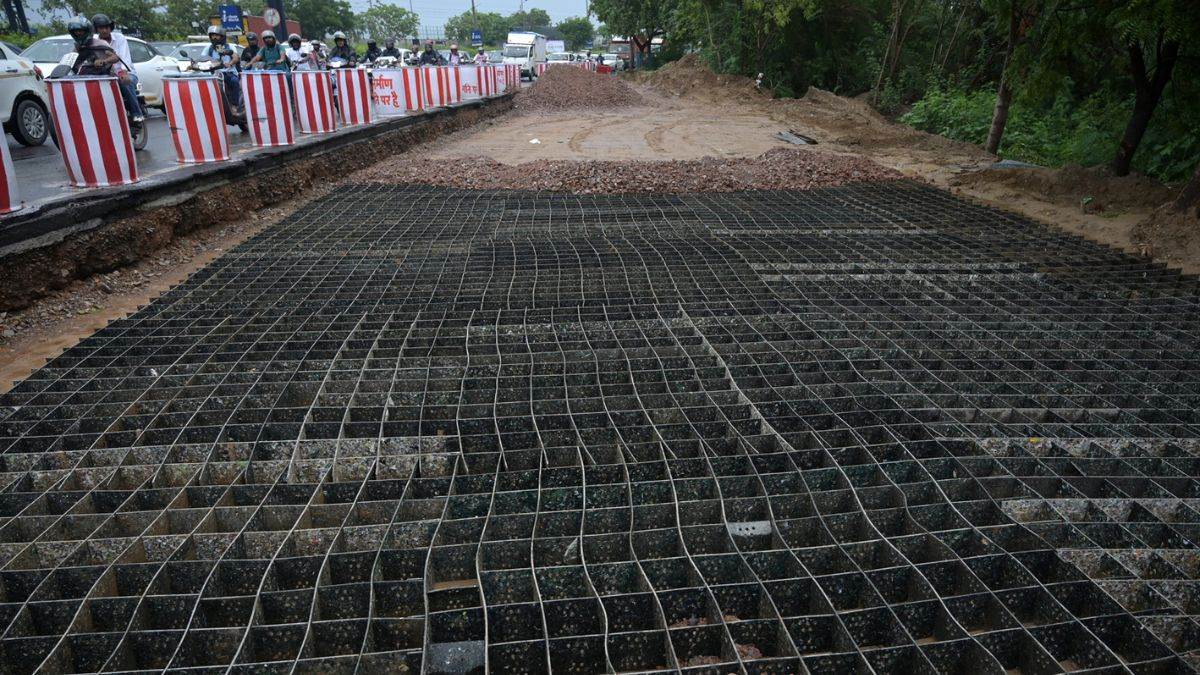
Sustainable infrastructure development and waste management, India has launched its first field trial employing an innovative technology that transforms end-of-life plastic into robust geocells for road construction, particularly in challenging terrains. This groundbreaking initiative, a collaborative effort between the Central Road Research Institute (CRRI) and Bharat Petroleum Corporation Limited (BPCL), marks a pivotal moment in the nation’s quest for eco-friendly urban and regional development, promising to tackle plastic pollution while enhancing road durability.
The innovation centres on “Geocells” – three-dimensional, block-shaped modules meticulously crafted from mixed and end-of-life plastic waste, a category notoriously difficult to recycle. These modules, designed to be filled with soil or construction debris, are set for rigorous field trials with the Military Engineering Services (MES) starting in August. This strategic partnership aims to demonstrate the efficacy and resilience of these geocells in high-stress, hard-to-access regions, showcasing their potential to revolutionise road building in India’s diverse geographical landscape.
A pilot demonstration has already been successfully conducted near the DND-Faridabad-KMP Expressway, validating the core concept. According to Ankita Behl, Principal Scientist at CSIR-CRRI, the challenge lay in processing diverse quality waste plastics through mechanical recycling to produce consistent modules with thicknesses ranging from 4-8 mm. Extensive laboratory testing and plant trials, conducted in collaboration with TATA Projects and supported by the National Highways Authority of India (NHAI) on a 160-metre road section, have shown promising results, with no signs of cracks or deformation detected under load-bearing tests.
This pioneering technology offers a multi-faceted solution that aligns perfectly with the agenda of creating zero net carbon and sustainable cities. By repurposing plastic waste that would otherwise contribute to landfills and environmental degradation, it significantly reduces the ecological footprint of road construction. Furthermore, its application in difficult terrains—often remote areas—can foster more equitable access and connectivity, bridging geographical divides and contributing to inclusive development. The ingenuity lies not just in waste utilisation but also in creating a superior engineering product that promises enhanced structural performance and longevity for India’s extensive road network.
The joint patent held by CSIR-CRRI and BPCL underscores the nation’s commitment to indigenous innovation for environmental stewardship. This project moves beyond conventional plastic road applications by utilising technical textiles made entirely from end-of-life plastic, including multi-layered plastics which were previously excluded from Indian Roads Congress (IRC) specifications. As India continues to expand its infrastructure, such advancements are critical for building a resilient, eco-conscious, and connected society, transforming waste from a liability into a valuable resource that paves the way for a greener, more sustainable future.
Also Read: Union eases FGD norms slashing power tariffs by paise 25–30 unit
