


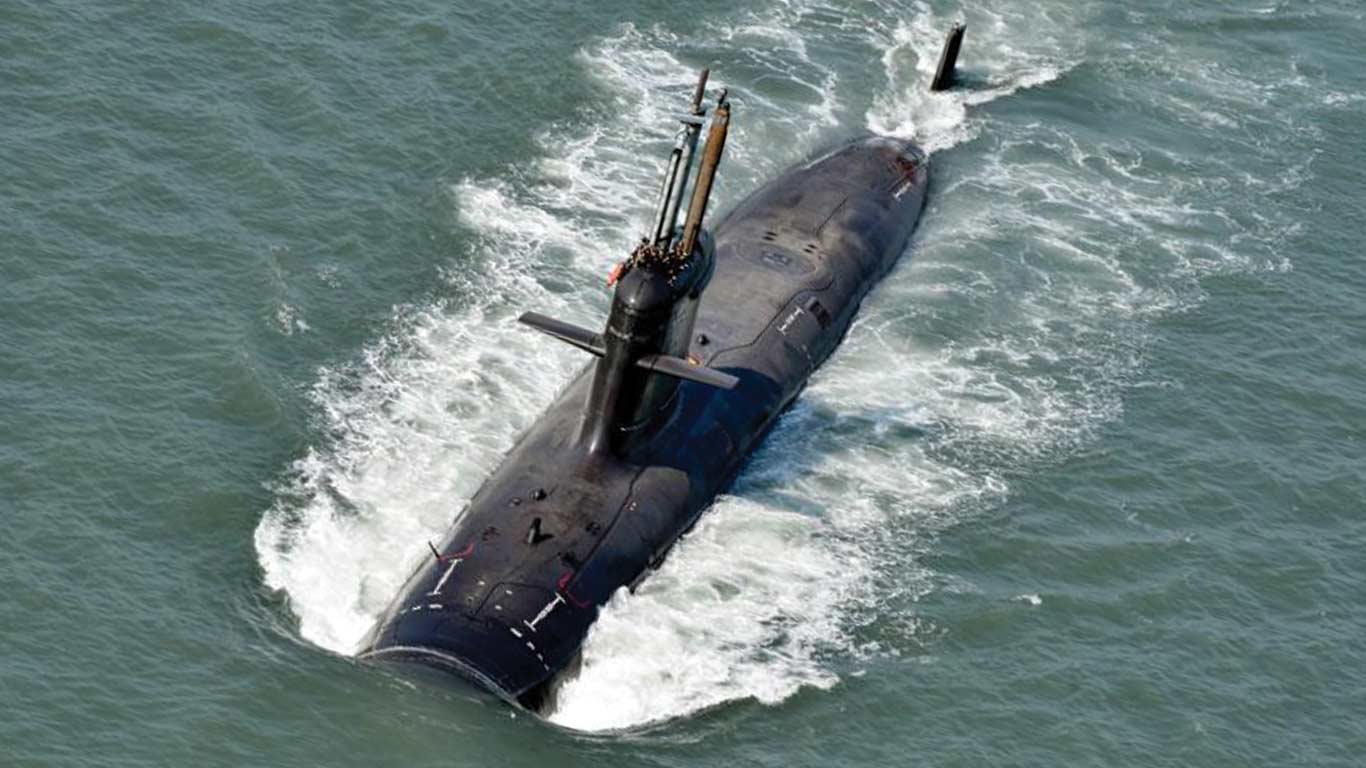
India is moving towards finalising two landmark submarine acquisition programmes worth over ₹1 lakh crore, marking one of the largest defence modernisation efforts under the government’s Make in India initiative. The deals are expected to substantially enhance the Indian Navy’s undersea warfare strength at a time when the Indian Ocean Region faces mounting strategic challenges.
The first project, already cleared by the Defence Ministry, involves the construction of three additional Scorpene-class submarines under Project-75. These diesel-electric submarines are to be built at Mazagon Dock Shipbuilders in collaboration with France’s Naval Group. Valued at around ₹36,000 crore, the programme is seen as a follow-on to the six Scorpenes that have already been commissioned, with the final signing expected once technical and commercial negotiations conclude. Running parallel to this, a second, much larger plan — the ₹65,000 crore Project-75 (India) or P-75(I) — is also moving forward. This project will deliver six next-generation stealth submarines equipped with advanced propulsion and weapons systems. The ambitious programme, which has been in the pipeline since 2021, is intended to be a cornerstone of India’s long-term maritime security strategy. However, officials familiar with the matter expect negotiations on cost and execution to continue for six to nine months before a final agreement is sealed.
Together, the two contracts represent more than just defence expenditure. They signal a strong push towards indigenisation, with domestic shipyards expected to play a significant role. Industry experts note that the scale of these projects will not only boost the Navy’s submarine fleet but also deepen the transfer of critical technologies to Indian industry. This is in line with India’s stated goal of reducing dependence on foreign imports and fostering self-reliance in advanced defence manufacturing. Strategically, the acquisitions assume greater significance as India faces increasing Chinese naval deployments in the Indian Ocean. With Beijing rapidly expanding its submarine fleet, analysts argue that India must accelerate its own modernisation to maintain balance in regional waters. Officials underscore that the forthcoming submarines will provide the Navy with a crucial edge in stealth, endurance, and strike capabilities.
The deals also highlight the growing intersection of security and economic policy. By binding together national defence imperatives with industrial growth and employment generation, the projects are expected to create a multiplier effect across India’s shipbuilding and ancillary sectors. While cost negotiations remain complex, defence planners view the expenditure as an investment in both security and strategic autonomy. If concluded within the projected timelines, the submarine programmes could transform India’s maritime posture in the next decade. For a country seeking to safeguard its trade routes, protect its coastline, and assert its influence in the Indo-Pacific, these acquisitions represent a decisive step forward.
Also Read: HC Orders Urgent Demolition Of Collapsing Buildings In Vasai Following Safety Warnings
