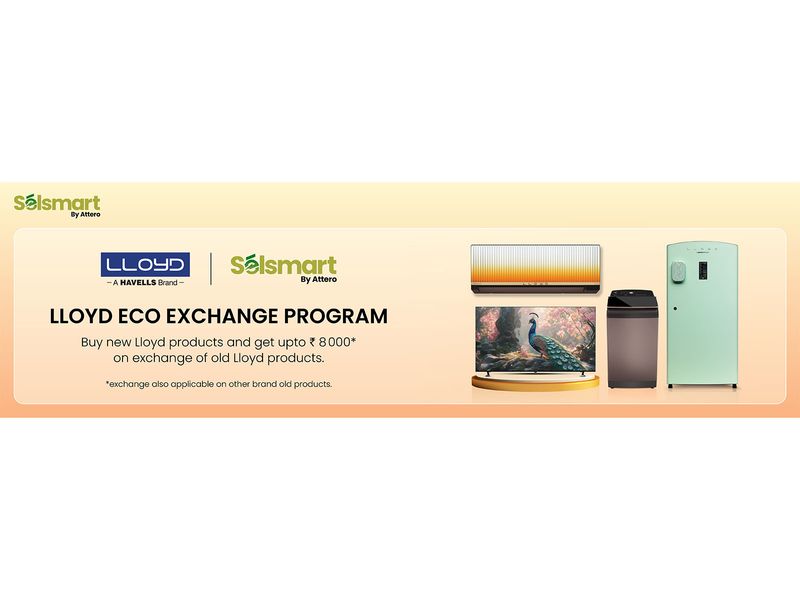
India Selsmart And Lloyd Drive Responsible Appliance Exchange
In a bid to reduce e‑waste and promote responsible consumer behaviour, a new Lloyd Eco Exchange Program has been rolled out across India through a collaboration between sustainable recycling platform Selsmart by Attero and consumer durables brand Lloyd from Havells India. The initiative is designed to make appliance upgrades more sustainable by offering consumers economic incentives to exchange old devices and ensure they are recycled through scientific processes rather than discarded in landfills.
The programme enables households to bring in end‑of‑life appliances — including air conditioners, refrigerators, washing machines and televisions of any brand — to participating Havells and Lloyd outlets, where devices are instantly valued and consumers receive immediate credit that can be applied towards the purchase of new Lloyd products. Organisers say the scheme will unfold progressively through partner retail networks, expanding accessibility beyond metropolitan centres into smaller cities where sustainable practices are needed most. For urban planners and sustainability advocates, the initiative ties directly into the challenge of managing electronic waste, a growing environmental and health concern. India’s formal e‑waste recycling capacity has been expanding as platforms such as Selsmart streamline consumer participation, but formal collection still accounts for a fraction of the total waste generated annually, with industry estimates suggesting the need for much greater material flow and investment to scale operations nationwide.
Selsmart, launched in 2024 as a direct‑to‑consumer take‑back model, already operates in over 25 cities and handles tens of thousands of collection orders every month. With an aim to integrate circular economy principles into everyday purchasing decisions, the platform offers doorstep pick‑ups, traceability and fair resale values — features that help demystify recycling for households and encourage participation. Once collected, devices are processed at advanced Attero facilities using a combination of mechanical, hydrometallurgical and pyrometallurgical methods that recover valuable metals with high purity. Recovery systems can extract critical materials including copper, gold, silver and battery metals — inputs increasingly in demand for energy storage, electronics manufacturing and clean technologies. Recovered materials are reintegrated into domestic supply chains, supporting both circularity and strategic industrial self‑reliance.
Beyond environmental impact, the exchange scheme represents a behavioural nudge in a market where appliance replacement cycles are shortening amid rising incomes and urbanisation. Providing consumers with tangible economic value at the point of exchange — rather than relegating old products to informal channels — helps internalise the cost of responsible disposal and reduces pressure on overstretched landfill infrastructure. Industry experts caution that scaling such models will require expanded regulatory frameworks and greater public awareness. Extended Producer Responsibility (EPR) regulations already mandate manufacturers to manage end‑of‑life products, but gaps remain in implementation and consumer engagement, particularly outside major cities. Strengthened incentives and logistics linkages could accelerate adoption and spur investment into recycling infrastructure.
As the programme expands, its success could inform broader strategies for embedding circular economy practices in consumer markets. By aligning economic incentives with sustainability outcomes, such initiatives may help cities reduce waste burdens, preserve resources and catalyse localized recycling ecosystems that support both environmental and industrial goals.