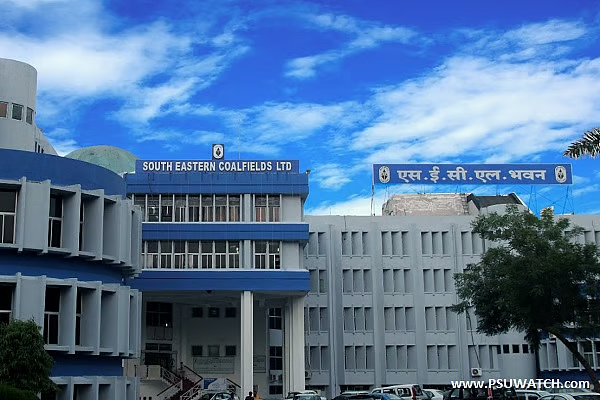
India SECL Production Growth Strengthens Coal Supply
South Eastern Coalfields Limited (SECL), a key subsidiary of Coal India Limited, has reported a notable rise in production and dispatches for FY26, underscoring the growing demand for coal in India’s energy and infrastructure ecosystem. The performance positions SECL as a critical contributor to meeting the country’s increasing electricity needs, particularly as urban consumption and industrial activity expand.The company recorded coal production of approximately 176.2 million tonnes during the fiscal year, marking a 5.26% increase compared to the previous year. Alongside this, coal offtake rose by 4.6% to around 178.6 million tonnes, indicating stronger supply to power plants and industrial users.
SECL also achieved its highest-ever overburden removal—an operational benchmark that reflects improved mining efficiency and capacity utilisation. The company stands out as the only Coal India subsidiary to report growth across all three key operational parameters: production, dispatch, and overburden removal. The growth comes at a time when India’s energy demand is being shaped by rapid urbanisation, rising temperatures, and increased infrastructure activity. Coal continues to remain the backbone of electricity generation, supplying the majority of the country’s power needs and supporting sectors such as construction, transport, and manufacturing.Urban development experts highlight that improved coal output has direct implications for city economies. Reliable fuel supply ensures uninterrupted power for residential cooling, industrial operations, and infrastructure execution—particularly during peak demand periods such as summer months.
SECL’s performance also reflects a broader operational push within Coal India to enhance productivity through better mine planning, mechanisation, and workforce efficiency. The company operates across Chhattisgarh and Madhya Pradesh, regions that are central to India’s coal production landscape and energy supply chain.However, the expansion of coal output continues to raise long-term sustainability considerations. While higher production supports immediate energy security, it also underscores the challenge of balancing fossil fuel dependence with climate commitments. Urban planners note that as cities grow, the pressure to transition towards cleaner energy systems will intensify, even as coal remains indispensable in the near term.At the same time, SECL is exploring diversification strategies, including potential engagement in new energy segments, signalling an early shift towards a more balanced energy portfolio. This reflects a broader industry trend where traditional energy companies are beginning to align with evolving environmental and policy expectations.
From an infrastructure perspective, the company’s growth supports stability in sectors reliant on consistent power supply, including cement, steel, and construction materials. These sectors are essential to India’s urban expansion, making coal supply a foundational element of development.Looking ahead, SECL’s trajectory will be closely tied to how effectively it can sustain production growth while adapting to changing energy dynamics. As India advances its infrastructure ambitions and climate goals simultaneously, the role of coal producers will increasingly be defined by their ability to balance scale with sustainability.