


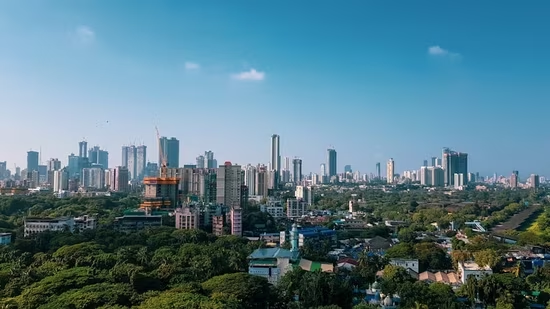
India’s residential property market has emerged as a global outlier, recording one of the fastest rates of price growth worldwide even as several international housing markets remain subdued. Annual home price appreciation touched nearly 10 per cent, placing India among the strongest performers globally and highlighting the resilience of domestic urban demand.
This momentum has been underpinned by sustained sales volumes across the country’s largest cities. Residential transactions in major urban centres remained stable through 2025, with the second half of the year marking the strongest activity levels seen in over a decade. Analysts interpret this as evidence that end-user demand rather than speculative buying continues to anchor the market. Market balance indicators have remained relatively healthy despite rising inventory levels. While unsold stock has increased, this is largely attributed to the launch of higher-value projects rather than weak absorption. The average time required to clear existing inventory has remained broadly unchanged, suggesting that supply and demand are still aligned. Price growth has not been uniform. Northern and southern markets led the uptrend, reflecting regional economic drivers, infrastructure expansion, and employment growth. The National Capital Region recorded the steepest rise, followed by southern technology hubs, while Mumbai despite its high base continued to post steady appreciation. Urban economists note that this pattern mirrors job creation trends and the expansion of knowledge-based industries. A notable shift in buyer behaviour has reshaped the market’s composition. Homes priced above Rs 1 crore now account for roughly half of all residential sales in major cities, signalling rising household incomes and an increased willingness to pay for larger, better-designed homes. This transition has also encouraged developers to focus on execution quality, project completion timelines, and financing support rather than aggressive price discounts.
From a broader urban development perspective, the trend reflects a maturing housing cycle. Cities are seeing greater demand for mid- to premium-segment homes that offer improved liveability including better ventilation, access to green spaces, and proximity to employment clusters. Such preferences align with the growing emphasis on climate resilience and healthier urban living environments. Macroeconomic stability has played a critical role. Easing borrowing costs, controlled inflation, and steady income growth have improved affordability, allowing households to absorb higher prices without excessive leverage. This has insulated India’s housing market from the volatility affecting several global peers where affordability pressures remain acute. Looking ahead, analysts expect residential growth to moderate rather than reverse. Price appreciation is likely to be selective, driven by location quality, infrastructure access, and developer credibility. Supply pipelines are also becoming more disciplined, reducing the risk of overheating.
For India’s cities, the challenge now lies in ensuring that rising values translate into inclusive and sustainable urban growth. As housing markets strengthen, attention will need to shift toward expanding affordable supply, improving transit connectivity, and embedding climate-sensitive planning into residential development ensuring that resilience grows alongside prosperity.
Also Read: India US Trade Reset Lifts Real Estate Outlook
India Residential Market Shows Global Outperformance
