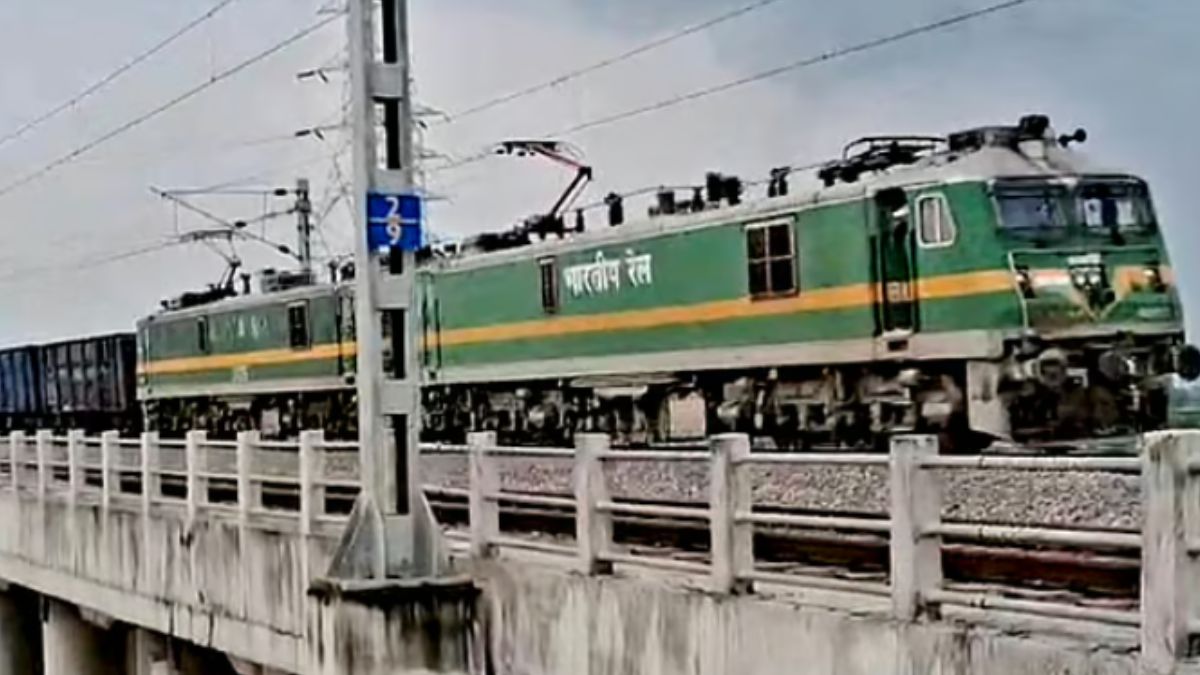
India Railways Trials Asia’s Longest Freight Train Linking Kashmir Valley
Indian Railways is accelerating its modernisation drive with three landmark milestones the trial of Asia’s longest freight train, the foundation of a mega rail coach manufacturing hub in Madhya Pradesh, and the arrival of the first freight service in the Kashmir Valley signalling a transformative leap for the country’s freight and passenger connectivity.
The trial run of ‘Rudrastra’, a 4.5-kilometre-long freight train, recently marked a breakthrough in India’s rail freight capabilities. Operated in the East Central Railway zone, the train was assembled by linking six box rakes and propelled by seven locomotives. Covering 209 kilometres between Uttar Pradesh and Jharkhand in just over five hours, the massive formation carried 345 wagons, optimising both fuel efficiency and manpower. Officials believe this innovation will significantly reduce logistical bottlenecks, paving the way for faster and greener cargo transport.While still behind Australia’s 7.3-kilometre freight record, ‘Rudrastra’ strengthens India’s position among nations equipped with advanced long-haul freight technology. With India’s freight network being a crucial artery for economic growth, the development reflects a shift towards higher capacity trains that can move more goods per journey, reducing carbon emissions per tonne-kilometre.
In another major step, Madhya Pradesh is set to house a ₹1,800-crore rail coach manufacturing hub by Bharat Earth Movers Limited (BEML). Spread across more than 60 hectares in Umaria village, the ‘Brahma’ facility aims to produce coaches for Vande Bharat, Amrit Bharat and metro trains. The plant is projected to create over 5,000 jobs and will start with an annual capacity of up to 200 coaches, scaling to 1,100 within five years. Industry experts say the plant could reduce India’s reliance on imports and help meet the surging demand for modern, energy-efficient rolling stock.Adding to the momentum, the Kashmir Valley has been linked to the national freight grid for the first time, with a goods train from Punjab arriving at Anantnag Goods Shed. This inaugural freight service covered nearly 600 kilometres in under 18 hours, delivering cement and bypassing the unpredictable Srinagar–Jammu highway. The route forms part of the Udhampur–Srinagar–Baramulla Rail Link (USBRL) project, which is expected to revolutionise freight movement in the region by ensuring all-weather, low-emission connectivity.
From long-haul freight innovations to manufacturing localisation and the integration of remote regions into the rail network, these developments represent a unified push towards an eco-friendlier, more self-reliant, and inclusive transport ecosystem. Analysts note that such milestones not only enhance economic efficiency but also bring India closer to its vision of sustainable mobility, making railways a central pillar of the nation’s green growth agenda.