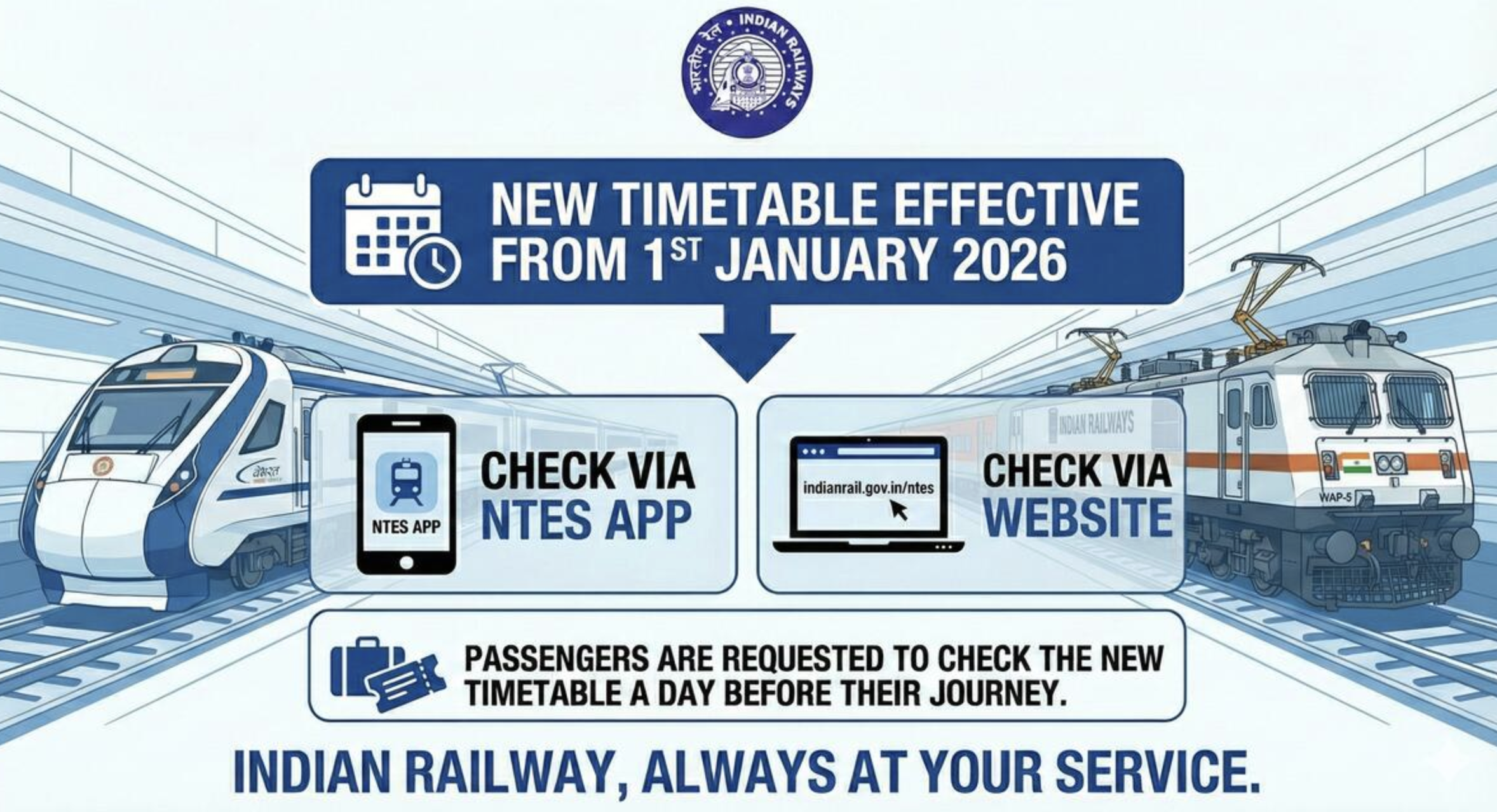
Indian Railways has introduced a nationwide timetable reset for 2026, marking one of its most extensive operational recalibrations in recent years. The revised schedule, implemented under the Timetable of Trains 2026 framework, expands services while reducing travel time on hundreds of routes—an effort that directly affects daily commuters, long-distance travellers, and regional economies reliant on rail connectivity.
The new timetable brings 122 additional passenger services into operation across categories, alongside speed enhancements for 549 existing trains. Railway officials describe the exercise as a system-wide attempt to improve punctuality, optimise asset use, and align train operations more closely with evolving passenger demand patterns rather than static, legacy schedules. A significant share of the new additions falls within the Mail and Express segment, reflecting continued demand for affordable intercity travel across medium and long distances. At the same time, the network has been reinforced with newer-generation services, including semi-high-speed and modern long-distance trains, aimed at improving comfort and reducing end-to-end journey time on high-density corridors. Several of these services have been introduced through a flexible “time-on-demand” approach, allowing capacity to respond more dynamically to traffic growth.
Speed rationalisation forms the core of TAG 2026. Over five hundred trains now operate with revised run times, achieved through a mix of better pathing, reduced halts, infrastructure upgrades, and improved signalling coordination. Rail planners note that while some time savings are incremental, cumulative reductions across busy corridors can translate into meaningful reliability gains, particularly where delays cascade across the network. The scale of change varies across zones, reflecting uneven demand growth and infrastructure readiness. Rail systems in southern and western India account for a large proportion of accelerated services, while northern and eastern zones have seen a higher share of new introductions and route extensions. This differentiated approach, officials say, is intended to balance regional equity with operational feasibility.
Urban and transport economists point out that timetable reforms are often overlooked compared to headline infrastructure projects, despite their outsized impact. Faster and more predictable trains reduce logistics costs, improve labour mobility, and strengthen the economic integration of smaller cities with metropolitan centres. From a climate perspective, improving rail efficiency is critical to keeping passenger and freight movement aligned with India’s low-carbon transport goals. For passengers, TAG 2026 translates into shorter journeys on many routes, more choice across service categories, and improved frequency in select corridors. However, experts caution that timetable gains must be sustained through maintenance discipline and capacity augmentation, particularly on saturated sections where even small disruptions can erode punctuality gains.
Railway officials indicate that the revised timetable will continue to be monitored through performance data and passenger feedback, with scope for mid-cycle adjustments. As travel demand rises with urban expansion and economic recovery, TAG 2026 underscores a strategic shift: treating time as infrastructure, and efficiency as a public service outcome rather than an internal operational metric.
India Railways Timetable 2026 Brings Faster Journeys