


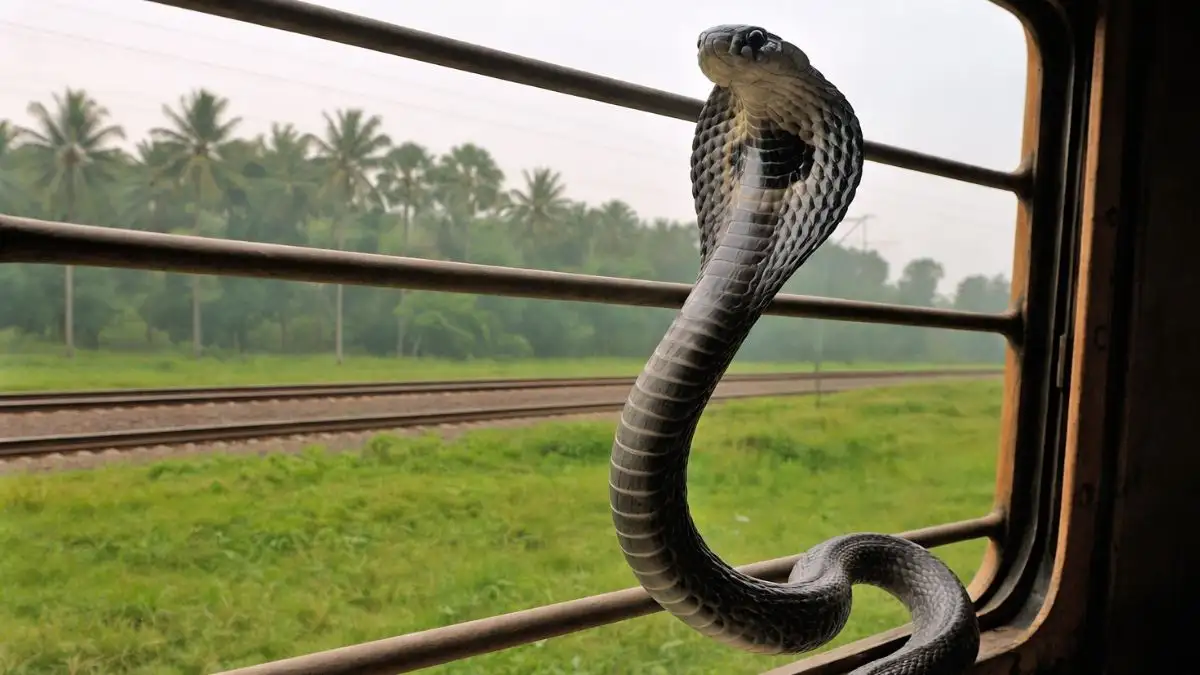
India’s vast railway network, long viewed as a backbone of economic integration and low-carbon mobility, is facing new scrutiny over its unintended ecological consequences. Recent scientific findings suggest that freight and passenger trains may be inadvertently transporting king cobras across regions, relocating the species into unfamiliar and often unsuitable habitats. The revelation raises complex questions about infrastructure-led connectivity, biodiversity protection, and how urban and transport planning intersects with fragile ecosystems.
The concern emerges from field-based research tracking snake rescue data and movement patterns across multiple states. Wildlife researchers have observed that king cobras, attracted to warm and sheltered spaces, sometimes enter stationary rail coaches or cargo wagons. When trains travel hundreds of kilometres, the snakes can be displaced far beyond their native ecological range, increasing risks to both human settlements and the animals themselves. For cities and towns along railway corridors, the implications are not trivial. Urban expansion already places pressure on surrounding forests and wetlands, compressing wildlife habitats into shrinking pockets. Accidental translocation through rail infrastructure compounds this stress, introducing apex predators into peri-urban or agricultural zones ill-equipped to support them. Urban planners warn that such disruptions can heighten human-wildlife conflict, strain local rescue networks, and destabilise existing biodiversity balances. Transport economists note that railways remain one of India’s most energy-efficient freight systems, critical to reducing emissions compared to road transport. However, the findings underscore that sustainability must extend beyond carbon metrics. “Green infrastructure must also be biodiversity-sensitive infrastructure,” observes an urban ecology expert, pointing out that linear projects like railways can function as both connectors and disruptors of natural systems.
The issue also reflects gaps in operational protocols. While forest departments and rail authorities coordinate on elephant corridors and large mammal movement in select zones, smaller and less visible species often fall outside mitigation frameworks. Wildlife professionals argue that routine inspection of idle rolling stock, improved sealing of cargo wagons, and staff training could significantly reduce accidental animal transport without affecting rail efficiency. From a governance standpoint, the study adds urgency to calls for integrated land-use planning. As cities densify and logistics hubs expand, railway yards increasingly sit adjacent to human habitation and degraded forest edges. These transitional landscapes become entry points for wildlife, highlighting the need for buffer zones, habitat restoration, and cross-sector coordination between urban bodies, transport agencies, and environmental regulators. There are also social dimensions. King cobras are culturally significant yet feared, and sudden appearances in unfamiliar regions can trigger panic, retaliatory killings, or unsafe rescue attempts. Community awareness programmes, coupled with rapid response teams, are essential to protect both residents and wildlife.
Looking ahead, experts suggest that India’s infrastructure growth phase presents an opportunity rather than a constraint. Embedding biodiversity audits into transport operations, leveraging technology such as thermal sensors in yards, and aligning railway expansion with regional ecological maps could help reconcile mobility goals with conservation needs. As climate change accelerates species movement and habitat shifts, the episode serves as a reminder that resilient cities and transport systems must anticipate ecological feedback loops — not just economic demand. The challenge for India’s rail-led development model will be to ensure that connectivity strengthens human opportunity without quietly unsettling the natural systems cities depend on.
Also Read: Ahmedabad Rail Network Faces Compliance Challenge
India Railways Linked To Wildlife Habitat Disruption
