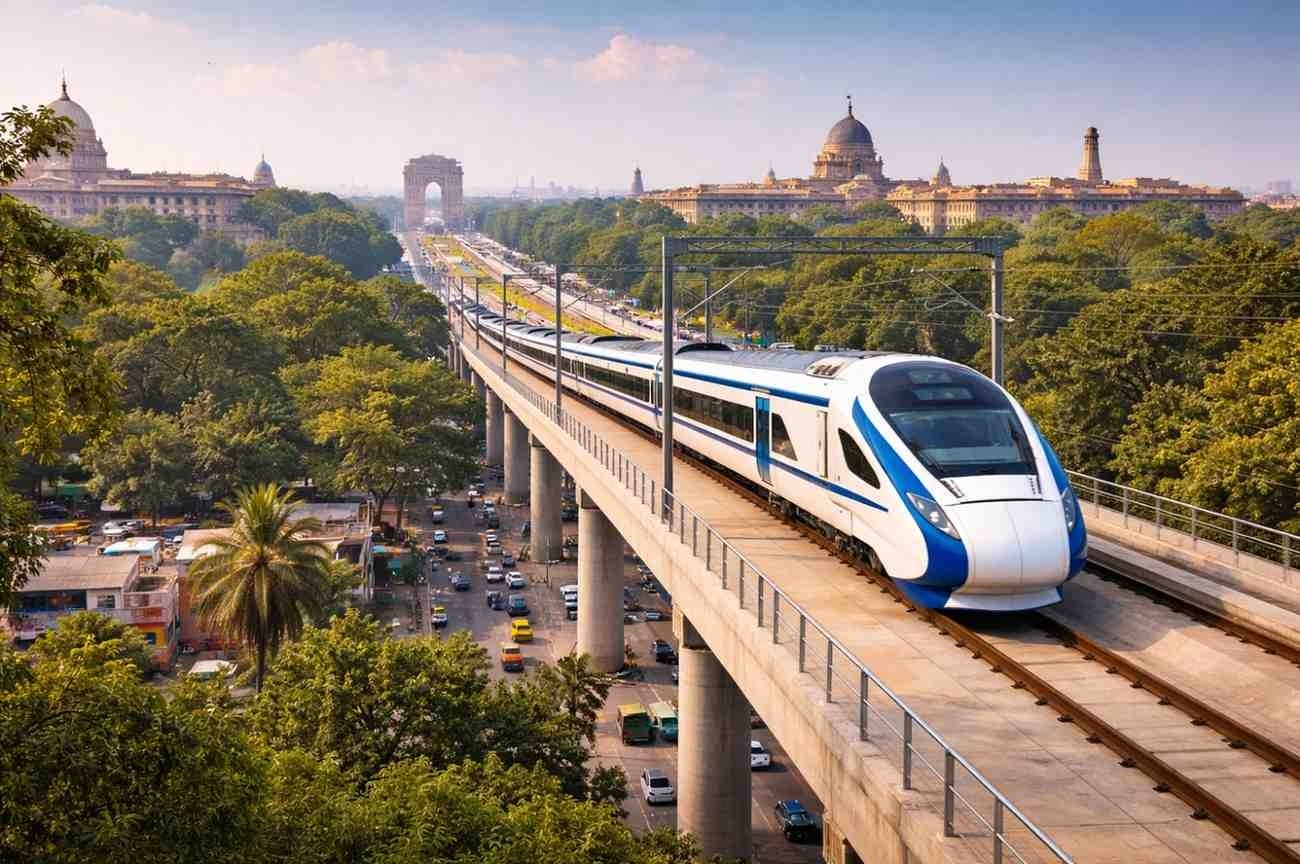
India’s national transport strategy is entering a new phase as policymakers refine plans for future high speed rail corridors, placing greater emphasis on routes that demonstrate stronger demand potential and operational viability. Recent policy deliberations linked to the Union Budget indicate that the proposed Delhi–Varanasi corridor has emerged as a priority alignment, while some previously discussed routes are being reconsidered or redesigned. Officials familiar with the planning process say the shift reflects a deeper assessment of travel demand patterns, project feasibility and financial sustainability. High-speed rail networks require substantial upfront investment in specialised infrastructure, including dedicated tracks, advanced signalling systems and purpose-built stations. As a result, corridor selection is increasingly being guided by passenger volumes, connectivity potential and long-term economic impact.
Under the revised strategy, the Delhi–Varanasi alignment is expected to remain one of the central components of India’s high speed rail corridors roadmap. The route would link major population centres across northern India, potentially reducing travel times dramatically between the national capital and one of the country’s most visited cultural and economic hubs. Transport planners say such corridors are designed not only to speed up passenger movement but also to reshape regional development patterns. By connecting cities within a few hours of travel, high-speed rail can encourage economic integration, strengthen tourism flows and create new investment zones around station areas. At the same time, certain previously proposed alignments are undergoing revision. One example under review involves a route that originally connected Mumbai with Nagpur, which is now being reconsidered with a focus on improving connectivity between Mumbai and Pune. Industry analysts note that corridor modifications often occur during early planning stages as feasibility studies identify more viable passenger markets or engineering conditions.
The preparation of detailed project reports for several high speed rail corridors has been led by the national agency responsible for bullet train infrastructure development. These reports typically evaluate engineering design, land acquisition requirements, environmental considerations and projected ridership levels before a project moves into implementation. Urban infrastructure specialists emphasise that high-speed rail development is closely tied to broader goals of sustainable mobility. Electrified high-speed trains can offer lower per-passenger emissions compared to short-haul flights or private car travel, particularly when integrated with urban transit systems that enable seamless last-mile connectivity. However, experts also caution that the success of these projects will depend on careful planning around station areas, land use and multimodal connectivity. Without integration with city transport networks, the economic and environmental benefits of high-speed rail may not be fully realised.
For India, the evolving pipeline of high speed rail corridors represents an attempt to modernise long-distance mobility while supporting balanced regional growth. As feasibility studies continue and corridor alignments are refined, the next phase of planning will determine how quickly the country can translate these ambitions into operational high-speed rail services capable of reshaping intercity travel.