Goa Coal Dust Pollution Sparks Urban Health Concerns
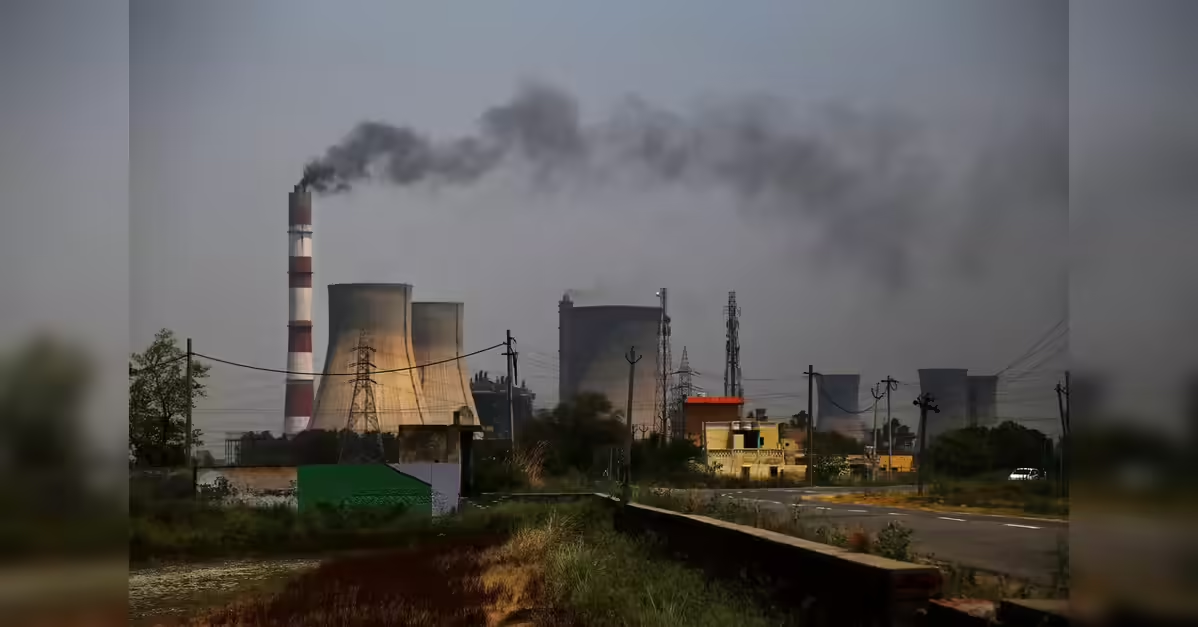
India has outlined plans to add approximately 97 gigawatts (GW) of new coal and lignite-based thermal power capacity by the fiscal year 2034-35, a move designed to ensure reliable electricity supply amid rising demand from urbanisation, industry and electrification of transport. The government’s strategy seeks to balance energy security with the country’s broader renewable and climate commitments, even as the global energy transition accelerates.
According to recent disclosures by the Ministry of Power in Parliament, India’s thermal capacity requirement is forecast to grow to around 307 GW by 2034-35, up from about 212 GW installed in March 2023. To fulfil this need, an additional minimum of 97 GW of coal and lignite-based power plants will be developed, including new projects planned and under construction.This expansion comes against the backdrop of India’s rapid electrification, with peak power demand reaching record levels and supply deficits nearly eliminated in recent months. Installed capacity has surpassed 500 GW, driven by both fossil and non-fossil sources. India’s renewable sector — spanning solar, wind and hydro — has grown substantially, yet coal remains central to meeting baseload and evening peak supply needs.
Energy planners and infrastructure experts describe the additional thermal capacity as a “firming backbone” for the grid: a buffer that operates when variable renewable generation (such as solar and wind) cannot meet demand during non-sunlight hours or periods of low wind. Without sufficient dispatchable capacity, grid stability can be challenged, particularly during industrial demand peaks and in regions with limited energy storage.However, this policy choice also highlights the ongoing tension in India’s energy roadmap. While new coal projects are set to augment supply reliability, they sit alongside equally ambitious renewable goals — including a target of 500 GW of renewable energy capacity by 2030 and a pledge to achieve net-zero emissions by 2070. Energy sector leaders argue that coal capacity expansion is a short-to-medium-term necessity while renewable technologies, grid infrastructure and storage systems scale up.
Notably, a substantial chunk of the planned thermal projects already has momentum: thousands of megawatts have been commissioned since 2023, tens of gigawatts are under active construction, and additional projects are in planning or contracted for future build-out. These developments incorporate both stressed assets and new brownfield capacity.Decarbonisation advocates acknowledge that coal additions can create friction with climate goals, but industry voices stress that expanded capacity may be paired with efficiency improvements and, over time, cleaner technologies such as carbon capture, utilisation and storage (CCUS) or co-firing with biomass. They also see coal’s role evolving as India’s grid flexibility improves. (Analyst commentary)
For cities and regional planners, this dual-track approach has direct implications. Reliable electricity underpins industrial growth, housing expansion, logistics hubs and electrified transport networks. Yet it also raises questions about long-term emissions, air quality and the pace of climate-resilient infrastructure deployment in rapidly urbanising regions.As India navigates this complex energy transition, attention will likely focus on how thermal and renewable capacity can be integrated effectively, and on policies that encourage grid flexibility, storage investment and cleaner generation technologies alongside traditional power sources.