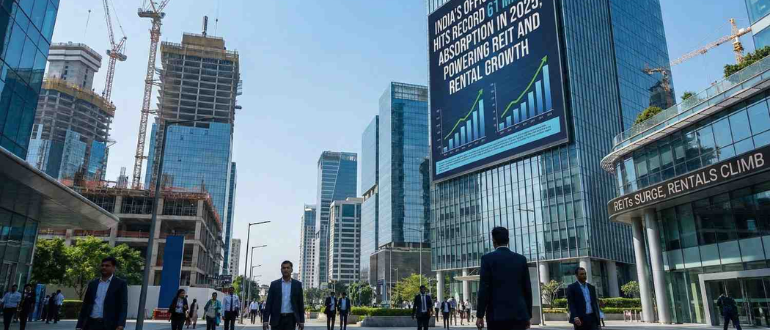
India Office Leasing Growth Signals Resilient Urban Demand
India’s commercial real estate sector opened the year on a firm footing, with office leasing activity rising significantly across the country’s largest urban centres. The increase, recorded during the January–March quarter across seven key cities, points to sustained occupier confidence despite ongoing global economic volatility and evolving workplace strategies.
Data released by a leading real estate consultancy indicates that total office absorption reached 18.3 million square feet during the quarter, marking a notable rise from the same period last year. The uptick in India office leasing growth reflects a combination of corporate expansion, steady hiring in select sectors, and the continued scaling of Global Capability Centres (GCCs), which are increasingly anchoring demand in metropolitan markets.Bengaluru retained its position as the country’s most active office market, driven by technology firms, engineering services, and multinational back-office operations. The city’s performance underscores how established innovation ecosystems continue to attract long-term occupiers, even as companies reassess global footprints. Industry observers note that such demand is not merely cyclical but tied to structural shifts in how firms distribute operations across geographies.
Other cities, including Hyderabad, Pune, and Chennai, also contributed to the broader India office leasing growth trend, supported by competitive rental values and improving infrastructure. Meanwhile, Delhi-NCR and Mumbai saw steady activity, with demand linked to financial services, consulting, and flexible workspace operators adapting to hybrid work patterns.Urban planners suggest that this growth phase presents both opportunity and responsibility. Expanding office footprints can strengthen local economies, generate employment, and improve urban productivity. However, it also raises questions about sustainable land use, transport integration, and energy consumption. As more companies commit to environmental, social, and governance (ESG) goals, there is increasing pressure on developers to deliver energy-efficient, transit-oriented, and climate-resilient commercial spaces. The rise of GCCs has emerged as a particularly influential factor shaping leasing trends. These centres, often set up by global firms to manage technology, finance, and operations functions, are driving demand for high-quality, future-ready office environments. Their growth is also encouraging cities to upgrade digital infrastructure and urban services, reinforcing the link between real estate and broader urban development.
At the same time, flexible workspace providers continue to expand, reflecting a shift in occupier preferences towards agility and cost optimisation. This evolving demand profile is likely to influence how future office developments are designed, with greater emphasis on adaptability, wellness, and reduced carbon footprints. Looking ahead, the trajectory of India office leasing growth will depend on global economic conditions, corporate hiring trends, and the pace of infrastructure delivery in emerging business districts. For cities, the challenge will be to convert this momentum into inclusive and sustainable growth, ensuring that expanding commercial activity aligns with long-term urban resilience and quality of life.