


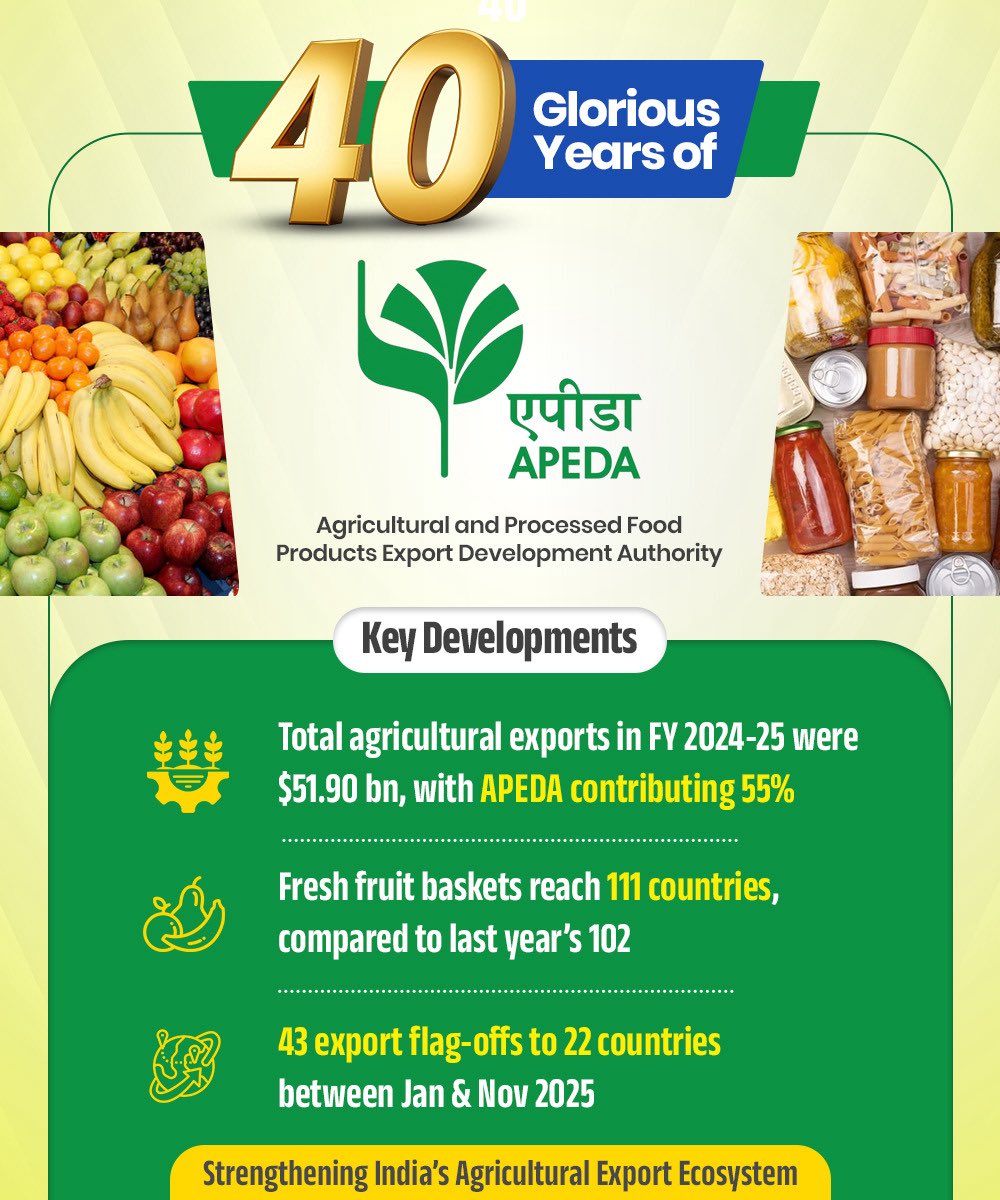
India this week marked four decades of the Agricultural and Processed Food Products Export Development Authority, a statutory body that has shaped the country’s agri-export architecture since the mid-1980s. The milestone comes at a time when agricultural exports have crossed the $50 billion mark, underscoring the sector’s growing weight in trade, rural incomes and food processing investment.
Set up under an Act of Parliament in 1985 and operational from February 1986, the Agricultural and Processed Food Products Export Development Authority was created to streamline and promote overseas shipments of farm and value-added food products. It replaced an earlier export promotion council focused on processed foods, expanding the scope to include fresh produce, cereals, meat, dairy and niche products.Operating under the Ministry of Commerce and Industry, APEDA registers exporters of notified products and issues Registration Cum Membership Certificates, a prerequisite for accessing international markets in several categories. The authority also frames quality norms, oversees inspection systems and supports branding initiatives aimed at positioning Indian produce globally.
Trade economists say APEDA’s role has evolved beyond traditional export facilitation. In recent years, it has supported traceability systems, organic certification and improved packaging standards, all of which are critical in meeting stringent global food safety benchmarks. The authority acts as the secretariat for the National Programme for Organic Production, regulating certification processes that enable Indian organic products to access premium markets.India’s agricultural export basket now spans basmati rice, fruits, vegetables, guar gum, spices, honey, meat products and processed foods. According to industry analysts, coordinated efforts between producers, exporters and regulators have helped expand India’s presence in West Asia, Europe and North America.
From an urban development perspective, the growth of agri-exports has implications for logistics infrastructure. Cold chain facilities, warehousing hubs and port connectivity have gained prominence in peri-urban zones. Experts note that integrating food processing clusters with sustainable logistics systems can reduce wastage, cut emissions and improve farm-to-port efficiency.APEDA also plays a data-driven role, publishing export statistics that inform policy decisions and market planning. Such information is increasingly valuable as climate variability affects crop patterns and global supply chains face disruptions.
Officials from the commerce ministry have indicated that future priorities include expanding value addition, enhancing digital platforms for exporter services and deepening compliance with sustainability standards. As climate resilience becomes central to agriculture policy, export promotion frameworks will likely integrate carbon accounting, water-use efficiency and regenerative farming metrics.Four decades on, APEDA’s trajectory reflects India’s shift from commodity-led exports to diversified, standards-driven agri trade. The next phase will test how effectively the authority aligns export growth with rural prosperity, food safety and environmentally responsible production systems.
Also Read:Saurashtra Cement Operational Pressures Hit Industry
India Marks APEDA 40 Year Milestone
