


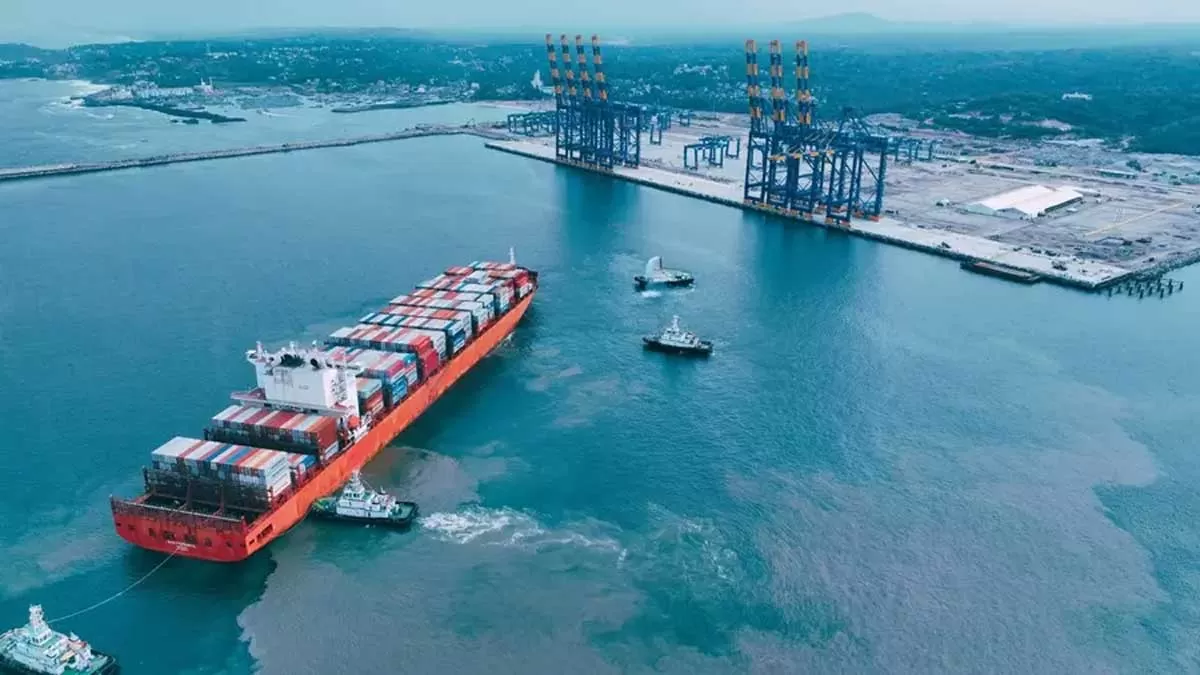
India is set to commission its first deepwater transshipment port at Vizhinjam, near Thiruvananthapuram, Kerala, on May 2. With the formal inauguration scheduled for 11:00 AM, the launch of the Vizhinjam International Seaport marks a strategic leap forward in the country’s maritime and global trade ambitions.
Positioned just 11 nautical miles off a major international shipping corridor, the port is designed to redirect a significant share of global cargo traffic through Indian shores. The Vizhinjam Port, developed with a capital outlay of ₹8,900 crore, is engineered to become a transcontinental shipping gateway. It boasts a natural depth of 20 metres, allowing it to berth the world’s largest container ships, including ultra-large vessels that were previously rerouted to foreign ports such as Colombo, Singapore, and Dubai. With a semi-automated infrastructure and high-capacity handling systems, Vizhinjam is set to become a game-changer in India’s trade logistics ecosystem.
The strategic potential of this port cannot be overstated. Its capacity to process 3 million TEUs (twenty-foot equivalent units) annually—scalable to 4.5 million—offers India a chance to drastically reduce its dependence on transshipment facilities in neighbouring countries. This shift is projected to cut annual logistics costs by approximately ₹2,500 crore, unlocking greater economic value while improving cargo turnaround time. Since its soft launch in July 2024, the port has demonstrated remarkable operational efficiency. With nearly 6 lakh TEUs handled across 285 vessel movements, Vizhinjam has already shown signs of becoming a formidable player in the global shipping circuit. Its commissioning certificate was granted in December 2024, following a series of successful trials.
Developed in a public-private partnership between the Kerala government and a private conglomerate, the project is being heralded as one of the most significant infrastructure ventures in South India. The state contributed ₹5,595 crore, while the private partner infused ₹2,454 crore into the first phase, with expansion investments projected to reach ₹20,000 crore. The port’s design incorporates sustainability principles—optimising energy use, embracing digitalisation, and reducing emissions through advanced logistics management. By shifting a significant volume of shipping closer to India’s own ports, the initiative also cuts the carbon footprint of rerouted cargo, aligning with India’s vision for a net-zero emissions future.
The commissioning event, anticipated to draw extensive public and media attention, will unfold under tight security, with around 2,000 personnel deployed in the area. Beyond the spectacle, however, lies a long-term shift: the transformation of India’s coastline into a high-performance global logistics network. As India eyes its future as a developed, self-reliant economy, Vizhinjam emerges not just as a port, but as a symbol of the country’s maritime resurgence. It combines geography, technology, and vision to redefine India’s global trade presence—offering an indigenous alternative to foreign-dominated routes and strengthening the country’s logistical independence. The activation of Vizhinjam is more than infrastructure; it is a gateway to opportunity, empowering regional development, sustainable trade, and positioning India as a critical node in global maritime commerce.
Also Read :Shipping Ministry Calls for Tax Reforms to Boost Indian Ship Flagging
India Launches Vizhinjam Port to Strengthen Global Trade Role
