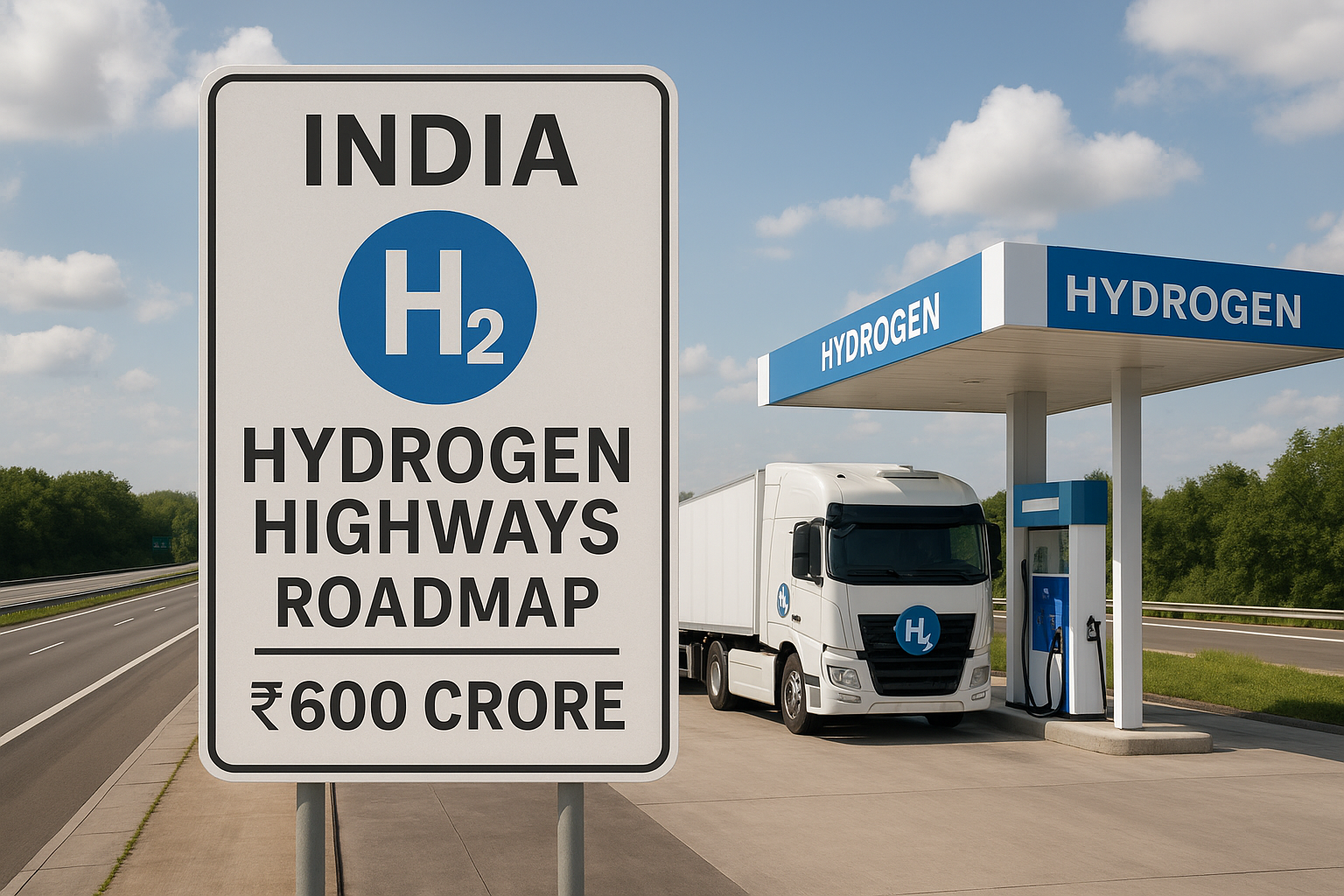
Create an image for this make it look realistic & natural and size dimensions should be 1200 or above
India has launched a ₹600 crore pilot project to develop hydrogen highways across ten national corridors, aiming to power heavy-duty freight and public transport with zero-emission fuel. The initiative, part of the National Green Hydrogen Mission, seeks to overcome electric vehicle range limitations, test hydrogen refuelling infrastructure, and pave the way for a nationwide clean transport network supporting long-haul, high-mileage operations.
According to senior officials, the pilot will serve as a testing ground for both technology and infrastructure viability before scaling the network nationwide. The move dovetails with the government’s National Green Hydrogen Mission, which targets producing five million metric tonnes of green hydrogen annually by 2030, as part of the broader Vision 2047 sustainability roadmap. Energy sector leaders from Indian Oil Corporation, Bharat Petroleum, and Hindustan Petroleum are in advanced discussions to develop and operate the fuelling and storage network. This collaboration seeks to integrate hydrogen supply chains with existing fuel infrastructure, reducing both cost and deployment time. Officials have confirmed that hydrogen fuel stations will be strategically placed to serve high-density freight routes, allowing uninterrupted intercity operations.
Vehicle manufacturers are equally engaged in shaping the project’s success. Original Equipment Manufacturers, including leading commercial vehicle producers, are expected to supply prototype hydrogen-powered trucks and buses for rigorous field trials. These trials will not only validate the technical feasibility of hydrogen in India’s climatic and geographic conditions but also measure operational costs, refuelling efficiency, and environmental impact. Industry experts believe the pilot is a significant step towards decarbonising India’s logistics sector, which accounts for a substantial share of the country’s greenhouse gas emissions. Unlike conventional fuels, green hydrogen produced from renewable energy emits only water vapour when used in fuel-cell vehicles, offering a scalable path to climate-neutral transport.
While electric mobility continues to expand in passenger segments, hydrogen is increasingly being recognised as the more practical choice for high-mileage, heavy-duty applications where battery weight, charging times, and limited range remain barriers. The hydrogen highways could also open the door for innovation in regional bus services, intercity freight, and even industrial supply chains. Officials stress that the pilot will provide critical data for shaping future policy, from incentives for hydrogen adoption to establishing safety and operational protocols. If successful, the corridors could become a blueprint for pan-India deployment, accelerating the shift to clean-energy mobility and aligning with India’s net-zero commitments. As the first refuelling stations take shape, India’s transport sector stands on the cusp of a green transition one that may redefine not only how goods and passengers move, but also the nation’s standing in the global clean energy race.