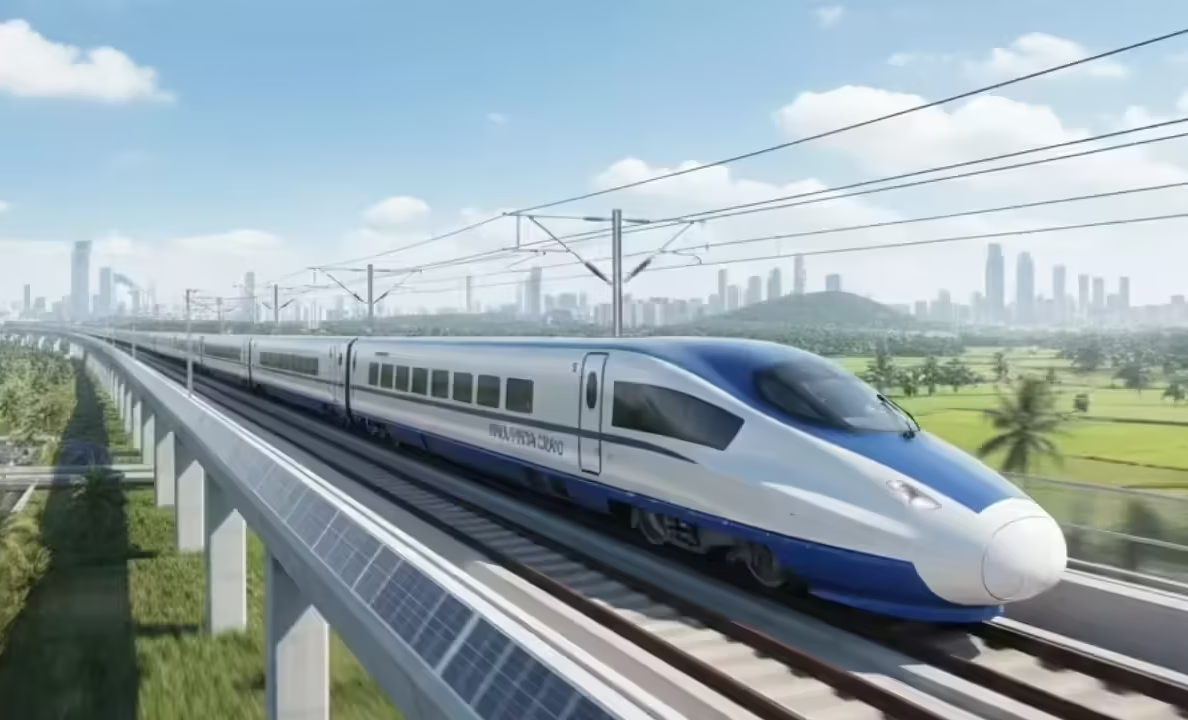
India’s intercity travel landscape is set for a structural shift after the Union government outlined plans for a new network of high speed rail corridors linking some of the country’s largest economic and population centres. Announced as part of the Union Budget 2026–27, the proposal signals a renewed push to compress travel times, improve regional productivity, and reduce the environmental cost of long-distance mobility.
The planned corridors will connect Mumbai–Pune, Pune–Hyderabad, Hyderabad–Bengaluru, Hyderabad–Chennai, Chennai–Bengaluru, Delhi–Varanasi and Varanasi–Siliguri. Together, they form a multi-regional grid designed to serve the western, southern, and northern growth belts, where congestion on roads and conventional rail has become a constraint on economic efficiency. According to officials familiar with the proposal, the high speed rail corridors are expected to cut current travel times by more than half on several routes. Journeys that currently take an entire working day could be reduced to a few hours, fundamentally changing how businesses plan operations and how workers access opportunities across city regions. Urban economists note that such time compression often leads to the emergence of larger labour markets and stronger intercity business ecosystems.
A key feature of the plan is the southern high speed triangle linking Bengaluru, Chennai, and Hyderabad. Urban planners see this as particularly significant, as it connects technology hubs, manufacturing clusters, ports, and research centres across multiple states. Improved rail connectivity between these cities is expected to reduce dependence on short-haul flights and private vehicles, offering a lower-emission alternative for frequent intercity travel. The corridors are being backed by a substantial increase in railway capital expenditure in the current budget cycle. A large share of the allocation is earmarked for passenger safety, signalling upgrades, and modern rolling stock. Transport analysts argue that this focus will be critical for public confidence, especially as higher operating speeds demand stronger safety systems and maintenance regimes.
Beyond passenger movement, the high speed rail announcement sits alongside plans for an additional dedicated freight corridor in eastern and western India. Together, these investments point to a broader strategy of separating passenger and freight traffic, improving reliability across the rail network, and easing pressure on highways that currently handle a large share of logistics movement.
From a sustainability perspective, high speed rail is increasingly viewed as a climate-resilient transport solution for a rapidly urbanising country. If integrated with metro networks, bus systems, and transit-oriented development around stations, the corridors could encourage denser, more walkable urban growth while limiting sprawl along highways.
However, experts caution that execution will be decisive. Land acquisition, financing models, and coordination with state governments will determine how quickly the corridors move from announcement to construction. There are also calls for transparent assessment of regional impacts to ensure smaller cities and peri-urban areas benefit alongside major metros. As detailed project reports and timelines emerge, the focus will shift to how these high speed rail corridors reshape India’s economic geography shortening distances not just on the map, but in everyday life for millions of travellers.
India High Speed Rail Corridors Reshape Intercity Travel