


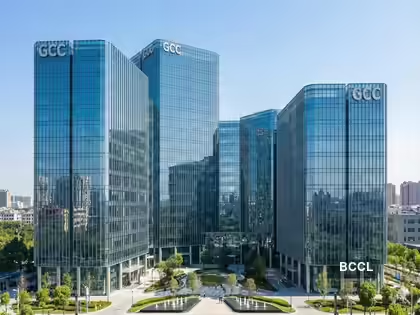
India’s commercial real estate market is undergoing a structural reset, with Global Capability Centres (GCCs) emerging as the primary engine of office demand and urban economic growth. Even as global corporations remain cautious amid geopolitical and macroeconomic uncertainty, India’s office sector has continued to post record leasing volumes, signalling a decoupling from broader global slowdowns.
Industry estimates suggest GCCs now account for over two-fifths of office absorption across the country’s largest cities, underscoring their central role in shaping workplace strategies and real estate investment decisions. What began as a cost-arbitrage model has evolved into a network of strategic hubs supporting core business functions, advanced analytics, product engineering, healthcare research and financial services operations. Urban economists tracking the sector estimate that India’s GCC ecosystem is on track to cross the USD 100 billion threshold by the end of the decade, nearly doubling its economic footprint from the late 2010s. This expansion is being driven by the depth of India’s skilled workforce, improving digital infrastructure and a maturing office market capable of delivering large-scale, high-quality Grade A developments. Office leasing data from 2025 highlights the scale of this transformation. Total absorption across major cities crossed 80 million square feet, with GCC-led occupiers accounting for a disproportionately large share of take-up. Bengaluru continues to dominate this landscape, supported by its concentration of technology talent, established innovation clusters and a deep pipeline of institutional-grade office assets. Analysts note that the city’s GCC density has reinforced its position as the country’s most resilient office market, even during periods of global volatility.
However, the growth story is no longer limited to traditional metro centres. Secondary cities are increasingly attracting multinational occupiers seeking cost efficiencies, workforce diversification and business continuity. Urban planners point out that this decentralisation is reshaping regional development patterns, spreading office demand beyond a handful of saturated corridors and easing pressure on core metropolitan infrastructure. From a supply perspective, developers have responded by accelerating the delivery of Grade A office stock, particularly in southern and western markets. New completions have remained aligned with demand, helping maintain stable vacancy levels and supporting rental growth without triggering speculative oversupply. This balance has strengthened investor confidence, especially among long-term institutional capital. The rise of Real Estate Investment Trusts has further reinforced market maturity. Although listed office assets still represent a relatively small share of total stock, analysts see significant headroom for expansion as portfolios diversify into technology-enabled workplaces, data centres and mixed-use business districts. Urban sustainability experts caution that the next phase of GCC-driven growth will test cities’ ability to deliver climate-resilient infrastructure, public transport connectivity and inclusive housing near employment hubs.
If managed well, the GCC expansion could support more compact, transit-oriented urban forms rather than unchecked sprawl. As India positions itself deeper within global enterprise value chains, GCCs are no longer just tenants of office buildings. They are quietly redefining how cities plan, how talent clusters evolve, and how commercial real estate aligns with long-term economic resilience.
Also Read: Bengaluru townships reshape housing demand in 2026
