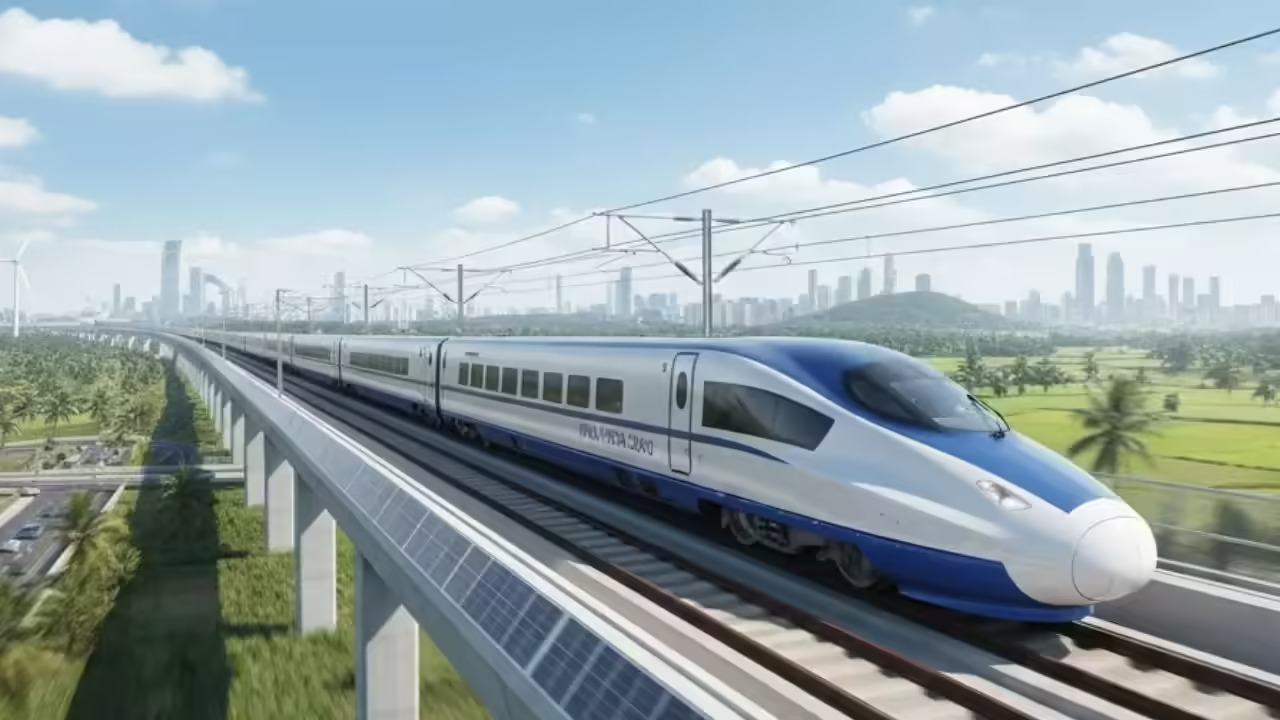
Construction activity is accelerating on the Mumbai Ahmedabad bullet train corridor, India’s first high-speed rail project, as railway authorities push forward with civil works, track systems and station development along the western economic corridor. Once operational, the line is expected to significantly reduce travel time between two of the country’s largest commercial centres while introducing high-speed rail technology to India’s transport network.
The 508-kilometre corridor will connect Mumbai and Ahmedabad through a dedicated high-speed rail alignment spanning Maharashtra, Gujarat and a small stretch of Dadra and Nagar Haveli. Designed for speeds of up to 320 kilometres per hour, the Mumbai Ahmedabad bullet train service is expected to cut the journey between the two cities to just over two hours, dramatically reshaping intercity mobility in western India. The project is being implemented by the national high-speed rail corporation with technical and financial collaboration from Japan. Railway officials indicate that construction has gained momentum after early delays, with major progress reported on viaducts, bridges and elevated sections that will carry the high-speed tracks.
Engineering works are particularly advanced in Gujarat, where long stretches of the elevated guideway structure are nearing completion. Across the corridor, hundreds of kilometres of pier foundations and viaduct segments have already been erected, alongside multiple river bridges and specialised track beds designed for high-speed train operations. These concrete track structures form the foundation for precision rail alignment required for bullet train services. One of the project’s most technically challenging components lies in Maharashtra, where engineers are building a long underground section linking the Bandra Kurla Complex business district with the Shilphata area. The tunnel includes India’s first undersea rail passage beneath Thane Creek, designed to allow the high-speed alignment to pass beneath environmentally sensitive coastal areas.
The corridor will include 12 stations located across major urban centres along the route, including four in Maharashtra and eight in Gujarat. Railway planners say the station network is intended to support regional connectivity, linking industrial clusters, ports and emerging economic zones along the western corridor. Alongside civil construction, work has begun on traction infrastructure and operational systems. Thousands of electrification masts have already been installed to support a high-capacity overhead power supply that will enable trains to operate at sustained high speeds. Noise barriers are also being deployed along large sections of the alignment to reduce acoustic impact in surrounding communities.
The Mumbai Ahmedabad bullet train project is expected to be introduced in phases, with the first operational segment likely to open in Gujarat before the full corridor becomes functional later in the decade. Transport analysts note that phased commissioning could allow operational systems and passenger demand to stabilise before the entire network becomes active. Beyond the western corridor, the national rail system is also evaluating several additional high-speed rail routes linking major metropolitan regions across the country. Proposed corridors connecting cities such as Mumbai, Pune, Hyderabad, Bengaluru and Delhi are currently under various stages of survey and planning.
Urban mobility experts say the long-term success of high-speed rail in India will depend on financial sustainability, ridership demand and integration with existing rail and metro systems. If implemented carefully, high-speed rail corridors could reshape regional travel patterns while offering a lower-carbon alternative to short-haul aviation across densely populated economic regions.
India Bullet Train Corridor Reshapes Western Mobility