


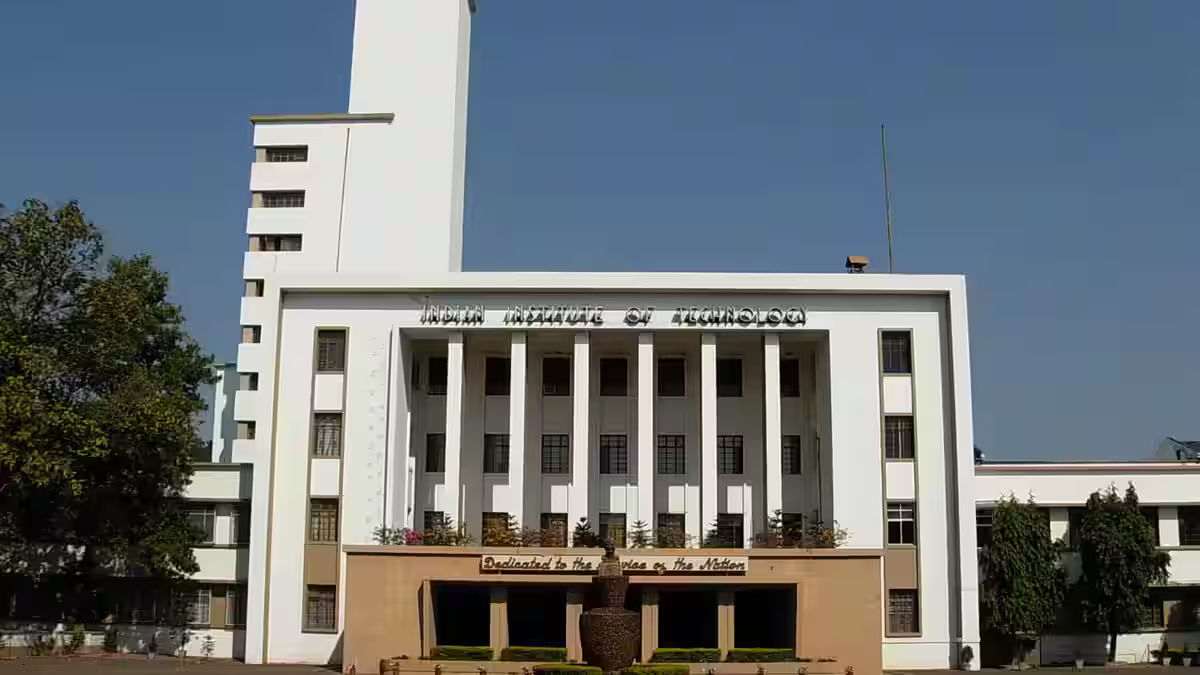
In a strategic step with implications for climate-aligned urban sustainability and circular economy practice, a premier technical institute in eastern India has formalised a partnership with a state-owned energy company to establish a compressed biogas facility on its sprawling campus. The initiative, announced at a major energy conclave, will convert on-site biodegradable waste into renewable fuel and organic fertiliser — a model with potential application in dense urban precincts struggling with waste and emissions.
The planned compressed biogas (CBG) plant marks a significant diversification of the institute’s infrastructure beyond teaching and research, embedding resource recovery systems that echo global shifts towards low-carbon campus operations. Situated on a 2,100-acre site accommodating students, faculty and staff, the facility is designed to process food and other organic waste streams, producing a clean biofuel for energy use and nutrient-rich residues suitable for agricultural application. Urban planners and sustainability experts underscore the relevance of such installations for Indian cities, where burgeoning populations and limited landfilling capacity intensify waste management challenges. The biogas plant targets methane — a potent greenhouse gas emitted by unmanaged organic waste — transforming it into compressed biogas, which can substitute fossil fuels for heat or power. This aligns with national low-emission development strategies and municipal ambitions to decarbonise urban energy mixes. Beyond energy substitution, the initiative dovetails with broader efforts to cultivate circular resource flows. The nutrient-rich digestate generated by the biogas process can enhance soil health, reducing dependence on synthetic fertilisers, whose production is energy-intensive and carbon-emitting. This facet resonates with sustainable land management priorities in peri-urban and rural hinterlands of fast-growing cities.
Officials involved describe the campus facility as a “living laboratory” where engineering research, hands-on experimentation and capacity building converge. Industry experts see this as a critical bridge between academic innovation and scalable infrastructure solutions for climate-stressed cities. By embedding empirical research into everyday operations, the project could yield best practices that support municipal authorities in retrofitting similar plants within residential townships and commercial districts. Economists note that while up-front costs for biogas infrastructure can be notable, the long-term economic case strengthens as cities seek to reduce landfill loads, cut energy expenditures, and generate local employment in green sectors. A senior urban development consultant highlights that such projects can stimulate ancillary markets, including bioenergy servicing, equipment maintenance, and agricultural supply chains.
Critically, the plant also offers educational and skills development opportunities for students and technicians alike. Workforce development is central to equitable growth strategies, enabling communities to participate in and benefit from the transition to sustainable urban systems. Integration of practical training modules into academic curricula could position graduates to lead decarbonisation efforts across sectors. As the project progresses from agreement to implementation, attention will turn to regulatory alignment, community engagement, and performance monitoring. If successful, the campus biogas facility could become a replicable template for knowledge institutions and urban neighbourhoods aiming to close resource loops, reduce emissions and reframe waste as a strategic asset.
Also Read: Mumbai Introduces Stricter Sanitation Rules For Pet Owners From February
IIT Kharagpur Advances Clean Energy Campus Project
