


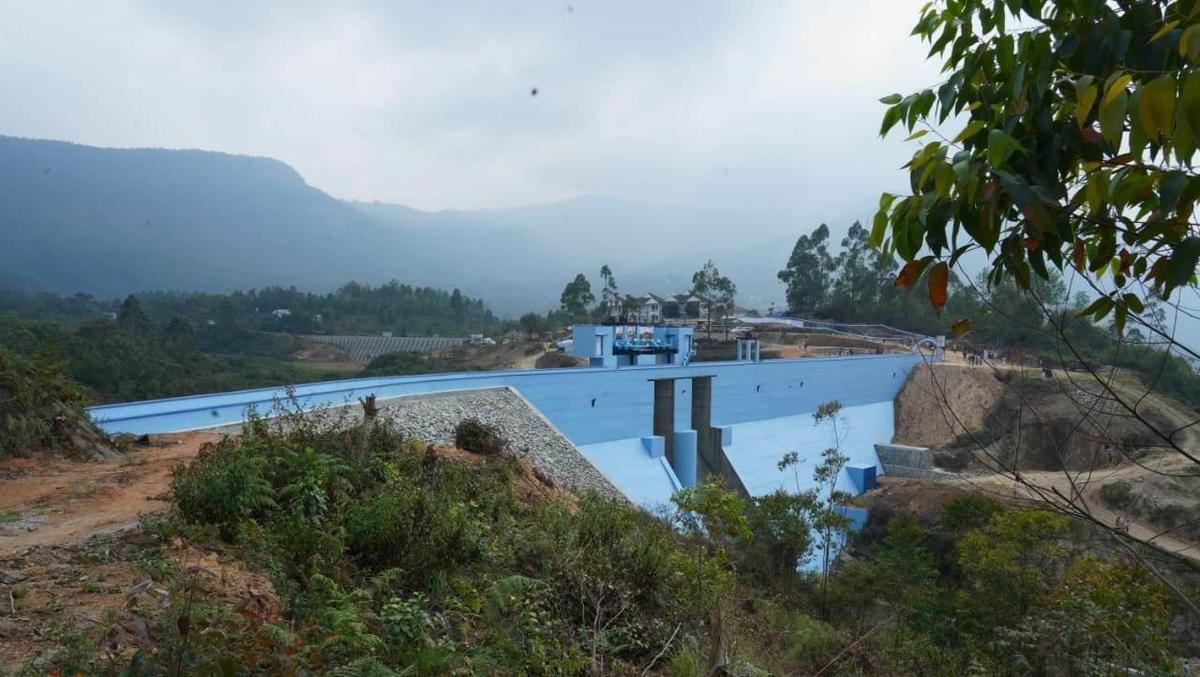
A new irrigation asset aimed at strengthening water security in Kerala’s high ranges has been commissioned in Kanthaloor, Idukki district. The Pattissery Dam, built at a cost of ₹60.34 crore, is expected to enhance drinking water availability and support agriculture in the drought-prone Anchunadu region along the Kerala–Tamil Nadu border.
The project forms part of the broader Chenkalar irrigation initiative and has been developed by the state’s irrigation department to address seasonal water shortages that frequently affect upland farming communities. With a storage capacity of one million cubic metres, the composite structure is designed to stabilise irrigation across approximately 240 hectares in Kanthaloor and neighbouring Keezhanthoor.Officials from the water resources department said the reservoir will play a critical role during peak summer months, when surface flows reduce sharply and groundwater reserves decline. By creating a controlled storage buffer, the dam is expected to reduce dependence on erratic rainfall and improve cropping reliability in a region known for vegetable cultivation and horticulture.
Kanthaloor, situated near the inter-state boundary, has long relied on small streams and seasonal flows for irrigation. Agricultural economists note that the absence of assured water supply has historically limited productivity and crop diversification. The new storage infrastructure could enable farmers to transition toward higher-value crops and multi-season cultivation, strengthening rural incomes.The dam’s commissioning also has implications beyond agriculture. Infrastructure planners suggest that improved water availability may support eco-tourism and agri-tourism initiatives in Anchunadu, an area with historical and landscape significance. Stable reservoirs often become focal points for controlled tourism activity, provided environmental safeguards are maintained.From a climate resilience perspective, decentralised storage projects such as Pattissery are increasingly viewed as adaptive responses to shifting rainfall patterns. Kerala’s high-altitude districts have experienced uneven monsoon distribution in recent years, with intense bursts followed by prolonged dry spells. Small- and medium-scale reservoirs can moderate this variability by capturing surplus runoff during heavy rainfall and redistributing it gradually.
However, hydrologists caution that long-term performance will depend on catchment protection and sediment management. Without upstream soil conservation and periodic desilting, storage efficiency can decline over time. Environmental monitoring will also be essential to ensure that downstream ecological flows are maintained.The state government has indicated that expanding access to clean and reliable water remains a priority in border and hill regions. In this context, the Pattissery Dam represents both an irrigation intervention and a broader investment in rural infrastructure stability.As Kerala recalibrates its water management strategy amid climate pressures, projects in districts like Idukki highlight a shift toward strengthening localised storage systems that support agriculture, livelihoods and regional economic balance.
Idukki Pattissery Dam boosts irrigation capacity
