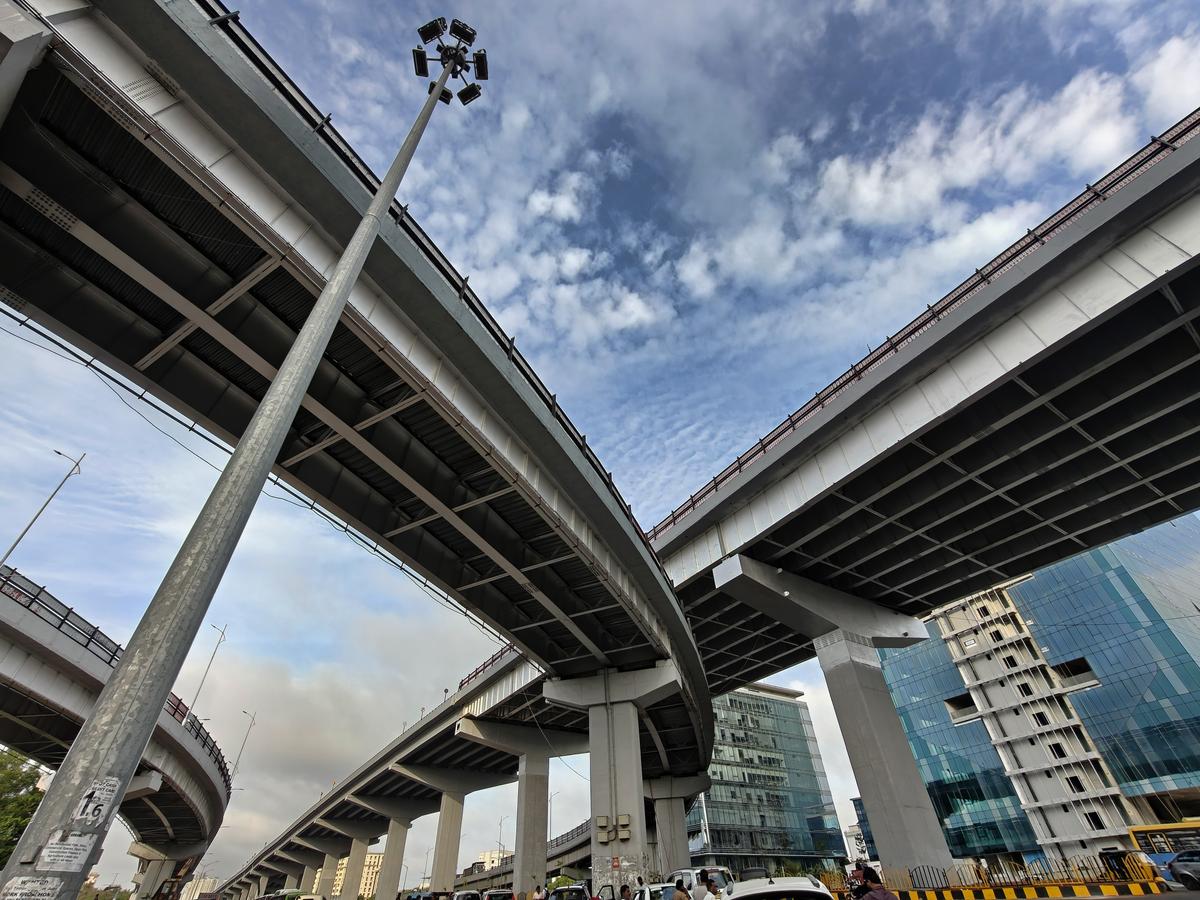
Hyderabad’s Latest Flyover Sparks Traffic Woes Near Gachibowli
Hyderabad’s newly inaugurated PJR flyover, meant to ease congestion between Kondapur and Gachibowli, has instead become a hotspot for peak-hour gridlock. Despite its six-lane structure and connectivity to the Outer Ring Road, poor lane merging near Radisson Hotel and unregulated traffic volumes have left motorists crawling through the corridor. As experts and commuters raise design and planning concerns, questions mount over the city’s flyover-centric development model and its long-term sustainability.
Touted as a vital link to Hyderabad’s IT corridor, the PJR flyover was designed to support high-capacity vehicular flow from Kondapur to Gachibowli. However, with up to 75,000 vehicles daily, the infrastructure is showing early signs of failure. The key pinch point near the Radisson Hotel, where traffic from multiple directions merges onto a narrow corridor, has turned into a bottleneck. Commuters report delays stretching beyond 20 minutes during rush hour, with traffic backups extending well onto the flyover. Temporary fixes, such as redirecting one lane and shifting a U-turn by 150 metres, have reduced waiting times slightly, but congestion persists. Meanwhile, the absence of clear signage and malfunctioning traffic signals further confuse motorists, particularly new users. Authorities are now considering road widening in this stretch, but experts argue that reactive solutions alone won’t solve the problem. The mismatch between flyover capacity and downstream road width remains a core design flaw.
According to urban mobility experts, Hyderabad’s traffic troubles are rooted in a supply-focused planning philosophy that fails to manage demand effectively. Each new flyover, while offering brief relief, ends up transferring congestion downstream, nullifying its intended benefit within months. The PJR flyover’s design, which begins slightly ahead of the older Shilpa flyover, is now favoured by navigation apps. As a result, traffic meant for other routes has rerouted here, aggravating stress on already narrow connecting roads. This shift in vehicular flow—from ORR to city sectors like Kukatpally, Hafeezpet, and Madinaguda—was not anticipated in the original traffic assessment. Experts stress that while short-term measures like lane diversions may offer temporary relief, long-term solutions lie in a redesign of mobility strategy—prioritising multimodal transport, real-time data use, and traffic distribution systems. Without this shift, even new flyovers will continue to create choke points faster than they can solve them.
The traffic snarl at Hyderabad’s PJR flyover is a microcosm of the challenges plaguing urban mobility in growing metros. While infrastructure expansion remains essential, its benefits are quickly erased if downstream networks are not proportionately upgraded. As pressure mounts on narrow roads and outdated junctions, experts call for a paradigm shift from road-widening to better demand management and integrated planning. Until then, commuters navigating Hyderabad’s newest flyover will continue to experience delays, frustration, and diminishing returns from what was supposed to be a time-saving solution.