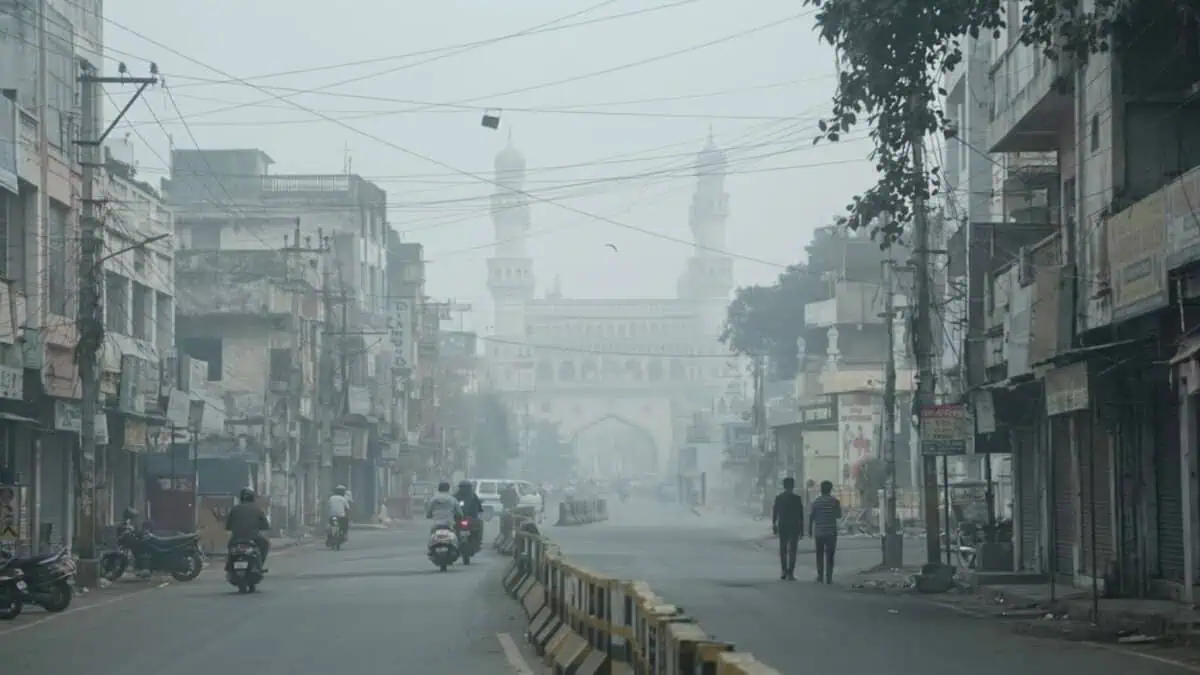
Hyderabad is bracing for a sharper winter chill as dense fog persists across the city and surrounding districts, with meteorological forecasts indicating a further drop in night-time temperatures over the coming days. The weather shift, driven by changing wind patterns across central India, is beginning to affect daily mobility, aviation reliability and road safety in one of India’s fastest-growing metropolitan regions.
Weather officials tracking national systems point to cold northerly and north-westerly airflows entering peninsular India after the movement of a western disturbance across the northern belt. This transition is expected to lower minimum temperatures across parts of Telangana, including the Hyderabad urban region, by one to three degrees Celsius, with deeper dips likely in northern districts bordering central India. For Hyderabad, where winter extremes are typically moderate, the persistence of fog has become the more disruptive factor. Early-morning visibility has dropped sharply on several arterial corridors, including expressways and national highways that support commuter traffic and logistics movement. Urban transport planners note that even brief visibility loss can slow freight movement, increase accident risk and strain emergency response times in a city that relies heavily on road-based mobility.
The aviation sector is also feeling the impact. Fog-related visibility constraints during early hours have previously led to flight delays and diversions, underscoring the sensitivity of airport operations to short-lived but intense weather events. As Hyderabad strengthens its role as a regional business and technology hub, consistent air connectivity is increasingly linked to economic competitiveness and investor confidence. Beyond transport, the colder nights raise concerns for vulnerable populations, particularly informal workers, the elderly and residents of low-income settlements where housing insulation is minimal. Urban development specialists argue that such weather events reveal the intersection between climate variability and housing quality, reinforcing the need for climate-responsive building design even in cities not traditionally associated with harsh winters.
Meteorologists expect districts such as Adilabad, Sangareddy, Medak and neighbouring regions to experience more pronounced temperature drops, with spillover cooling effects extending into the metropolitan area. Fog formation is also likely to persist for several mornings, driven by moisture retention and weak surface winds. From a planning perspective, Hyderabad’s experience highlights the growing need for climate-resilient urban systems. As weather patterns become less predictable, cities must adapt through better forecasting integration, responsive traffic management and public communication systems that help residents adjust daily routines with minimal disruption.
Authorities have advised commuters to adopt safer driving practices during fog-prone hours and travellers to verify flight schedules before departure. However, urban policy experts stress that long-term resilience will depend on infrastructure designed for variability rather than historical norms. As winter conditions deepen over the next week, Hyderabad’s challenge will be less about record-breaking cold and more about how effectively the city manages recurring climate stress. The current spell serves as a reminder that even incremental shifts in temperature and visibility can have outsized impacts on large, interconnected urban economies.
Hyderabad Winter Fog Exposes Urban Climate Stress