


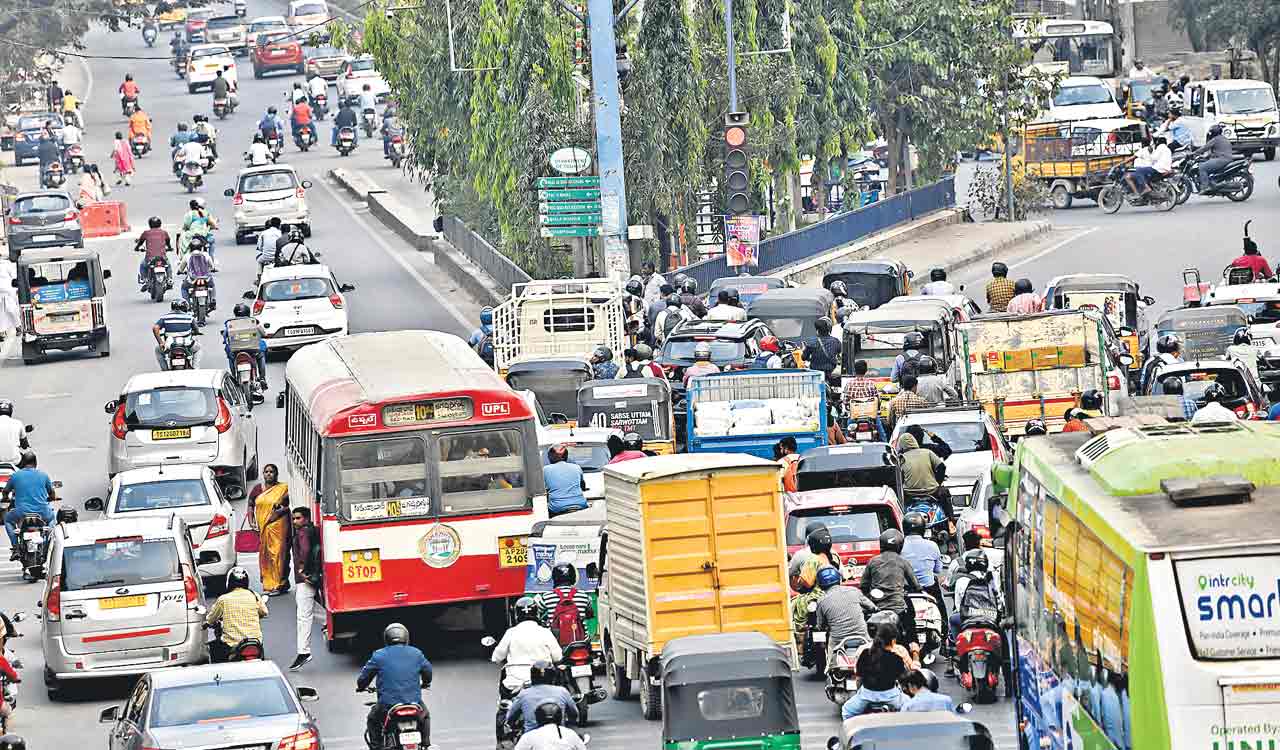
In a sweeping enforcement drive across Hyderabad, traffic authorities have registered over 9,000 cases in just ten days against motorists obstructing designated free-left lanes at major junctions — a move aimed at easing congestion and improving urban road safety in one of India’s fastest-growing metros.
According to senior traffic officials, 9,142 motorists were penalised under provisions of the Motor Vehicles Act for blocking free-left turns, a violation increasingly cited as a contributor to gridlock at signalised intersections. Free-left lanes are designed to allow uninterrupted vehicle movement even during red signals, helping decongest arterial roads and reduce idle time at junctions.Officials say the enforcement drive is not merely about issuing challans but correcting a pattern of road behaviour that disrupts traffic flow. When vehicles queue across free-left lanes, intersections lose their designed efficiency, leading to longer signal cycles, spillback traffic and elevated collision risks. In dense commercial corridors and near mixed-use developments, such obstructions disproportionately affect pedestrians, cyclists and public transport users.
Urban mobility planners note that Hyderabad’s vehicle population has grown sharply over the past decade, intensifying pressure on junction infrastructure. While flyovers and grade separators have been added across growth corridors, intersection management remains critical in built-up areas where road widening is limited. In such contexts, adherence to free-left rules becomes a low-cost yet high-impact traffic management tool.Traffic authorities indicated that special monitoring teams have been deployed at high-volume junctions during peak hours. Surveillance cameras and on-ground personnel are being used to identify repeat offenders. The focus, officials said, is to ensure smoother vehicular movement, lower the probability of crashes and safeguard compliant commuters.
Road safety analysts argue that consistent enforcement can also have environmental implications. Vehicles idling at signals contribute to localised air pollution and fuel wastage. By keeping free-left corridors unobstructed, cities can reduce stop-start traffic patterns that elevate emissions — a small but meaningful step towards cleaner urban mobility.However, experts caution that enforcement alone may not be sufficient. Clear road markings, advance signage and public awareness campaigns are essential to ensure motorists understand the purpose of free-left lanes. In high-footfall areas, better pedestrian channelisation is also necessary to prevent conflict between turning vehicles and walkers.
As Hyderabad expands its commercial districts and transit-oriented developments, efficient junction management will become central to sustaining economic productivity and liveability. Authorities say the current drive will continue, signalling a shift towards stricter compliance as the city attempts to balance rapid motorisation with safer, more resilient transport systems.
Hyderabad traffic police act on free left turn violations
