


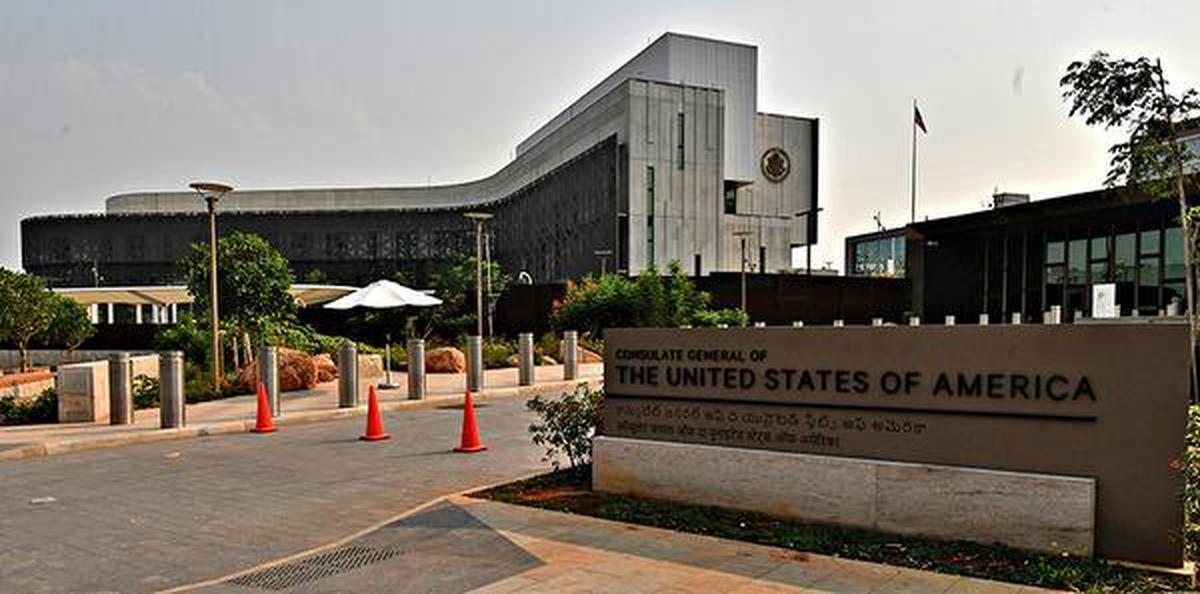
Traffic movement in Hyderabad’s western corridor was rerouted on Monday following a temporary road closure near the United States Consulate in the Financial District. The restriction, enforced on security grounds, prompted Cyberabad traffic authorities to issue a detailed diversion plan affecting key stretches connecting Gachibowli, the IT corridor and adjoining residential zones.
The closure blocks access from both ends of the Consulate approach road, altering commute patterns in one of the city’s busiest commercial precincts. The Financial District and Gachibowli host major technology campuses, corporate offices and high-density residential developments, making even short-term traffic interruptions significant for daily mobility and business operations.Under the revised plan, motorists travelling towards Gachibowli from the ICICI Bank junction are being guided to divert right at the Insurance Regulatory and Development Authority of India junction, proceed via the Telangana State Industrial Infrastructure Corporation junction, and rejoin the main carriageway further ahead. Vehicles approaching from TNGO’s Colony are being redirected through internal connector roads, including Prism Road and adjacent hospitality corridors, to access the Financial District without crossing the restricted zone.
Traffic officials have advised commuters to follow on-ground diversion signage and coordinate with personnel deployed at critical junctions. While the advisory is temporary, it underscores the growing complexity of traffic management in high-security and high-density urban districts.Urban mobility planners note that Hyderabad’s western growth arc has evolved rapidly over the past decade, with commercial real estate expansion often outpacing road network augmentation. As more diplomatic missions, multinational firms and residential towers cluster within the Outer Ring Road belt, the need for resilient traffic planning has become more pressing.
Temporary closures near strategic installations can expose structural bottlenecks, particularly where arterial roads lack parallel alternatives. Experts argue that long-term solutions lie in multimodal integration — expanding metro connectivity, improving last-mile public transport, and creating pedestrian-friendly corridors to reduce private vehicle dependence.From an economic perspective, smooth traffic circulation in the Financial District is critical. The zone contributes significantly to employment generation and service exports. Even short disruptions can affect employee commute times, logistics schedules and client access. Authorities have therefore emphasised proactive communication and route planning to minimise inconvenience.
As Hyderabad continues to position itself as a global business and diplomatic hub, balancing security requirements with urban mobility efficiency will remain an ongoing challenge. The current diversion exercise offers a reminder that infrastructure resilience must extend beyond construction to include dynamic traffic management systems capable of responding to real-time events without paralysing core economic districts.
Also Read:Infrastructure in Rohtak Hospital Unused Amid Funding Gap
Hyderabad Traffic Diversions Near US Consulate
