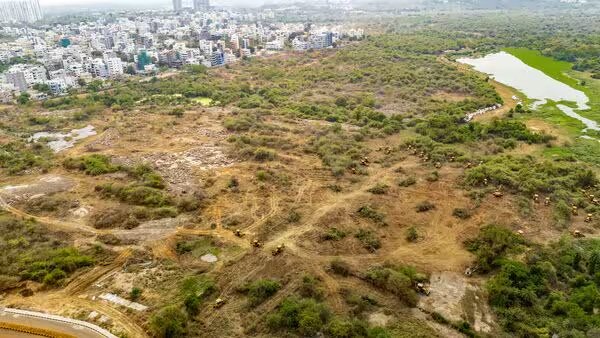
Hyderabad is preparing to scale up its IT infrastructure with plans to establish new technology clusters on government land across key suburban areas. Officials from the state industrial infrastructure authority are evaluating public land in Serilingampally, Gandipet, and Rajendranagar mandals of Ranga Reddy district to attract additional IT companies. The initiative follows recent high-value land auctions near established tech hubs, signalling strong investor confidence in the city’s knowledge economy.
Urban planners and industry experts note that the expansion could further consolidate Hyderabad’s status as a major IT destination in India. “Creating designated clusters on government land provides clarity and reduces transactional risk for companies, which in turn accelerates sustainable urban development,” said a senior urban development official. Strategically, these clusters aim to optimise land use while curbing ad hoc encroachments and informal settlements that often emerge around rapid commercial expansion.
The city’s efforts intersect with complex historical land ownership patterns. A significant proportion of land around Hyderabad was granted as donations during the erstwhile Nizam’s rule. Over time, many of these parcels, particularly those without documented heirs, reverted to government ownership. However, disputes have emerged as some private entities have presented contested documentation, claiming rights through historical donations or general power of attorney agreements. Current litigation affects roughly 380 acres across several villages in Serilingampally and Gandipet mandals, highlighting the need for careful legal and cadastral oversight in urban planning. To mitigate encroachment risks, authorities are deploying digital land survey technologies. These tools provide accurate, real-time mapping of property boundaries and help monitor lakes and other ecologically sensitive areas, aligning with broader goals of climate-resilient urban expansion. Experts emphasise that integrating technology into land management ensures equitable access to urban opportunities while preserving environmental resources in rapidly growing metropolitan zones.
Economically, the initiative could catalyse further IT investment, generate local employment, and stimulate allied sectors such as residential real estate, retail, and transport infrastructure. The planning approach also incorporates considerations for inclusive growth, ensuring that expansion benefits a broad demographic of urban residents rather than concentrating advantages in a few high-value zones. Analysts caution, however, that balancing rapid development with long-term environmental sustainability and legal clarity remains a central challenge for municipal and state authorities. As Hyderabad charts this next phase of IT corridor development, its ability to harmonise economic opportunity, equitable urban planning, and environmental stewardship will shape the city’s trajectory as a global knowledge economy hub.