


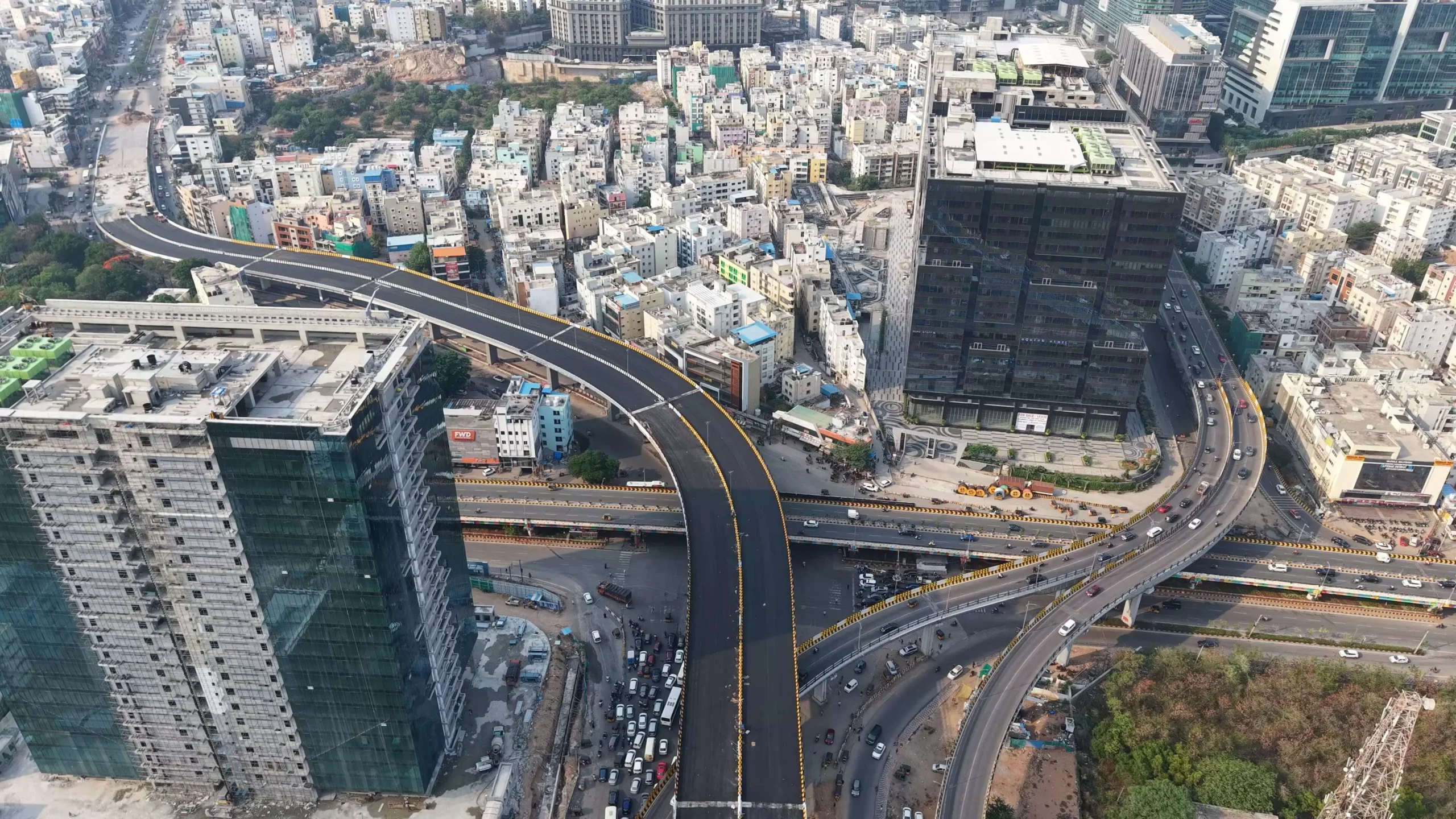
Hyderabad’s transport planning is increasingly leaning on steel bridge technology as the city looks to ease chronic congestion without widening roads or acquiring large land parcels. Over the past decade, a series of elevated steel flyovers across key junctions have emerged as a core component of Hyderabad steel bridges strategy, reflecting a shift towards faster, space-efficient urban infrastructure delivery in a rapidly densifying metropolis.
City transport officials point to steel structures as a pragmatic response to Hyderabad’s constraints. Compared with conventional concrete flyovers, steel bridges can be fabricated off-site, assembled quickly and installed with minimal disruption to traffic and nearby neighbourhoods. This approach has proven particularly useful at high-density intersections where land acquisition is politically sensitive, socially disruptive and financially expensive.One of the earliest large-scale deployments was at a major commercial junction in the central business district, commissioned in the early 2020s. Traffic studies conducted after its opening indicated smoother vehicle dispersal across adjoining corridors and reduced intersection delays during peak hours. Subsequent additions in the same zone strengthened east–west connectivity, cutting travel time for daily commuters moving between residential and employment hubs.
Similar outcomes have been reported along northern and western corridors. A steel flyover connecting institutional and residential areas near a major urban park helped decongest multiple arterial roads feeding into the city centre. Transport planners note that these interventions are less about creating new road capacity and more about removing bottlenecks that slow down existing networks.The impact is also visible in the western growth belt, where a steel bridge linking a dense residential catchment to high-end commercial districts shortened travel distances and improved bus movement. Urban mobility experts argue that such targeted links are critical in cities where mixed land use has intensified and daily commutes increasingly cross short but congested stretches.
Beyond traffic flow, Hyderabad steel bridges carry broader economic and environmental implications. Faster construction reduces project timelines and cost overruns, an important factor for municipal budgets under pressure from expanding service obligations. From a climate perspective, shorter construction periods mean lower emissions from prolonged traffic diversions and construction activity, aligning with the city’s emerging focus on low-disruption infrastructure.However, challenges remain. Some upcoming steel bridge projects have faced delays due to unresolved land ownership issues and utility shifting, highlighting that speed advantages can be undermined by administrative bottlenecks. Industry experts caution that steel flyovers should complement, not replace, investments in public transport, pedestrian safety and last-mile connectivity.
With additional steel bridges planned to create longer signal-free corridors and support metro rail alignments, Hyderabad’s experience is being closely watched by other Indian cities facing similar density pressures. The next phase will test whether these structures can be better integrated with public transport and non-motorised mobility, ensuring that rapid construction translates into inclusive and resilient urban movement rather than car-dependent growth.
Also Read:Kolkata Municipal Climate Training Advances Urban Resilience
Hyderabad Steel Bridges Reshape Urban Traffic Flow
