


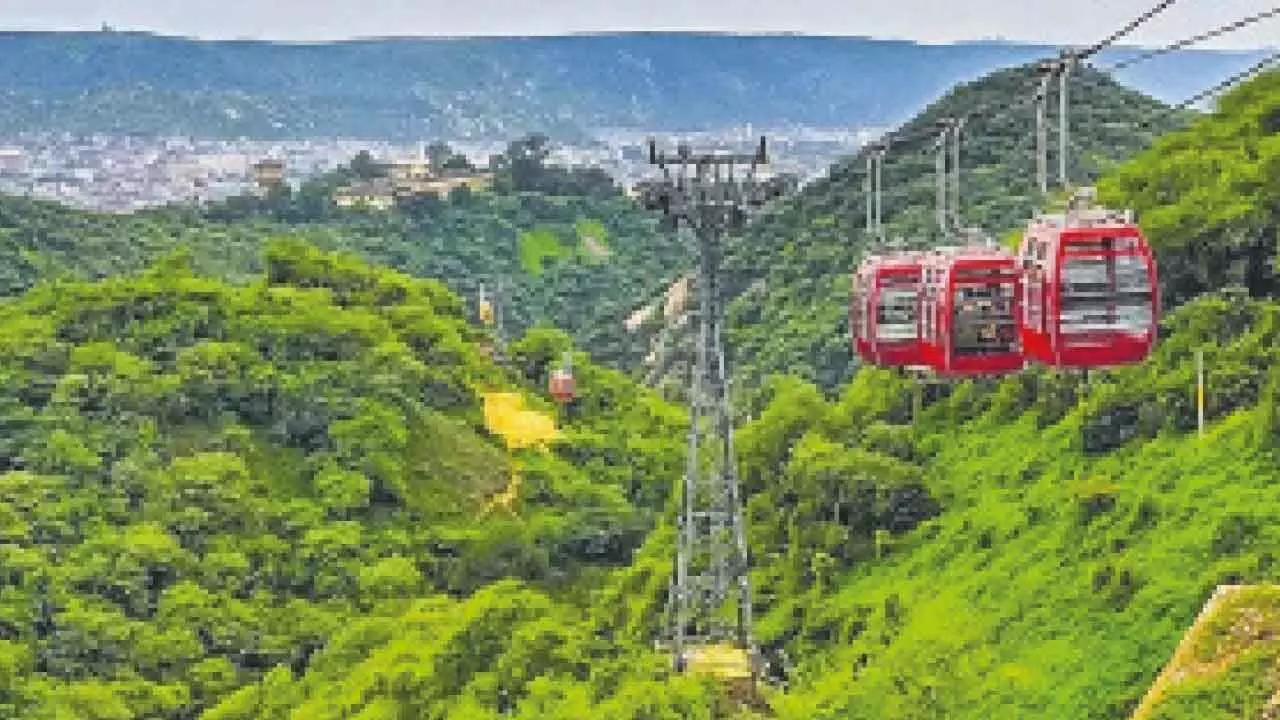
Hyderabad’s proposed ropeway linking Golconda Fort with the Qutb Shahi Tombs has encountered early-stage resistance, raising questions over inter-agency coordination for heritage infrastructure projects in the city. The ₹100 crore initiative, positioned as a tourism mobility upgrade, is facing challenges even before its feasibility report is finalised.
The Hyderabad Metropolitan Development Authority (HMDA) has proposed a 1.5-kilometre aerial ropeway to improve connectivity between two of the city’s most visited heritage sites. The authority has engaged a real estate advisory firm to prepare a Detailed Project Report (DPR), including technical feasibility and land requirements. However, officials indicate that preliminary surveys have slowed due to limited cooperation from key departments whose approvals are essential.One of the principal constraints relates to land along the proposed alignment. Portions of the stretch fall near defence establishments in the Langar Houz area, where training activities are routinely conducted. According to officials familiar with the matter, securing engagement with defence authorities has proven difficult at this stage. Clearances from archaeological and public works departments are also pending, affecting data collection required for the DPR.
The Hyderabad Ropeway Project is being conceptualised as a low-emission mobility solution aimed at reducing vehicular congestion around the fort and tomb complex. Together, the two sites attract roughly 10,000 visitors daily, including a significant number of international tourists. Urban planners argue that better last-mile connectivity could disperse crowding, shorten travel time between monuments and enhance the visitor experience without adding to road traffic.At the same time, heritage experts caution that any elevated transport system must be evaluated carefully for visual and structural impact. Ropeways, while considered environmentally lighter than road widening, require tower installations and terminal structures. Integrating these into protected landscapes demands coordination across planning, archaeology and defence agencies.
The project proposal also includes commercial amenities at terminal points, such as food courts and retail kiosks, intended to generate revenue and support maintenance. Market analysts note that such models are increasingly common in urban tourism corridors, where infrastructure is paired with curated public spaces. However, these additions can complicate land use approvals, particularly in heritage-sensitive zones.The Hyderabad Ropeway Project now hinges on whether agencies can align on security, conservation and urban mobility objectives. Infrastructure specialists say early institutional coordination is often the deciding factor in projects that intersect defence land and protected monuments.
For a city seeking to balance tourism growth with climate-conscious mobility, the outcome of this proposal will set a precedent. If clearances are secured, the ropeway could become a model for sustainable heritage connectivity. If not, it may highlight the structural gaps that slow down urban innovation in complex governance environments.
Also Read:Pune Greenfield Airport To Accelerate Regional Growth
Hyderabad Ropeway Project Hits Defence Roadblock
